China shocked by Israeli defense minister’s ‘no need for additional authorization’ remarks, says killing of Iranian leaders unacceptable
Conflict enters ‘new stage’ with spillovers involving key energy facilities
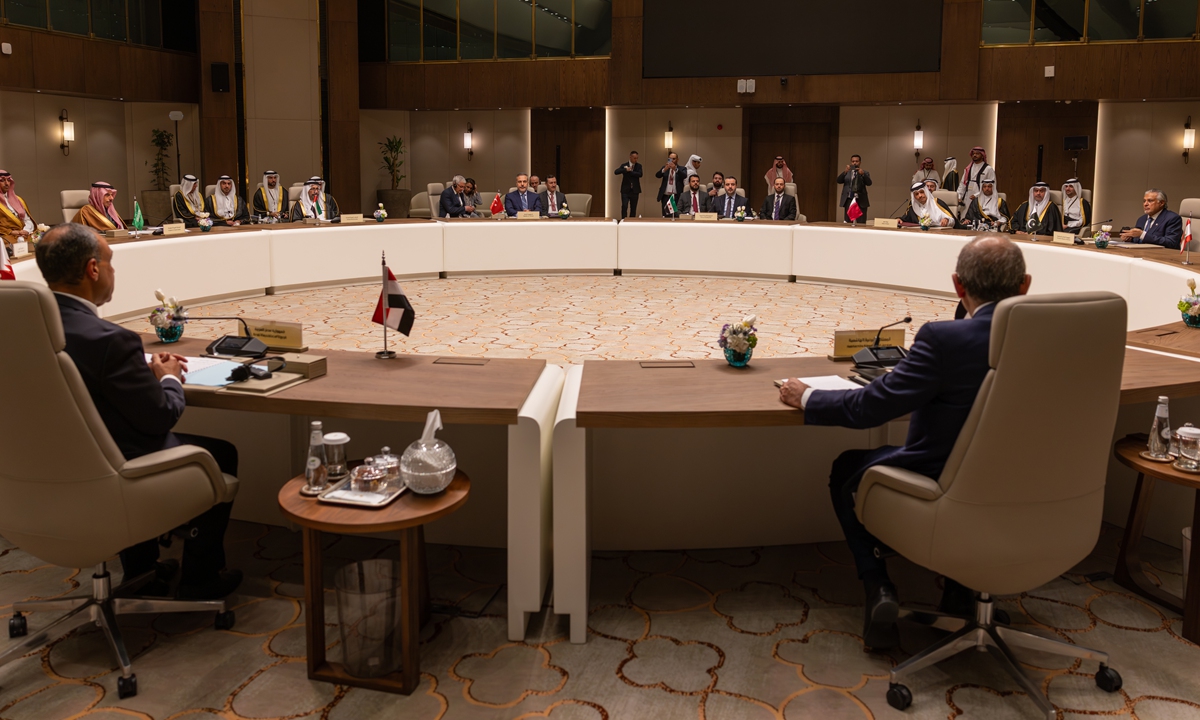
Foreign ministers from Arab and Muslim countries convene for urgent discussions in Riyadh, Saudi Arabia, on March 19, 2026, as conflict in the Middle East spilled over to energy facilities. Photo: VCG
China on Thursday said it is "shocked" by the remarks by Israeli Defense Minister Israel Katz, who said Prime Minister Benjamin Netanyahu and he have authorized the Israel Defense Forces to kill any Iranian official without the need for additional authorization.Katz's remarks came as US-Israel strikes killed three high-ranking Iranian officials in the past three days, including Iranian Secretary of Supreme National Security Council Ali Larijani, commander of the internal Basij militia Gholamreza Soleimani and Iranian intelligence minister Esmaeil Khatib.
"The killing of Iranian leaders and attacks on civilian targets are by no means acceptable," said Chinese Foreign Ministry spokesperson Lin Jian, adding that China is always against the use of force in international relations.
As the war entered its 20th day on Thursday, the conflict has rapidly evolved from strikes on military targets to a full-scale exchange of attacks on energy infrastructure. The conflict has also spilled over to energy facilities in neighboring Saudi Arabia, UAE and Qatar, sending shockwaves through global energy markets.
'New stage'
Escalating attacks on Persian Gulf oil-and-gas infrastructure are sending the US-Israeli war with Iran into a dangerous new phase that threatens to worsen the crisis over global energy supplies, the Wall Street Journal reported.
Israel on Wednesday struck Iran's South Pars gas field, the world's largest and the crown jewel of Iran's energy industry. Hours later, Iran launched missiles against oil and gas facilities across Qatar, Saudi Arabia and the United Arab Emirates, hitting Qatar's Ras Laffan Industrial City and setting off fires there, Al Jazeera reported Thursday.
The South Pars gas field, shared between Iran and Qatar (where the Qatari side is known as North Dome), contains an estimated 1,800 trillion cubic feet of usable gas - enough to supply the entire world's needs for 13 years, according to Reuters.
CNN said Iran's production of gas from South Pars is the biggest source of its domestic energy supply. Iran has previously suffered power shortages because of disruptions to gas supplies, so any impact would affect its ability to produce electricity and heat homes.
After intercepting missiles fired from Iran, the UAE shut down its Habshan gas facility, according to the Arab Weekly. For its part, Saudi Arabia stated that on Wednesday it intercepted and destroyed four ballistic missiles launched toward Riyadh, in addition to foiling an attempted drone attack on a gas facility in its east.
According to Al Jazeera, Saudi Arabia's Foreign Minister Prince Faisal bin Farhan Al Saud warned Iran at a news conference on Thursday that tolerance of its attacks on his country and those of neighboring Gulf states is limited, calling on Tehran to immediately "recalculate" its strategy.
"So when this war eventually ends, in order for there to be any rebuilding of trust, it will take a long time. And I have to tell you, if Iran doesn't stop … Immediately, I think there will be almost nothing that can re-establish that trust," he added.
Prince Faisal's warning followed a meeting of foreign ministers from Arab and Islamic countries in the Saudi capital earlier in the day to discuss the expanding war in the region. In a joint statement issued after the meeting, the ministers condemned what they described as deliberate Iranian attacks using ballistic missiles and drones targeting residential areas and civilian infrastructure, including oil facilities, desalination plants, airports, housing complexes and diplomatic premises, Reuters reported.
Liu Zhongmin, a professor at the Middle East Studies Institute of Shanghai International Studies University, told the Global Times on Thursday that the current conflict has entered a highly dangerous stage and is even undergoing a qualitative shift.
He noted that earlier exchanges of strikes between the US, Israel and Iran were largely aimed at military targets, with only limited spillover damage to civilian facilities and infrastructure. Now, however, the Middle East's economic lifelines are becoming direct targets.
"While concerns previously focused on the security of shipping through the Strait of Hormuz, the situation now threatens not only transportation but also production. Strikes on gas fields and oil production facilities could put both energy production and transportation at risk simultaneously, with potentially immeasurable consequences for the global economy," Liu added.
Notably, regarding Israel's latest strike on the South Pars gas field, Trump wrote on Truth Social that the "US knew nothing about this particular attack," while declaring that Israel would not carry out any further attacks on the "extremely important and valuable" South Pars gas field unless Iran "unwisely decides to attack a very innocent, in this case, Qatar."
However, the Wall Street Journal and Axios reported that Trump knew of Israel's plan to attack the South Pars in advance and supported it.
Liu said the escalation reflects the "overlapping actions of three parties." The US had sought to pressure Iran to reopen the Strait of Hormuz, but Iran instead retaliated, while Israel continued strikes against Iranian leaders, pushing the conflict toward a more dangerous stage and expanding it into the oil and energy sectors.
"Before the death of Ali Larijani, Iran still appeared to leave some room for compromise and had signaled a desire to end the conflict soon. The Trump administration had also indicated willingness to end the war at an appropriate time, suggesting that both the US and Iran do not want the conflict to escalate into a full-scale war," said the expert.
Targeting Iranian leaders may bring limited tactical gains but are unlikely to change the course of the war or achieve strategic goals. Repeated attacks on senior leaders could instead trigger stronger retaliation, while Iran's relatively stable political and security system, with institutionalized succession mechanisms, makes it difficult to weaken its decision-making capacity, Zhu Yongbiao, director of the Center for Afghanistan Studies at Lanzhou University, told the Global Times.
However, with the US military having conducted more than 7,800 strikes and suffering 13 deaths and approximately 200 injuries so far, the US administration is internally discussing plans to deploy additional troops - a move that contradicts Trump's campaign promise to avoid dragging the US into new Middle East wars, Reuters reported Thursday.
According to The Washington Post, citing a senior administration official, the Pentagon "has asked the White House to approve a more than $200 billion request to Congress to fund the war in Iran."
Close communication with China
Chinese Foreign Minister Wang Yi on Thursday held a phone conversation with British Foreign Secretary Yvette Cooper upon the latter's request, exchanging views on the Middle East situation, Xinhua News Agency reported.
Cooper outlined the UK's views on the current situation in the Middle East, stating that in an increasingly turbulent world, the UK hopes to maintain close communication with China, work to bring the fighting to an early end, resume diplomatic negotiations, and seek a long-term solution.
Wang Yi said that there are no winners in the prolonged wars, and a ceasefire and end to hostilities are the will of the people. China urges all parties to immediately cease military actions and resolve differences through equal dialogues. Adding that as permanent members of the UN Security Council, China and the UK bear the responsibility of maintaining international peace and security, according to Xinhua.
Meanwhile, the ongoing conflict has heightened nuclear safety concerns, with WHO Eastern Mediterranean Regional Director Hanan Balkhy stating that UN staff are closely monitoring the fallout from US-Israeli strikes on Iran's nuclear facilities and maintaining high vigilance for any nuclear threat. She warned that the worst-case scenario - a nuclear incident - would cause lasting harm to the region and potentially the world, with consequences persisting for decades, Politico.eu reported.
Chinese experts noted that the overlap of risks related to energy, economic security and nuclear safety highlights how the conflict has moved beyond its initial so-called "punitive" objectives and entered a stage marked by unpredictable attrition and escalating spillover risks.
"We do not believe in a ceasefire. We believe in the end of the war; the end of the war means precisely the end of the war on all fronts … to witness peace throughout the region in Lebanon, Yemen, Iraq, Iran and other countries in the region," the Iranian Foreign Minister Abbas Araghchi said on Wednesday local time during an interview with Al Jazeera, he also noted countries including China could mediate, saying Beijing had previously played a "positive" role in brokering agreements between Iran and Saudi Arabia, Azer News reported.
Regarding the middle east situation, Chinese Foreign Ministry spokesperson Lin Jian also responded on Thursday that to help calm the situation and bring about peace, Special Envoy of the Chinese Government on the Middle East Issue Zhai Jun has visited several countries in the region over the past few days. He met with the foreign ministers of Saudi Arabia, the United Arab Emirates, Bahrain, Kuwait and Egypt, as well as the Secretaries General of the Gulf Cooperation Council (GCC) and the League of Arab States, and had a phone conversation with Minister of State at the Ministry of Foreign Affairs of Qatar for in-depth exchanges of views on the regional situation.
Lin noted that all parties have commended China's just position and efforts in promoting peace, and looked to China to play a bigger role. Special Envoy Zhai Jun's visit to the Middle East is part of China's intensive diplomatic mediation effort. China is a responsible major country and a sincere friend of countries in the region. To work for reconciliation and peace in the region is a cornerstone of China's Middle East policy.
RELATED ARTICLES