IN-DEPTH / IN-DEPTH
Chinese seafarer builds 'letters home radio station' near Hormuz, creating a vital link for sailors stranded by conflict
Waves of Hope
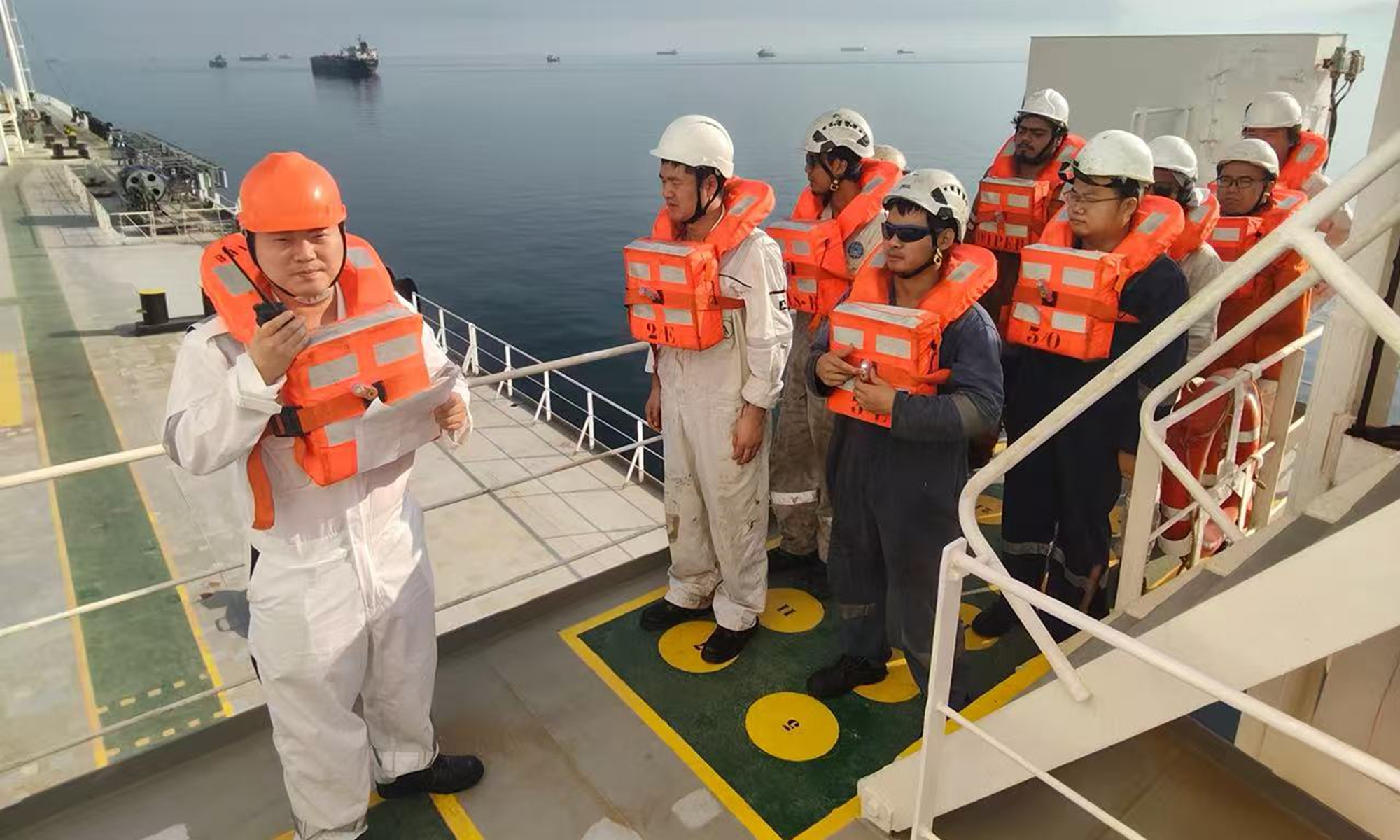
Liu Yiwen (left) and his crewmates conduct a drill in the waters near the Strait of Hormuz on March 15, 2026. Photo: Courtesy of Liu Yiwen
Editor's Note:
Recent tensions in the Strait of Hormuz and waters nearby are disrupting global trade and energy flows, threatening regional and global peace and stability. On March 16, Chinese Foreign Ministry spokesperson Lin Jian stated that China once again calls on parties to immediately stop military operations, avoid further escalation of the tense situation and prevent regional turmoil from further impacting the global economy.
The safety of Chinese seafarers in the area is of deep concern to their families back home. This special feature focuses on the Chinese crew members near the Strait of Hormuz. It tells the story of ordinary seafarer Liu Yiwen, who set up a makeshift "letters home" radio to relay messages of safety for fellow sailors cut off from communication. Their solidarity in extraordinary circumstances reveals the genuine bonds among Chinese abroad and offers a glimpse into the real lives of mariners on distant seas and the families who wait for them.
Across the ocean, a simple safety message and a genuine offer of help have become the warmest support in these overseas waters where communications are disrupted. These small acts of kindness let stranded countrymen feel the strength of having a solid backing, and truly reflect how Chinese people look out for one another abroad.
This was Li Bo's (pseudonym) second voyage sailing overseas. Due to the Middle East conflict, his ship was stuck near the Strait of Hormuz.
For several days, he had lost contact with his family. Li was worried, but his family back home was even more anxious.
Then, one day, his wife received a call from Hormuz. On the other end of the line came the message that Li Bo was safe.
That call wasn't made by Li himself. The man who helped relay the message of safety was Liu Yiwen.
A young Chinese seafarer, Liu has been sailing for eight years. He knows the Strait of Hormuz well, having sailed through this vital waterway linking the Persian Gulf and the Gulf of Oman many times before.

A satellite imagery of the Strait of Hormuz Photo: VCG
This time, war broke out just as his ship docked at the Port of Khor Fakkan in the UAE as usual, going through customs clearance and resupplying in preparation for crossing the Strait of Hormuz to load cargo in the Persian Gulf.
Staying put meant a delayed homecoming for Liu.
But compared to other ships farther offshore, they were fortunate. Liu's vessel was anchored close enough to shore for his phone to have internet access, and it was even connected to a China's telecommunications operator.
Many ships farther out, however, had temporarily lost connectivity due to signal jamming or interference from the conflict. Many could only learn about the situation on surrounding vessels via VHF radio, the maritime "public walkie-talkie."
Channel 16 had a relatively good signal.
"Does your ship have internet? What's the situation over there? We're too far out, we've had no signal for days, and we're really worried because we can't contact our families." Once, while monitoring Channel 16, Liu chanced upon such a message.
Liu then made direct contact. He later learned that the sailor on the other end couldn't reach home and was deeply concerned.
The anxious voice over the radio made Liu think of his own worried family. "My family kept sending me messages on WeChat," Liu recalled. "Then I thought, their families must be just as worried. I said my ship still had internet, and I could add his wife on WeChat to send word home that he was safe."
Soon, Liu added the sailor's family member on WeChat. After sending a few text messages, he held his phone's speaker close to the ship's radio microphone. The "message of safety" traveled from the anxious sailor, across the ocean, to his home.
From then on, while monitoring Channel 16, Liu would often pick up the microphone and ask, "Are there any Chinese ships nearby without an internet signal? I can help you contact your family back home."
Just like that, a temporary "home letters radio station" was set up over the Strait of Hormuz. With Liu's help, several seafarers were able to contact their families one after another, their messages of safety traveling thousands of miles from the Hormuz back to China.
These days, "thank you" has been the most common phrase the seafarers and their families say to Liu. And his usual reply is always the same: "It's nothing. We're all out here making a living, and I'm just glad I can help."
For those living far from home in a foreign land, the yearning for family and the wish to return are the most profound emotions. For their loved ones back in China, the greatest hope is simply that their family members come home safe and sound.
Sometimes, a home letter is a lengthy missive, filled with affection for family. Other times, it can be just a short sentence, or even a few words, carrying the weight of concern across the seas.
This makeshift radio station may not be needed for much longer, but the comfort it has brought to so many people will stay with them forever.
Thousands of years ago, the Tang Dynasty (618-907) poet Cen Shen wrote in "On Meeting a Messenger Going to Capital": Meeting you on horseback, with what brush can I write? I can but ask you to tell my kin I'm all right."
If we adapt these lines for today, they would read: "Separated by sea and land, with no signal. I can but ask you to tell my kin I'm all right."
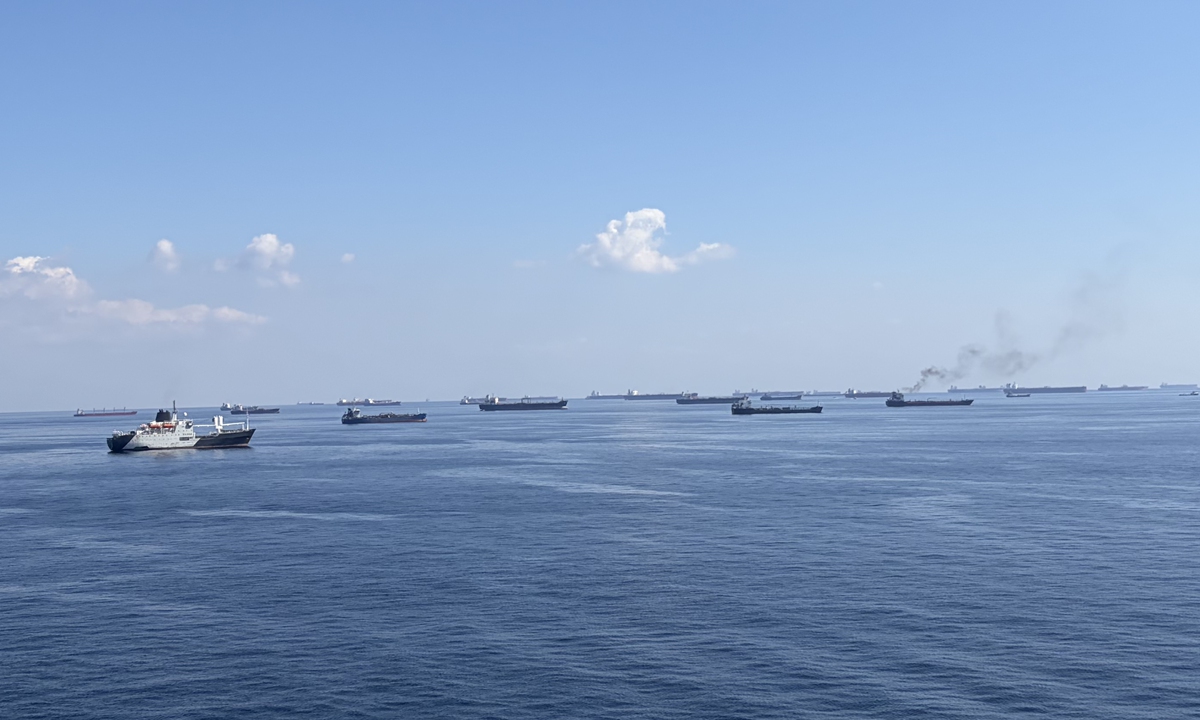
A view of the waters off the Strait of Hormuz, taken on February 27, 2026. Photo: Courtesy of Liu Yiwen
'Is he really okay?'
Liu Yiwen (Liu): "Is Wang Peng (pseudonym) your husband?"
Wang Peng's wife: "Yes. Is there a problem?"
Liu: "Have you lost contact?"
Wang Peng's wife: "Why is his phone turned off? Is he safe?"
Liu: Signals are blocked because of the war. He is safe, no need to worry. I am on a nearby ship. He called me on a high frequency channel and asked me to tell you that he is safe."
Wang Peng's wife: "That's good. These days I haven't been able to contact him. I have been very worried."
Liu: "At present, there is nothing to worry about. It's just that on his ship the network may not be good, messages cannot be sent out. I am relatively close to the shore, so I still have a signal here and can help you make contact. No need to worry, we are all here, there are many ships around. Also, as he has lost contact with you, there may be some other people adding you or your family on WeChat. If they ask you to transfer money, you must refuse - they are definitely scammers. People from his company may also contact you, but they definitely will not ask you for money."
Wang Peng's wife: "Is he really okay?"
Liu: "Yes, he is fine. I can call him and you should be able to hear him."
Wang Peng: "Dear, it's okay. Now here the network is cut off. We are anchored here, after one month there will be a signal again." (Liu speaking to Wang Peng. Wang Peng's wife: "I heard it, thank you" via VHF radio.)
Liu: "It's okay, it's okay. Working outside is not easy. If we can help each other, then we help each other. When family cannot get in touch, they must be very anxious, I can really understand that. But no need to worry, it is still safe here."
Wang Peng's wife: "That's a relief. Thank you very much."
Liu: "You can send me a voice message, your husband can hear it."
Wang Peng's wife: "Peng, if you can come back, come back as soon as possible. The whole family is waiting for you and is quite anxious."
'This call has finally let me really know he's safe'
Liu Yiwen: Is your family member named Hu Qiang (pseudonym)? He's a sailor, and his internet is blocked. His vessel is currently drifting in international waters outside the Persian Gulf. I'm on a ship nearby. I'm relatively close to shore, so I have a signal. He asked me to let you know he's safe and sound, and the ship is secure for now, so no need to worry. They'll probably change location in a few days and might get a signal then, so he can contact you directly. I tried calling you earlier, but for some reason, the call wouldn't go through. But really, don't worry. Everything is fine!
Hu Qiang's wife: How is he doing now? I'm so worried. Tell him to contact me the moment he gets a signal. Just knowing he's okay would put our minds at ease.
Liu: He's really fine. He's probably quite far from me, so the radio signal is unstable. You can add me on WeChat, and I'll try my best to get you two connected.
(After Liu and Hu Qiang's wife connected on WeChat, they used a combination of VHF radio and WeChat voice call to facilitate a conversation between Hu Qiang and his wife.)
Hu Qiang's wife: Thank you. This call has finally let me really know he's safe, and we can rest easier now. I hope he can come home soon. The whole family is very worried. Please tell him he must call me as soon as he has internet. We're all so anxious.
Liu: Okay, no need to worry. Everything is safe for now. The conflict will probably be over soon. I'll let you know if I hear any news.
'That's good, everything will definitely go smoothly'
Liu Yiwen: "This is Liu. I contacted you on March 5, do you still remember? I called you that day because your husband had no signal and couldn't contact you, I helped you and your husband Wang He (pseudonym) speak to each other."
Wang He's wife: "Yes, I am Wang He's wife. Thank you very much. That day I was really very anxious."
Liu: "Can you contact him directly now? I don't know which ship your husband is on, so I cannot track him."
Wang He's wife: "Now we have contacted them. The ship is preparing to return to China. Thank you very much, I was so worried. After I found out he is okay, I felt so relieved."
Liu: "That's good, everything will definitely go smoothly."
'Not as scary as what is said on the internet'
Liu Yiwen: "Hello, this is Liu. A few days ago I called you and helped you contact your husband Li Bo. Can you contact him directly now?"
Li Bo's wife: "Yesterday we contacted him, today there is no signal again. We are always worried about him."
Liu: "They should be going back soon, right?"
Li Bo's wife: "Originally it was planned for next month, it may be delayed."
Liu: "No need to worry. Now here is still safe. The situation is not as scary as what is said on the internet. If you cannot reach him again, I will try to call him again."
Li Bo's wife: "Okay, thank you, Liu. I hope you can all come back safely soon."
'Thank you, warm-hearted person'
Liu Yiwen: "Hello, this is Liu. On March 6 we talked on the phone. Have you contacted your husband Li Hang (pseudonym) now?"
Li Hang's wife: "Thank you for your trouble. Because of your help, now we have contacted him. He received shore signal, it was really not easy, thank you."
Liu: "Maybe his ship is too far from mine. I couldn't even contact him on a high frequency channel. Are they still here?"
Li Hang's wife: "He is still there. I don't know when he will come back. The signal there is not stable. The day before yesterday we contacted him, now we are waiting for his reply."
Liu: "That's good. If you cannot contact him, let me know, I will also try to call him. Now, this area is still very safe, so there is no need to worry. I will let you know, if there is any news."
Li Hang's wife: "That's great, thank you, warm-hearted person."
(Li Hang's wife told reporters that this is his second long-distance voyage. The whole family is waiting for him to return in April, and many things are arranged after April. She said she hopes he can come back safely as soon as possible. Regarding seafaring work, the family will still continue to support him.)
RELATED ARTICLES