Global risk-off sentiment weighs on equities, precious metals
Volatility reflects Middle East uncertainty, inflation risks and weaker rate-cut outlook: expert
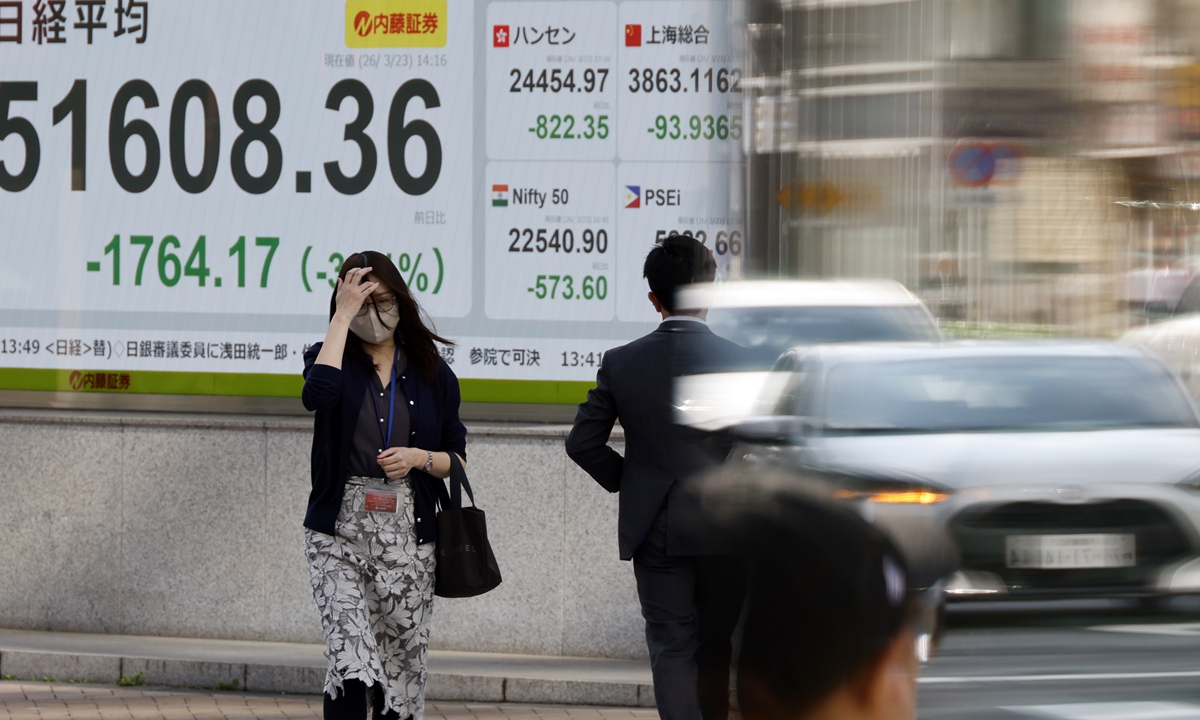
Passersby walk before a stock market indicator board in Tokyo, Japan, on March 23, 2026. The Nikkei index plunged 3.48 percent to close at 51,515.49, a 1,857.04-point drop triggered by spiking energy costs and heightened inflation anxiety amid escalating conflict in the Middle East. It is the first time the Nikkei closed below the 52,000 mark since January 9, 2026. Photo: VCG
Asian markets turned weaker on Monday amid lingering tensions in the Middle East and with volatile oil prices fueling risk-off sentiment, dragging equities lower and triggering sharp swings in precious metals, prompting investors to cut risk exposure.
In Asia, major markets declined as investors reacted to heightened geopolitical uncertainty and energy price volatility. Japan's Nikkei was down 3.48 percent at the close, while South Korea's Kospi dropped as much as 6.49 percent. Vietnam's VN Index declined 3.44 percent, and India's benchmark BSE Sensex fell more than 2 percent.
European markets opened lower on Monday amid ongoing tensions, with the pan-European STOXX 600 down 2.37 percent, the UK's FTSE 100 falling 2.44 percent, France's CAC 40 slipping about 2 percent and Spain's IBEX 35 declining 2.7 percent, as of press time.
Chinese mainland and Hong Kong markets were volatile on Monday, with the Shanghai Composite Index, Shenzhen Component Index and Hong Kong's Hang Seng Index each falling more than 3 percent, broadly in line with regional trends.
Analysts said that the sell-off was driven by mounting concerns over potential disruptions to energy supply and rising inflation risks, as crude oil prices have risen and hovered around $110 per barrel following the escalation of the conflict involving the US, Israel and Iran.
The current volatility in global financial markets reflects investors' view that the situation in the Middle East remains uncertain, with risks of further escalation, said Xi Junyang, a professor at the Shanghai University of Finance and Economics.
"As a result, global markets have turned more cautious, with investors favoring cash positions and locking in gains, which has added to overall market volatility," he told the Global Times on Monday.
Volatility also spilled over into commodities, driving pronounced moves in precious metal prices. Gold slid more than 8 percent on Monday to a four-month low, after recording its biggest weekly loss in about 43 years last week, according to Reuters.
Spot silver was down more than 5 percent to about $64 per ounce as of press time. It has dropped by about half compared to its price on January 29.
In response to the volatility, the Shanghai Gold Exchange on Monday issued a notice urging its members to closely monitor market developments, enhance risk contingency plans and help maintain stable market operations. It also advised investors to strengthen their risk awareness, manage positions prudently and invest rationally.
President Donald Trump backed down on targeting Iran's power network on Monday, saying the US and Iran have held constructive talks and that he would postpone any strikes on power plants and energy infrastructure, Reuters reported on Monday.
Trump's statement came after Iran threatened to attack Israel's power plants and those supplying US bases across the Gulf region if the US targets Iran's power network.
The stock market surged at the open on Monday. The Dow Jones Industrial Average surged 905 points, or 2 percent. The S&P 500 rallied 1.8 percent. The Nasdaq Composite, which nearly entered correction territory on Friday, was up 2.1 percent.
Commenting further on the volatility in global markets, Xi Junyang said that the latest swings largely reflect rising concerns over a renewed pickup in inflation, as higher energy prices have cast doubt on the outlook for easing price pressures, particularly in the US. In this context, expectations for Federal Reserve rate cuts have weakened, while US equities remain at elevated levels that have already priced in these expectations, the expert said.
Recent market developments appear to support this view. Before the escalation of the US-Israel conflict with Iran in late February, investors had priced in two rate cuts by the Federal Reserve this year. However, even a single cut is now seen as a more distant prospect, while other major central banks are also turning more cautious, according to Reuters.
The European Central Bank and the Bank of England have kept interest rates unchanged amid concerns over energy-driven inflation, while the Bank of Japan has signaled a possible rate hike as early as April, the Reuters report said
"Any disappointment on rate cuts could therefore trigger a correction in US markets. Given the close interlinkages across global markets, such a move would likely send ripple effects across other major markets," Xi Junyang added.
However, the expert noted that the impact of rising global energy prices and external market volatility on China would remain limited and manageable.
"China's diversified energy import sources, ample strategic reserves and a relatively strong yuan will help cushion the impact of higher oil prices," he said.
RELATED ARTICLES