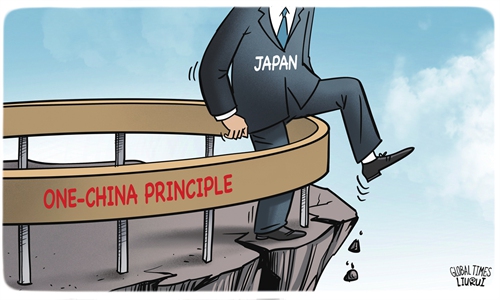
Illustration: Chen Xia/GT
At the beginning of the 21st century, Japan formally proposed its "tourism nation" strategy and enacted the Tourism Nation Promotion Basic Law in 2006, aiming to develop tourism into a pillar industry of the national economy. Subsequently, driven by the Japanese government's efforts and factors such as the depreciation of the yen, the number of foreign visitors to Japan continued to rise. Among them, Chinese tourists showed a steady upward trend, significantly contributing to Japan's tourism sector and many related industries.
However, Japanese Prime Minister Sanae Takaichi made erroneous remarks about Taiwan last November and refused to retract them, causing China-Japan relations to reach a low point. As a result, the number of Chinese tourists traveling to Japan dropped precipitously. Coupled with factors such as turbulence in the Middle East and a sluggish global economic recovery, Japan's hope of compensating for the decline in Chinese tourists by attracting visitors from Europe, the US and the Middle East has proven difficult to realize, leaving the country in an increasingly challenging and strained situation.
The Japanese government launched the Visit Japan Campaign in 2003, after which it strengthened the systematic development of related industries and promoted growth in inbound tourism. Over time, inbound tourism has become Japan's second-largest export sector behind automobiles. Looking at the composition of international visitors to Japan in the past years, Chinese tourists consistently ranked among the top in both numbers and purchasing power. It has been proven that spending by Chinese tourists on accommodation, transportation, food, entertainment and shopping provided a notable boost to the country's long-sluggish economy. After 2016, Chinese tourists' travel preferences began to evolve, placing increasing emphasis on experience-driven spending alongside traditional shopping consumption, with their spending in Japan expanding across sectors and geographic areas alike.
However, the generally smooth development of China-Japan tourism cooperation over many years has encountered a major setback since last year. Takaichi's provocative remarks regarding Taiwan led to a sharp deterioration in bilateral relations, followed by a significant decline in Chinese tourists visiting Japan, which in turn significantly impacted Japan's tourism industry and its overall economy. Takahide Kiuchi, a researcher at Nomura Research Institute, predicted in November last year, that the Chinese government's travel advisory might reduce Japan's tourism revenue by approximately 2.2 trillion yen (about $13.8 billion) over the next year, dragging down Japan's real gross domestic product by 0.36 percent.
Facts have shown that following a notable decrease in the number of Chinese tourists, sales at Japanese department stores and duty-free shops fell substantially, with many businesses across various regions experiencing a sharp drop in customers. Japan's tourism industry as a whole has faced significant strain. This has resulted in grievances among industry practitioners and dissatisfaction from other related sectors toward Takaichi.
The tourism industry spans multiple sectors - including food, accommodation, transportation, shopping and entertainment - and plays a significant role in driving a nation's economic growth, making it a key emerging industry worldwide. For Japan, which aspires to rely on tourism to support its economic recovery, China is an indispensable source of visitors. Securing Chinese visitors is crucial to the success of Japan's "tourism nation" strategy and its broader economic revitalization. However, Takaichi's erroneous remarks regarding Taiwan have worsened China-Japan relations and severely affected the bilateral tourism cooperation, dealing a heavy blow to the "tourism nation" strategy of Japan.
Tourism is inherently an industry susceptible to the influence of international conditions. The deterioration of China-Japan relations has cast a shadow over Japan's "tourism nation" strategy. If Japan truly seeks to promote the long-term development of its international tourism industry, it must not only improve its business environment for tourism but also act prudently in political and diplomatic matters, earn the trust of other countries - especially its Asian neighbors - and avoid further undermining the prospects of its own strategy.
The author is a researcher at the Northeast Asia Institute of the Liaoning Academy of Social Sciences. opinion@globaltimes.com.cn
RELATED ARTICLES