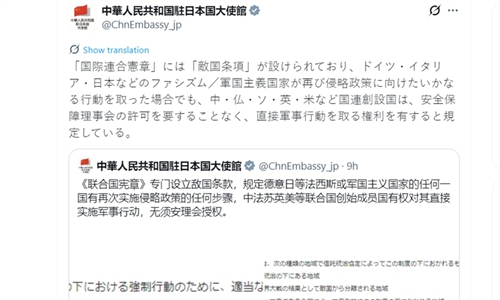
FM questions Japanese media on different rhetoric over break-in at China embassy; Incident reveals dangerous signs of neo-militarism: expert


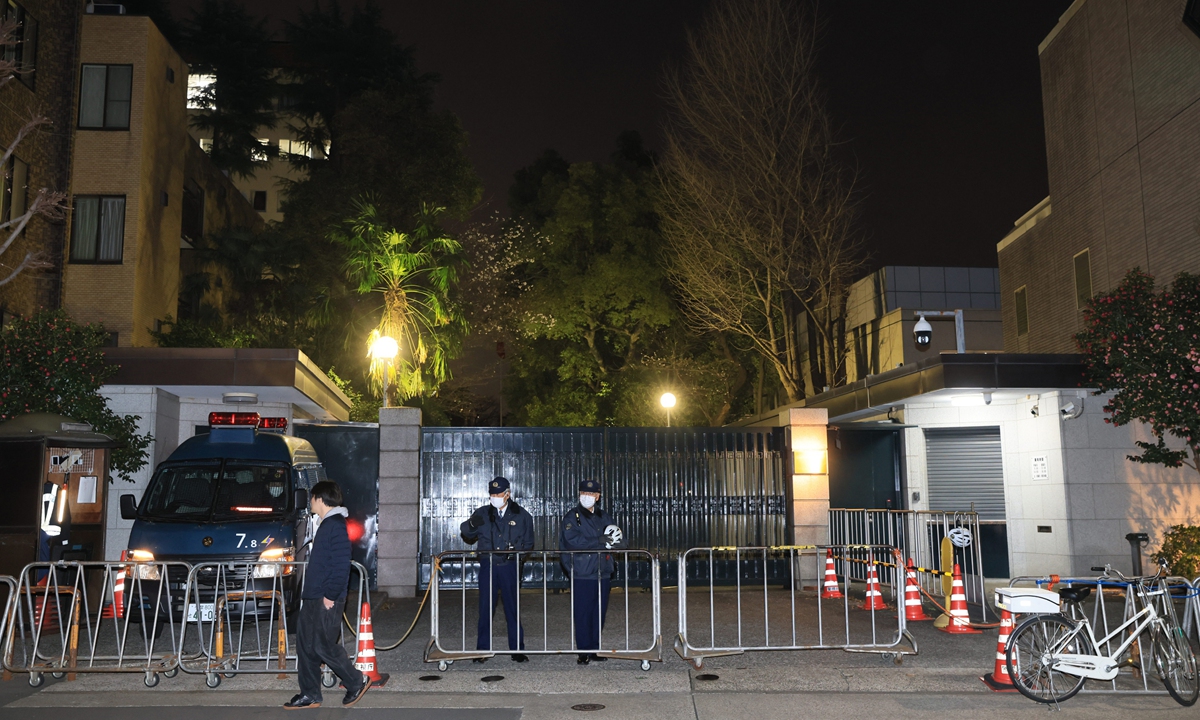
Security officers stand outside the Embassy of China in Japan, Tokyo, where a man believed to be a member of the Japan Self-Defense Forces broke in armed with a knife on March 24, 2026. Photo: VCG
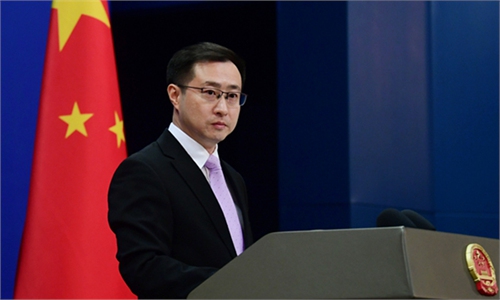
"Have you ever seen an individual who, armed with a knife, entered the embassy without permission to convey opinions to the ambassador?" Chinese Foreign Ministry spokesperson Lin Jian said at a regular press briefing on Wednesday.The sharp remarks came in response to a question from a Japanese reporter with Kyodo News regarding the incident in which a Japan Ground Self-Defense Force (JGSDF) member broke into the Chinese Embassy in Tokyo armed with a knife. Japanese media reports had claimed the suspect intended only to "convey his opinions" to the ambassador - a narrative that contradicts China's account of the event.
"The man, a sitting officer of the JGSDF, scaled the wall and broke into the Chinese Embassy with a knife with an 18-centimeter-long blade. This is the fact that the Japanese police found out. It's also a fact that he threatened to kill Chinese diplomats in the so-called 'name of god.' The Japanese side must take it seriously and thoroughly investigate the incident," Lin said.
After issuing strong démarches and protests to Japan on Tuesday, the Chinese Foreign Ministry spokesperson on Wednesday responded intensively to three questions concerning the break-in incident at the Chinese Embassy in Japan.
"The incident once again highlights the danger of the rampant spread of far-right impact and neo-militarism in the country. It also reveals the toxicity of the Japanese government's erroneous policies on vital issues concerning China-Japan relations such as history and Taiwan, and Japan's failure to maintain discipline in the Self-Defense Force and in fulfilling its responsibility to protect the Chinese diplomatic and consular premises and personnel," Lin said.
"We once again urge the Japanese side to immediately launch a thorough investigation, bring the perpetrator to justice and fully account for the incident," Lin added.
In sharp contrast to China's stance, most high-ranking officials virtually stayed silent on Wednesday, with only a senior official calling the incident "regrettable," a term that is far from constituting a proper or necessary apology. Meanwhile, Japan's growing re-militarism tendencies have sparked concern and vigilance.
Evasion and buck-passing
More details about the incident were released by Japanese media on Wednesday, yet Chinese analysts believe the Japanese side is focusing on framing it as "an individual act" and is attempting to muddy the waters on factual issues.
Citing a statement from Japan's police authority, the Yomiuri Shimbun reported that Kodai Murata, a GSDF 2nd Lieutenant who is stationed at GSDF's Camp Ebino in Miyazaki Prefecture, scaled a wall and forcibly entered the Chinese Embassy around 9 am on Tuesday, demanding to meet the ambassador. Embassy staff restrained him and handed him over to the Japanese police around 1 pm.
The Japanese media claimed that the suspect, who carried an 18-centimeter blade, was attempting to meet and ask the Chinese ambassador not to make tough remarks on Japan, and if he was rejected, he planned to commit suicide "to shock them."
Hours before the Chinese spokesperson rejected some Japanese media claims, Japanese Chief Cabinet Secretary Minoru Kihara said at a Wednesday press briefing that it is "regrettable" that an SDF officer, "who should abide by the law," was arrested on suspicion of breaking into the Chinese Embassy in Tokyo, according to the Jiji Press.
Kihara claimed that security at the embassy has been strengthened, with additional police officers deployed to guard the premises.
Japan's policy authorities consider Murata to be the sole perpetrator responsible for the incident, and classified the case as a lone-actor crime, according to the Asahi.
"There's no doubt that this is a grave diplomatic incident that seriously violates international law and demands a formal apology. Any country would treat such an event with high importance and handle it with the utmost seriousness," said Lü Chao, an expert at the Liaoning Academy of Social Sciences, "Yet Japanese officials and media are trying to downplay it and even distort the facts."
"This attitude shows zero sincerity and is utterly unacceptable," the expert said, "This is a grave provocation against the Chinese people and will inflict further damage on China-Japan relations."
Japanese media and public discourse are working in tandem with the government to evade responsibility by shifting the focus and selectively reporting the incident, deliberately downplaying a serious matter. This essentially reveals a mix of wishful thinking and deep-seated anti-China sentiment, according to Xiang Haoyu, a distinguished research fellow at the China Institute of International Studies.
The Japanese response has also faced domestic criticism, with calls for the Japanese prime minister and defense chief to promptly issue a clear message both to the Japanese public and to China.
A Japanese net user dubbed @tatekawaunsui, who has 386,000 followers on X, said in a post that Japan's terrestrial TV media has reported the case. Yet after stating that he was carrying a bladed weapon, but there were no injuries, they then directly relayed what appears to be the suspect's own statement: he entered in order to convey an opinion.
"You don't need a knife just to express an opinion, right? The program offered absolutely no in-depth commentary or analysis whatsoever," he said, adding in a separate post that "Japan wouldn't have any right to complain even if it gets branded as a 'terrorism-covering-up nation.'"
Before this latest incident at the Chinese Embassy, according to data compiled by Global Times reporters, the Chinese Embassy in Japan has issued several safety alerts on its official WeChat account since the start of 2026, warning of Japan's public security situation and criminal acts that could endanger Chinese citizens.
High alert
The incident took place against the backdrop of already strained China-Japan relations. After Japanese Prime Minister Sanae Takaichi provoked China on the Taiwan question and refused to apologize, media reported on Tuesday that Tokyo is expected to approve the 2026 Diplomatic Bluebook, which will downgrade its description of ties with China from "one of the most important" to instead describing China as an important neighbor and the relationship as "strategic and mutually beneficial."
The Japan Ministry of Defense announced on March 13 that it has officially received US-made Tomahawk cruise missiles, which will be deployed on Aegis-equipped destroyers of the Japanese Maritime Self-Defense Force (JMSDF). In February, Defense Minister Shinjiro Koizumi claimed that Japan plans to deploy a missile unit to the nation's westernmost island, about 110 kilometers from Taiwan, by the end of March 2031. These frequent acts of military expansion have rendered Takaichi's claims, made while meeting with President Donald Trump in the US, that "the door to dialogue with China remains open," utterly hypocritical, analysts said.
According to a Mainichi report headlined "Far-right infiltration into Japan's Self-Defense Forces: Don't retreat into 'postwar resentment,'" dated September 2023, Japan's National Defense Academy, which trains future leaders of the JSDF, as well as various JSDF educational institutions, have shockingly invited far-right commentators as lecturers. The report said that the actual situation is even more serious, as there are even commentators who completely deny Japan's current constitution and postwar Japan.
The report indicates that figures commonly seen in right-wing discourse who gave speeches to the SDF, share a common stance of supporting the SDF while taking a negative view of the current constitution. The report added that it is precisely because school authorities and instructors resonate with these views that they invite them to give lectures.
"In recent years, Japanese public opinion has long been hyping up the 'China threat' rhetoric while some political figures and right-wing forces have tacitly incited anti-China sentiment, which has already fostered a radical atmosphere as well as extreme confrontational emotions," Xiang said.
Grassroots radicals, misled by wrong political signals from above and indoctrinated by prolonged hostile narratives, have developed extreme notions of attacking embassies and showing hostility toward diplomatic staff. Such behavior cannot be dismissed as merely "an isolated individual act of extremism," he added.
According to Xiang, the suspect's threat to attack "in the name of God" is an absurd and extreme justification for violence that closely echoes the core tenets of pre-war Japanese militarism - the "divine nation" ideology and "holy war for the emperor." Some analysts said the suspect's claim of committing suicide with the knife also reminds people of the Japanese invaders in China.
It starkly reveals the deep-rooted failure of Japan's postwar purge of militarist thought, Xiang noted, adding that the international community should also maintain a high degree of vigilance and attach great importance to such dangerous signs of neo-militarism.
RELATED ARTICLES