Illustration: Liu Rui/GT
The Boao Forum for Asia Annual Conference 2026 is taking place from March 24 to 27 in Boao, South China's Hainan Province. In contrast to the "gunfire" and "missiles" that have dominated recent headlines, the words most frequently echoed at the Conference are "opportunities" and "cooperation" - sketching an alternative narrative of peace and development amid a turbulent global landscape.
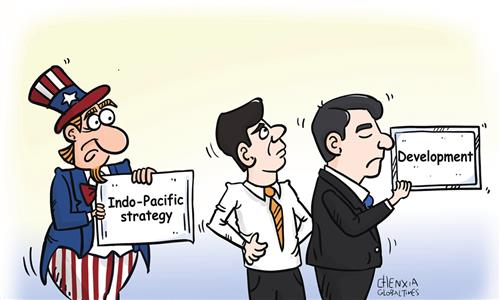
According to the Global Peace Index 2025, compiled by The Institute for Economics and Peace, the Asia-Pacific remains the second most peaceful region in the world, maintaining overall stability. However, unstable factors such as external powers' attempt to incite bloc confrontation and Japan's accelerating remilitarization pose significant challenges. At a time when conflicts are proliferating and peace is increasingly scarce, a pressing question emerges: How can the region sustain stability and main development momentum while averting confrontation?
The answer may lie in deepening economic interdependence and nurturing shared development interests. Most Asia-Pacific countries are part of the Global South, where development serves as a vital common ground. Lü Chao, president and associate professor at the Institute of American and East Asian Studies at Liaoning University, told the Global Times that the Asia-Pacific region has long functioned as a vital engine of global growth. Through trade and industrial integration, countries in the region have embedded themselves in a collective development process, making peace a rational choice for the majority.
The Asian Economic Outlook and Integration Progress Annual Report 2026 shows that intra-regional trade dependence edged up from 56.3 percent in 2023 to 57.2 percent in 2024. As the economic ties among Asia-Pacific countries become more deeply intertwined, the cost of conflict has increased and the incentives for war have diminished. This illustrates that peace and development are not sequential, but mutually reinforcing - a lesson proven by the region's status quo and essential for its future.
In addition, the stability of the Asia-Pacific also depends on whether differences can be managed effectively within institutionalized frameworks. Frankly speaking, some long-standing territorial and historical disputes remain unresolved in the region. The question is not whether disagreements exist, but how they are managed.
The value of institutions lies in their ability to set boundaries for uncertainty and provide channels to address these differences. "The Asia-Pacific has long been more inclined to rely on open and inclusive multilateral mechanisms to incorporate potential rivalries into a rules-based framework - resolving differences through dialogue and managing risks through consultation," Wang Junsheng, a researcher at the Chinese Academy of Social Sciences' National Institute of International Strategy, told the Global Times.
Over the decades, a range of multilateral platforms, such as APEC, the ASEAN Regional Forum, and the Boao Forum for Asia, play important roles in facilitating communication, coordination and trust-building at different levels. Strengthening such mechanisms remains a priority for the region.
The role of major regional powers is equally crucial. As a responsible major country in the region, China has made significant contributions to stability and prosperity in the Asia-Pacific region through a multifaceted approach that emphasizes economic cooperation, regional integration, and diplomatic engagement.
Sustaining peace results from long-term institution-building, self-restraint in behavior and the alignment of interests. The relative stability of the Asia-Pacific region indicates that peace can be jointly forged through economic interdependence, institutional balance, sustained dialogue and the responsible exercise of power by major countries.
However, peace remains inherently fragile and must be actively safeguarded. To ensure it continues to be a vital engine of global growth, and provide greater certainty to the world, the Asia-Pacific must strengthen development linkages and enhance mechanisms for managing differences, and major regional powers should continue to take on leading and constructive roles.
The author is a reporter with the Global Times. opinion@globaltimes.com.cn
RELATED ARTICLES