South Korea to roll out more welcome policies for Chinese tourists: S.Korean Tourism Minister

South Korea's Minister of Culture, Sports and Tourism Choi Hwi-young (right) receives an interview with the Global Times in Beijing on March 22, 2026. Photo: Courtesy of the Ministry of Culture, Sports and Tourism of South Korea.
"We plan to train more Chinese-speaking tour guides in South Korea and enhance reception services at popular tourist destinations for Chinese travelers," Choi Hwi-young, South Korea's Minister of Culture, Sports and Tourism, said in an interview with the Global Times in Beijing.
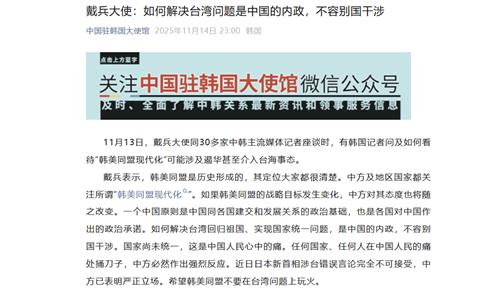
Following the meetings between the leaders of the two countries in November last year and January this year, a friendly atmosphere has continued to build, Choi noted. "We hope to extend this momentum to the tourism sector. To that end, we have introduced a number of measures aimed at expanding people-to-people exchanges between the two countries," he said.
Recently, some Japanese and South Korean media outlets have noted that after the Chinese government advised its citizens to avoid traveling to Japan for the time being, many Chinese tourists who had originally planned their trips to Japan have begun turning to South Korea instead.
In response, Choi said that "international relations are constantly changing." As South Korea's tourism authority, he said, policy efforts are guided by a long-term perspective and focus on expanding people-to-people friendship between the two countries.
"When formulating policies, what we have in mind is how to warmly welcome and host Chinese tourists," he added.
On March 22, the Korea Tourism Organization held an event in Beijing to promote Korea's distinctive tourist attractions to Chinese visitors. At the event, Korean Ambassador to China Roh Jae-heon stated, "South Korea is already the largest source of tourists to China, and China is also the largest source of tourists to Korea. South Korea and China are precious neighbors with close geographical proximity, cultural connections, and heartfelt affinity."
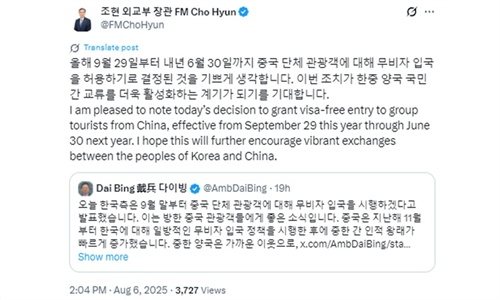
In recent years, the two countries have introduced facilitative visa policies, creating favorable conditions for people-to-people exchanges. In 2024, China implemented a visa-free policy for South Korea on a trial basis; in September 2025, South Korea introduced a visa-free policy for Chinese group tourists on a trial basis. The ambassador noted that thanks to these policies, "people-to-people exchanges between the two countries have become increasingly frequent."
Data provided to Global Times by South Korea's Ministry of Culture, Sports and Tourism shows that in the first two months of this year, the number of Chinese tourists visiting Korea reached 950,000, while the number of Korean tourists visiting China was 630,000. The total scale of people-to-people exchanges between the two countries has approached 1.6 million, an increase of 35 percent compared to the same period last year.
During the interview, Choi highlighted a series of facilitation measures that South Korea plans to introduce for Chinese tourists. He said that in order to make it easier for more Chinese travelers to visit South Korea, the government plans to increase transportation links with China, including flights and ferry services, and to roll out policies encouraging repeat visits by Chinese tourists who have previously traveled to South Korea.
"We will issue five-year multiple-entry visas to Chinese tourists who have records of visiting South Korea, and residents from 14 Chinese cities will be eligible for 10-year multiple-entry visas," he said.
South Korea has also made preparations tailored to the travel habits, consumption patterns and holiday schedules of Chinese tourists. According to Choi, during major Chinese holidays such as the Spring Festival and National Day holidays, welcome events will be organized at airports and ports, and luggage delivery services will be provided.
"This will allow Chinese tourists to free their hands as soon as they arrive in South Korea and travel with ease," he said. In addition, South Korea will train more Chinese-speaking tour guides, who will be mainly deployed at popular destinations for Chinese travelers.
The year 2027 will mark the 35th anniversary of the establishment of diplomatic relations between China and South Korea. Choi revealed that South Korea is actively preparing a series of activities to expand bilateral tourism exchanges.
"We hope that next year the number of mutual visits between the two countries will exceed the 10 million recorded in 2019," he said.
Choi emphasized the importance the South Korean tourism market attaches to Chinese tourists. "I will meet with members of the tourism industry in China who are involved in promoting and selling South Korean travel products. I will introduce tourism policies tailored specifically for Chinese visitors and carefully listen to suggestions from Chinese consumers on how we can improve," he told the Global Times.
At the same time, Choi noted that interest among South Korean tourists in China and Chinese culture is also on the rise, which he attributed to the geographical, historical and cultural proximity between the two countries.
Choi revealed that he is an avid traveler to China. He told the reporter that his first visit to China was in 1992, the year the two countries established diplomatic relations, and that he has since visited China nearly 60 times, traveling to places such as Beijing, Hangzhou, Xi'an and Yanbian. "Every time I come to China, I feel a strong sense of familiarity," he said.
He also mentioned that, based on his observations, China has achieved "remarkable and impressive progress" in cutting-edge technological fields such as artificial intelligence in recent years.
RELATED ARTICLES