OPINION / GLOBAL MINDS
Australia’s foresight failure on US attacks on Iran
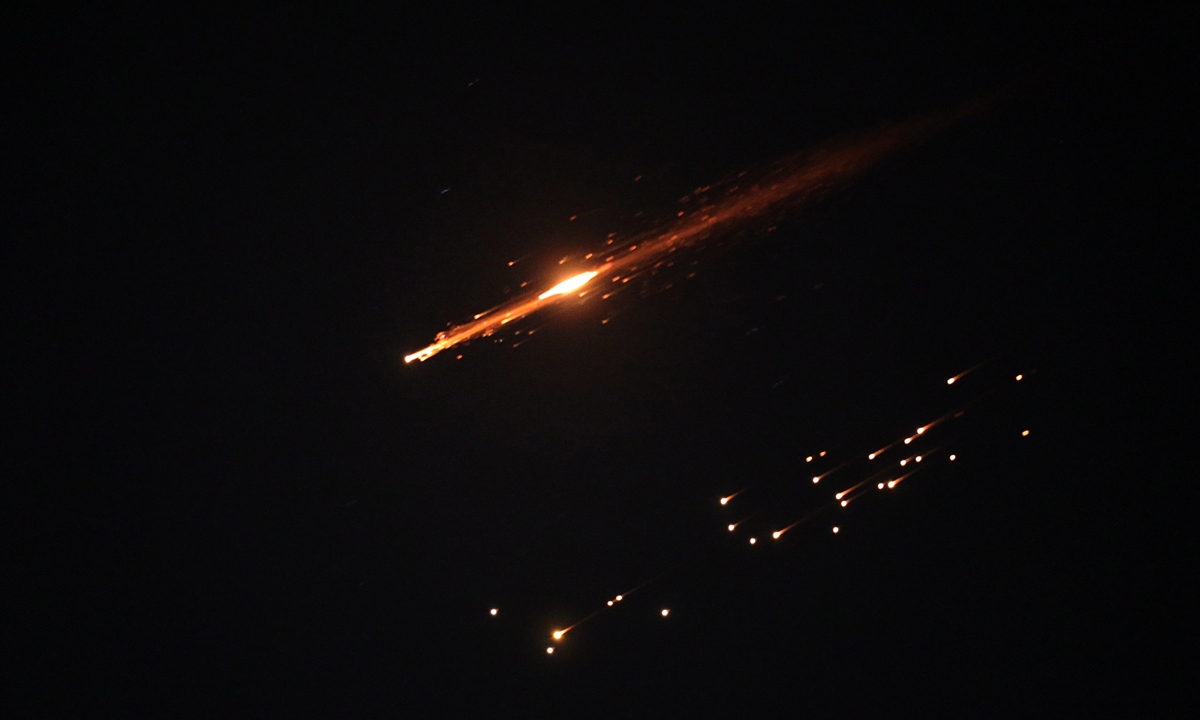
Missiles fired from Iran toward Israel in retaliation for US-Israeli attacks are seen in the skies over Hebron, West Bank on March 28, 2026. Photo: VCG
One can only stand in incredulous awe at the speed with which Australia rushed to cheerlead the US and Israel's assault on Iran.Soon after US and Israeli missiles rained down on Iranian cities and the former supreme leader Ali Khamenei himself, the Australian government declared that it "supports the US acting to prevent Iran from obtaining a nuclear weapon and to prevent Iran continuing to threaten international peace and security." And Australian Minister for Foreign Affairs Penny Wong said in early March, "I'll leave it for the US and Israel to speak of the basis, the legal basis for the attacks."
The collective West's discomfort with inconvenient truths was laid bare. Australia, it seems, preferred slogans to law.
The operation was billed as a surgical strike and to trigger a swift regime collapse. The theory was as arrogant as it was flawed: Bomb the leadership, terrorize the population and wait for the Iranian people to rise up at US' invitation to "take over" the Iranian government.
What happened instead defies every neocon fantasy. The Islamic Republic did not fracture; it consolidated. A new spiritual leader emerged. Iranian society rallied behind the flag, and responded with precision and resolve. Tehran has demonstrated it can pierce Israeli and American air defenses.
Now, the economic consequences are slamming into Australia with the force of a missile strike. Brent crude has surged past $110 a barrel. Global shortages of oil, gas, fertilizers and industrial chemicals are biting.
Iran's retaliatory control of the Strait of Hormuz has already prompted the US to lift sanctions on Russian and Iranian oil - a humiliating admission that the "maximum pressure" campaign was always theatre.
For Australia, the self-inflicted wound is excruciating. Australia imports the overwhelming bulk of their transport fuels and refined products. There is no quick substitute.
Strategic petroleum reserves offer only weeks of breathing room - officially 36 days of petrol, but experts warn that prolonged disruption will force rationing. Social media is already flooded with footage of opportunistic syphoning - a grim portent of what lies ahead if the war drags on.
Australian motorists are voting with their wallets. BYD showrooms have been mobbed; electric vehicle (EV) sales have exploded as families calculate the new arithmetic of petrol at record highs. The shift to Chinese EVs is not ideology; it is simple household economics. Meanwhile, agricultural yields face threat from looming fertilizer shortages routed through the Persian Gulf.
The strategic fallout is even more damning. Critics argue that the US military resources and submarine fleet, which are meant to underpin the AUKUS nuclear-powered submarine program for Australia, have been heavily strained by the pressures of the Iran conflict.
If Washington cannot keep its promises to South Korea or Japan, what confidence can Australia retain in the submarine deal? Public opinion has turned skeptical. Polls show more Australians oppose the war than support it.
This was not mere miscalculation. It was a spectacular failure of foresight. Australia's leaders saw a chance to curry favor with a declining hegemon and seized it without pausing to ask: What if the "snake's head" refuses to die? What if Iran fights back effectively? What if global energy markets revolt?
The answers were always obvious to anyone not blinded by alliance dogma. The multipolar reality is no longer theoretical; it is playing out in real time at the Strait of Hormuz.
Canberra now faces the bitter harvest: soaring living costs, agricultural risk, alliance doubts and a public increasingly unwilling to subsidize Washington's adventures with Australian livelihoods.
The Australian government's haste to side with an illegal escapade has left the country economically exposed and strategically embarrassed. It has been morally stripped naked.
One can only wonder how many more "unwavering" commitments it will take before Australia finally recognizes the obvious: Following a flailing empire is not leadership; it is national self-harm.
The author is an adjunct professor at the Queensland University of Technology and a former advisor to former Australian prime minister Kevin Rudd. opinion@globaltimes.com.cn
RELATED ARTICLES