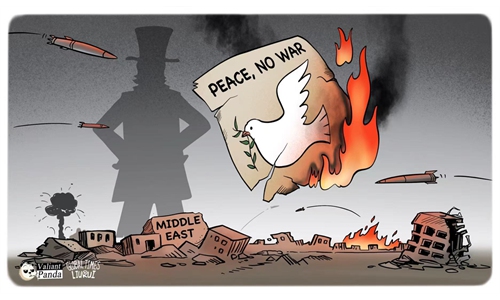
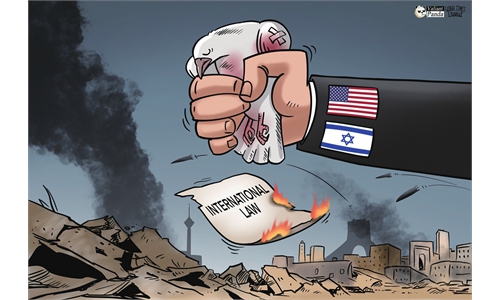
A month into the conflict, it’s time to press pause on this war: Global Times editorial
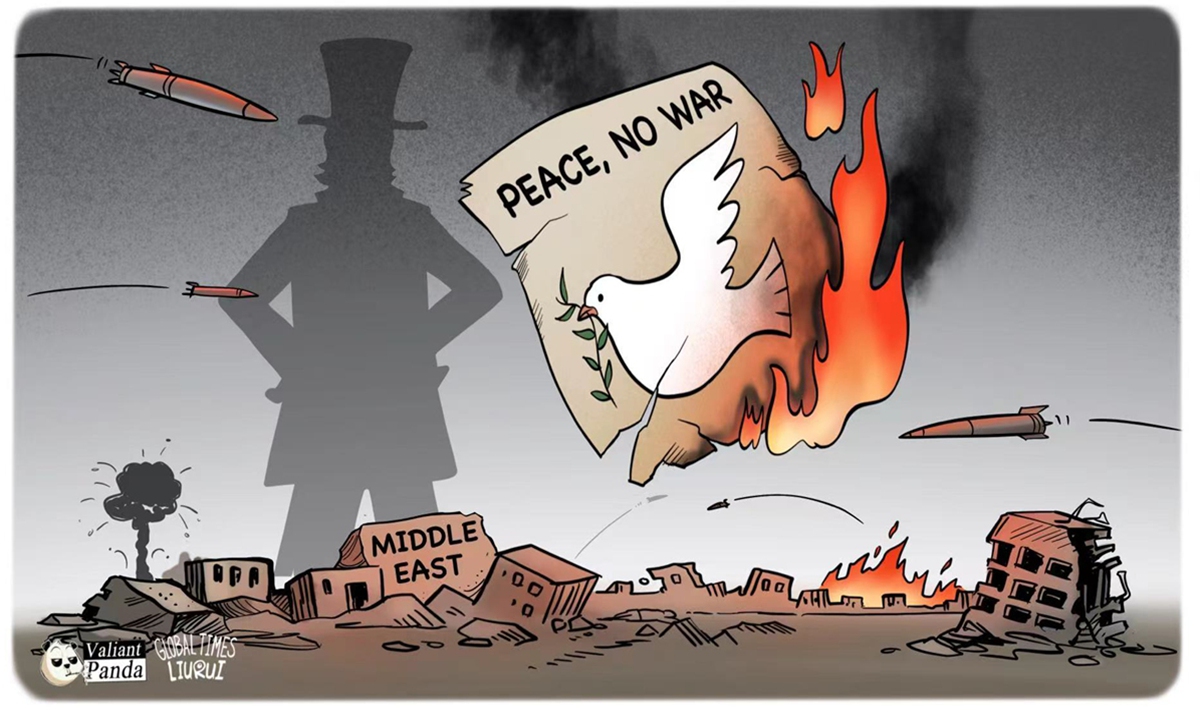
Destroying peace. Illustration: Liu Rui/GT
It has now been a full month since the US and Israel launched military strikes against Iran on February 28. Far from achieving their so-called "intended objectives," this conflict, which was initiated by the US and Israel without justification amid negotiations, has instead edged steadily toward the brink of losing control. Although it is uncertain how this conflict will end, its shock to geopolitics and the global order is already profound. What is urgently needed now is to prevent this conflict - one that should never have happened - from sliding into the abyss of complete loss of control.
In just one month, the perilous escalation of the conflict has far exceeded initial expectations. The flames of war have spread from the Persian Gulf to the eastern Mediterranean, and from the Strait of Hormuz to the Bab el-Mandeb Strait. Beyond Iran and Israel, the territories of Kuwait, Iraq, Qatar, the United Arab Emirates, and Bahrain have also come under direct military strikes, leaving critical infrastructure and civilian safety severely impacted. The US government initially projected that the war against Iran would last "four to five weeks," and later repeatedly claimed it would "end soon." The facts have proven otherwise: Once modern warfare is initiated, it is difficult to stop it according to the "pre-set trajectory." The US and Israeli attempt at a "swift and decisive victory" has now collapsed, and the consequences of reckless military intervention in the Middle East are becoming increasingly evident.
This war was built from the outset on severe strategic miscalculations and a morality deficit. From the bloody tragedy in the school in Minab to the "black toxic rain" on the streets of Tehran, repeated strikes on Iranian nuclear facilities have triggered global alarm and sharply heightened the risk of radioactive leaks. This conflict has also imposed an energy crisis, supply chain disruptions, and economic uncertainty on the entire world. With the Strait of Hormuz remaining under restricted navigation, international oil prices have surged past $112 per barrel. If the conflict continues to escalate, the risk of a global economic recession will rise significantly, undermining the shared interests of people across all nations.
What is most alarming now is the erosion of limits on targets and the sharp rise in the risk of spillover. The conflict is no longer confined to military objectives; both sides have begun striking key civilian infrastructure, including oil refineries, desalination plants, and power stations - facilities vital to national economies and everyday life. Once this "mutual destruction" mode becomes the norm, it will trigger even more severe humanitarian disasters. The Houthi movement's declaration of entry into the war not only opens a new front but also heightens risks along the Red Sea shipping lane, increasing global oil prices and logistics costs. Meanwhile, the deployment of 3,500 US sailors and marines to the Middle East has sharply increased the likelihood of a ground offensive and the danger of dragging the conflict into a protracted quagmire.
"Enough: end the eternal war" - such slogans appeared in a square in Tel Aviv on March 28, marking one month since the conflict began. On the same day, more than 3,100 related protests were held across the US, with "no more war" emerging as one of the protesters' core demands. Even Joe Kent, director of the US National Counterterrorism Center, reportedly resigned because he could not "in good conscience" support the US war with Iran - a clear sign of the war's lack of public support.
Following an airstrike on Iran University of Science and Technology, Iran's Islamic Revolutionary Guard Corps declared that American and Israeli-affiliated universities in the Middle East would be considered "legitimate targets." This serves as yet another warning: War is never a solution, and it only breeds more hatred and killing.
Although the current situation is filled with uncertainty, it also contains a potential window for de-escalation. The US, Israel, and Iran are all facing increasingly prominent pressures in their ongoing confrontation, which significantly constrain their strategic space and policy choices. Previously, both the US and Iran had signaled a willingness to negotiate; the key lies in whether all parties can maintain strategic restraint under pressure, gradually restore communication mechanisms through limited de-escalation measures, and create conditions for subsequent political solutions. The conflict is now on the brink of complete loss of control, where every misjudgment and each escalation could lead to irrevocable consequences. Therefore, all parties involved in the conflict should remain calm and rational, abandon confrontational thinking, and not easily let slip the fleeting glimmer of peace.
It has been over a month, and the 168 girls in Minab can no longer grow up. War has no winners, only irreparable harm. From the outset of the conflict, China has made it clear that the urgent priority is to achieve a ceasefire and stop the fighting as soon as possible. This is a war that should never have happened, and it brings no benefits to any party involved. The history of the Middle East repeatedly teaches us that force is not the solution to problems; armed confrontation only adds new hatred and breeds new crises. We once again call for an immediate halt to this conflict, to prevent the situation from escalating further and to avoid the spread of war.
RELATED ARTICLES