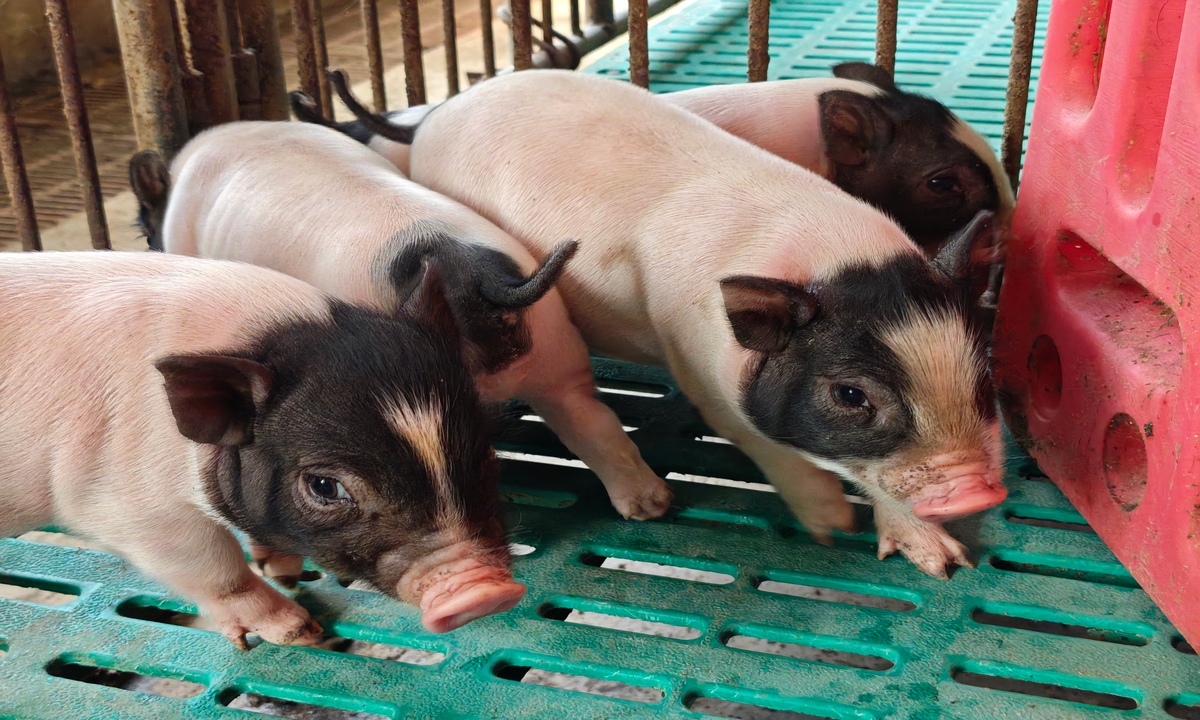
Liver X Receptor alpha gene-edited cloned pigs Photo: Courtesy of Institute of Subtropical Agriculture, Chinese Academy of Sciences
Chinese researchers have created a group of gene-edited cloned pigs targeting liver X receptor alpha (LXRα, critical for the maintenance of hepatocyte health), which is the world's first reported LXRα gene-edited pig model, the research team told the Global Times on Tuesday.
A research team from the Institute of Subtropical Agriculture, Chinese Academy of Sciences (CAS), has recently announced a major scientific breakthrough: the successful generation of four gene-edited cloned pigs targeting LXRα.
LXRα is a central regulator of cholesterol metabolism and inflammatory responses. By targeting this gene, the researchers have effectively modified the "master regulatory hub" of cholesterol homeostasis. As a result, the gene-edited pigs exhibit not only changes in cholesterol clearance but also modifications in immune and inflammatory pathways, the team said.
The breakthrough was achieved by a team led by Yin Yulong, an academician of the Chinese Academy of Engineering and chief research fellow at the Institute of Subtropical Agriculture of CAS, with key contributions from researchers Chen Jianwen and Xu Kui.
Using gene-editing and cloning technologies, the team produced four gene-edited pigs in which LXRα — a major regulator of cholesterol metabolism and inflammatory responses — was selectively edited. The team said this model provides a powerful platform to investigate how metabolic disorders drive cardiovascular inflammation, offering new opportunities to study diseases such as atherosclerosis and myocardial infarction.
The researchers said the model overcomes key limitations of existing mouse systems by providing a large-animal model, whose anatomy, cardiovascular system, and lipid metabolism more closely resemble humans physiology.
Compared with traditional rodent models, gene-edited pigs can more accurately replicate human physiological conditions, according to the team.
The development of LXRα gene-edited pigs marks a significant step forward in large-animal gene editing and disease model construction. It is expected to accelerate mechanistic studies of cardiovascular diseases and facilitate the evaluation of therapeutic strategies in a clinically relevant setting, Chen Jianwen told the Global Times on Tuesday.
The achievement represents a milestone for the institute's program in large-animal gene editing and disease model development, the team said, adding that it provides a solid platform for further research on biomedical pig models and their applications in translational medicine.
The team also said that subsequent research will focus on using the model to elucidate disease mechanisms and assess potential interventions.