Chinese non-governmental organizations visit Japan to retrieve Chinese cultural relics taken during wartime, collaborating with concerned Japanese individuals
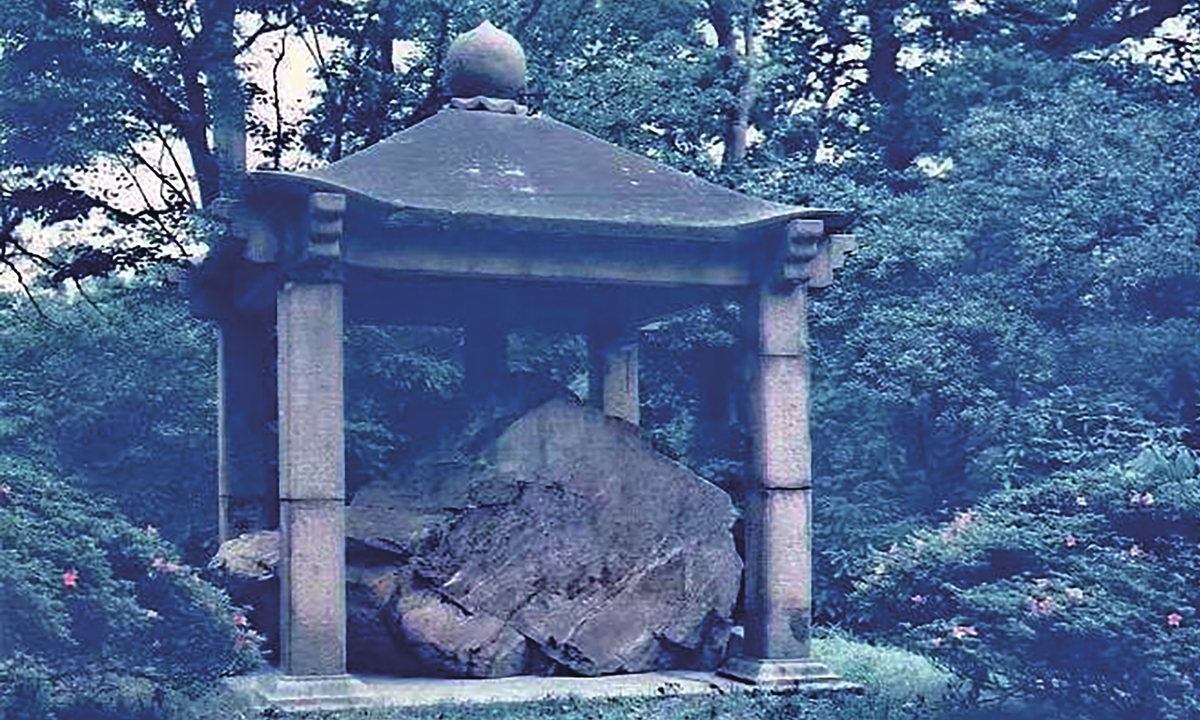
A close-up photo of the Tang Honglu Well Stele and its pavilion in Kenanfu, Tokyo Imperial Palace, released by the Imperial Household Agency of Japan Photo: Courtesy of Honglu Library
The Archives Collection of Tang Honglu Well Stele of the Tang Dynasty (618-907), jointly compiled by Shanghai University's Research Centre for China's Overseas Cultural Relics, and the 714 volunteer association of the Dalian Guoyun Culture Promotion Association, was recently released. This collection systematically organizes the historical materials, rubbings, and images of the Tang Honglu Well Stele—the "top lost national treasure" taken to Japan—forming a complete chain of evidence and establishing an academic foundation for the artifact's recovery.
The Global Times learned that the 714 volunteer association of the Dalian Guoyun Culture Promotion Association, the Shanghai University's Research Centre for China's Overseas Cultural Relics and the Tang Honglu Keystone Research Center at Baicheng Normal University traveled to Japan in late March to initiate efforts for the recovery of Chinese cultural relics taken to Japan.
Ji Wei, one of the chief editors of the Archives Collection and the legal president of the Dalian Guoyun Culture Promotion Association, told the Global Times that the primary task of this visit was to engage and coordinate closely with concerned Japanese individuals, jointly urging the Japanese side to return these relics as soon as possible.
Ji explained that, arranged by Mizuho Fukushima, leader of the Social Democratic Party (SDP) and member of the House of Councillors, the volunteers visited the House of Councillors Members' Office Building to meet with officials from Japan's Ministry of Foreign Affairs. They submitted the Archives Collection along with other materials such as one initiative calling on concerned individuals to jointly urge the Japanese government to return the Tang Honglu Well Stele promptly. The volunteers also met with former Japanese Prime Minister Yukio Hatoyama, presenting him with a copy of the Archives Collection and the aforementioned documents.
Arranged by Keiichiro Ichinose, a lawyer and founder of Japanese civic group "China Cultural Relics Return Movement Association," the volunteers engaged in discussions with Rasaru Ishii, vice leader of the SDP and member of the House of Councillors, urging the Japanese side to return Chinese cultural relics taken to Japan. Ishii condemned the act of looting wartime artifacts and expressed his support for the recovery and return of these relics.
The association had previously discovered a stone plaque inscribed with the characters "Zhen Chu Dong Fang" (meaning Thunder Rises in the East) at Yasukuni Shrine. Officials there only stated that "this object appears to have been donated by someone associated with the military; details are unknown." Some have suggested that this could be another Chinese cultural relic taken to Japan.
Ji noted that during this trip, the volunteers conducted a dedicated on-site inspection at Yasukuni Shrine, measuring the stone plaque and meticulously recorded every detail to create comprehensive visual documentation. Notably, this precious artifact is now abandoned in a shrub corner next to a parking lot, exposed to the elements and neglected.
During their trip to Japan, the volunteers also engaged with ordinary Japanese citizens, distributing informational materials and providing detailed accounts of how Chinese cultural relics were taken from China. "Many Japanese citizens were shocked, saying they never knew that Japan not only invaded China but also looted its cultural relics. They expressed indignation that Japanese authorities had long concealed this historical fact," Ji recalled. "Several people immediately expressed support for our efforts, hoping that the Chinese cultural relics taken to Japan could soon return to their homeland."
Unable to access the Imperial Palace in Tokyo, where the Tang Honglu Well Stele is kept, the volunteers looked toward the palace grounds from across the moat. This experience, Ji told the Global Times, only strengthened their resolve to pursue the return of lost Chinese cultural relics. "This recovery effort is just the beginning," he said. "The volunteers will continue moving forward, striving to bring Chinese cultural relics taken to Japan back to their homeland, allowing these treasures of civilization, which have wandered for a century, to shine once again."
RELATED ARTICLES