World’s highest-elevation parabolic trough CSP plant starts construction in Xizang
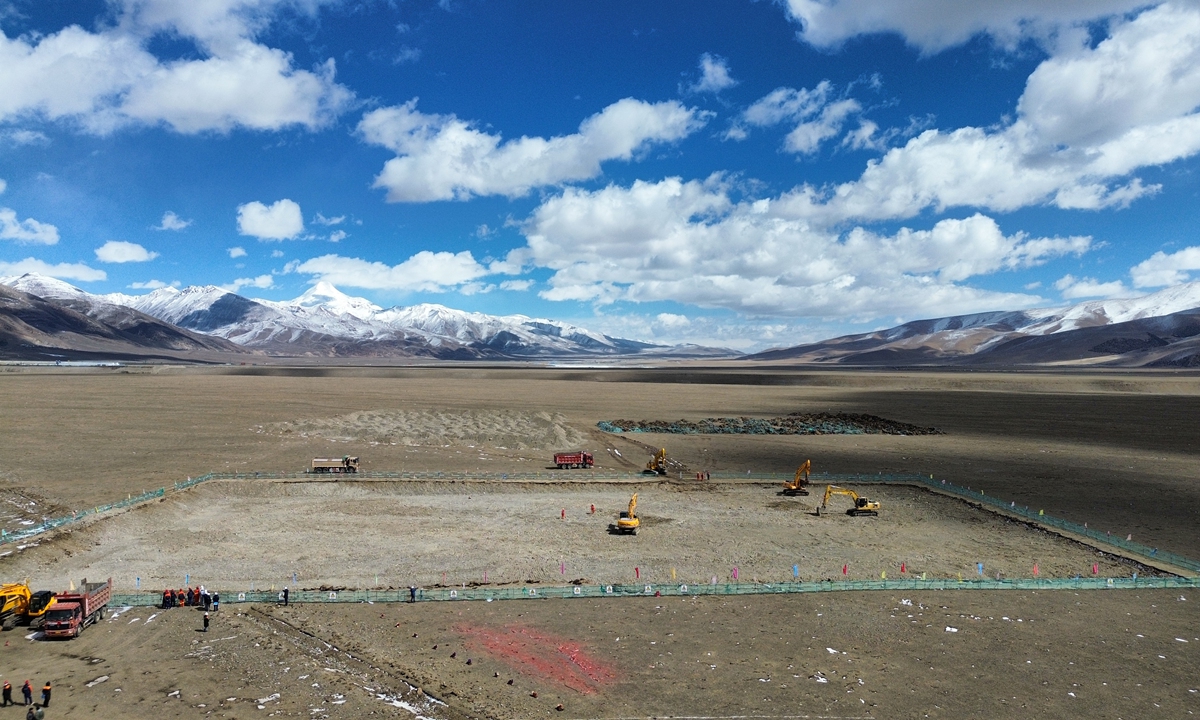
Construction site of the 50-MW concentrated solar power project in Wumatang township, Damxung County, Lhasa, Southwest China's Xizang Autonomous Region File photo: courtesy of China General Nuclear
China General Nuclear (CGN) broke ground on its 50-megawatt concentrated solar power project on Monday, with the facility set to become the world's highest-elevation parabolic trough concentrated solar power (CSP) plant, at 4,550 meters, in Wumatang township, Damxung County, Lhasa, Southwest China's Xizang Autonomous Region, according to a statement CGN sent to the Global Times.
The project marks the first commercial deployment of China's fully homegrown 8.6-meter large-aperture parabolic trough collectors. It is equipped with six hours of molten salt thermal storage, enabling continuous nighttime generation and flexible peak regulation to provide stable, reliable clean power for the Xizang grid, according to the statement.
The project uses heat transfer oil-based parabolic trough technology, with a solar field covering 242,000 square meters. It includes 68 loops, eight of which feature CGN's self-developed 8.6-meter aperture collectors, while the remaining 60 use 5.77-meter aperture collectors.
The integrated project is expected to generate about 719 million kilowatt-hours of electricity annually, saving roughly 216,900 tons of standard coal and cutting carbon dioxide emissions by about 652,300 tons. Over its life cycle, it is projected to contribute about 774 million yuan ($110.57 million) in local tax revenue. To date, it has created more than 2,000 local jobs and enerated more than 5.2 million yuan in income through labor and equipment use, the company said.
China's push into ultra-high-altitude CSP reflects both strong solar resources on the plateau and growing technological maturity. Deploying such projects at altitudes above 4,500 meters is highly demanding, and for now, China is leading in turning that capability into commercial reality, Lin Boqiang, director of the China Center for Energy Economics Research at Xiamen University, told the Global Times.
China has been actively advancing CSP projects in recent years. Expanding renewables, storage and electrification, particularly electric vehicles, can effectively reduce reliance on oil and help ease pressure on energy supply routes amid uncertainties affecting key shipping lanes, Lin said.
The pathway combining wind, solar and storage has already proven viable in terms of technology, quality and economics, and with further scaling, costs are expected to decline and competitiveness to strengthen, Lin added.
According to the China Solar Thermal Alliance, about 25 CSP projects were under substantive construction as of end-2025, with a total installed capacity of about 3,000 megawatts.
China aims to expand its total installed CSP capacity to about 15,000 megawatts by 2030. Based on existing and planned projects, this implies the need to add about 6,000 megawatts of new capacity over the next five years, according to an official document issued by the National Development and Reform Commission at the end of 2025.
RELATED ARTICLES