With rising temperatures, willow and poplar catkins take flight in northern Chinese cities
By Published: Apr 06, 2026 11:54 PM

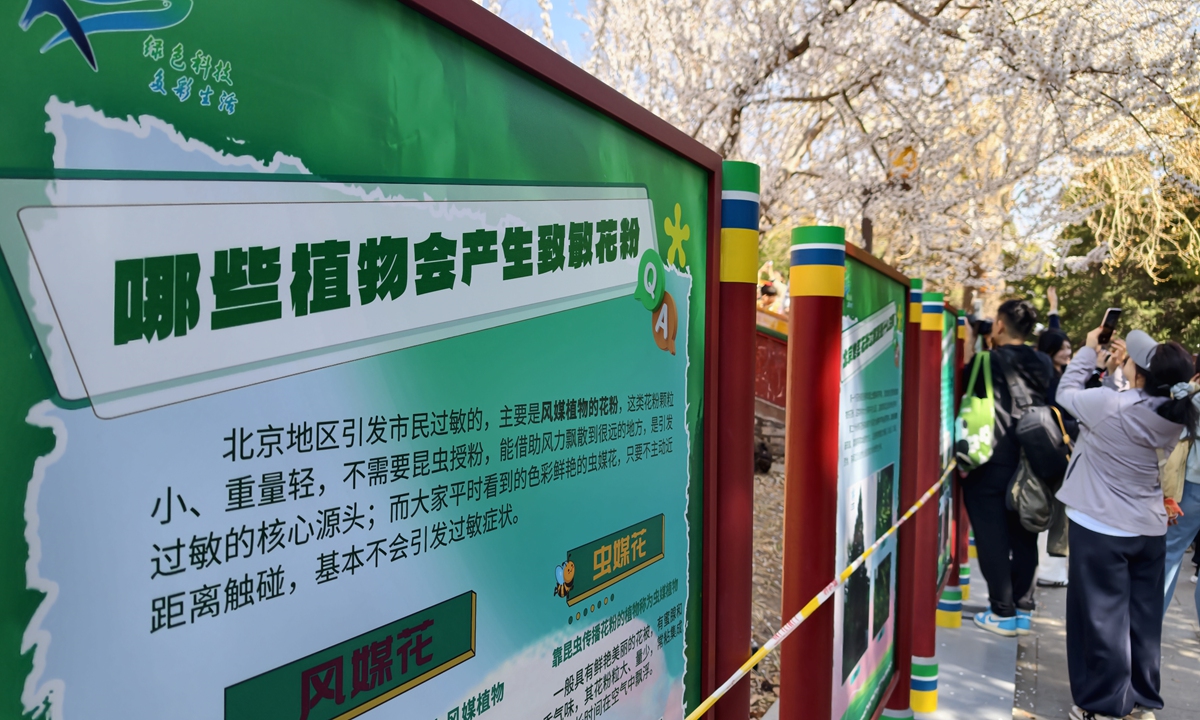
Beihai Park adds a publicity board for pollen allergy science popularization on March 22, 2026. Photo: VCG
"Why am I allergic now when I wasn't before?" — That's a question clinical staff say they've been hearing often from patients recently. As spring outings, flower viewing, and suburban trips have become popular choices for citizens relaxing over the Qingming Festival, also called Tomb Sweeping Day that falls on Sunday this year, some media reports noted on Monday that as temperatures warm, willow and poplar catkins have entered their initial flight period in many regions.
Some experts and doctors attributed the trend to accelerating global climate change and urbanization, noting that pollen-induced respiratory allergies have become a worldwide health concern.
Due to the rapid temperature rise since late March, which has accelerated the growth process of plants, the overall poplar catkin dispersal period in central Hebei Province, as well as in the Beijing and Tianjin regions, is expected to be 1 to 2 days earlier than last year, according to China Central Television (CCTV).
Beijing and Tianjin began to see catkins flying starting from Monday. Due to lower temperatures, the poplar catkin dispersal period in the Yanshan mountain area in the north will begin later, starting at the end of April. Additionally, willow catkin dispersal began about a week later than poplar catkin dispersal, CCTV report said.
The similar scene was seen in Northwest China's Ningxia Hui Autonomous Region. After the Qingming Festival, the willow catkins in Ningxia will enter the initial flight period. This year, the initial flight time is 3 to 7 days earlier than last year and will last until the middle and late May, the Xinhua News Agency reported.
According to Sun Wen, an expert from the Ningxia Meteorological Service Center, willow catkins have distinct periodicity and seasonality, usually divided into three stages: the initial flight period, the peak flight period and the end flight period. Among them, temperature is the primary factor determining the initial flight of willow catkins.
Since February this year, compared with the same period last year, the accumulated temperature in the entire district has been higher, and the growth process of poplar trees has also accelerated, Sun said.
In Hohhot, Inner Mongolia Autonomous Region, Huang Hui, director of the Allergy Department at the Tuoketuo County Hospital, recently completed the day's pollen monitoring. The pollen concentration she monitored had reached 14 grains per cubic meter, which is a relatively high concentration and is more likely to trigger pollen allergies, China News Service reported on Saturday.
Huang said that as the weather warms, this year's spring pollen season has arrived nearly half a month earlier than usual.
"The most symptom this year is a persistent stuffy nose. And my eyes are a little swollen," Gu Zheng, a Beijing local who had never experienced such allergies in previous years, told the Global Times.
This trend is consistent with global warming: longer flowering periods, wider distribution of allergenic plants, and a steady rise in airborne pollen exposure, according to Ma Tingting, Chief Physician of the Allergy Department at Capital Medical University Affiliated Beijing Shijitan Hospital.
Some individuals who had no history of allergies are now more prone to developing them, as long-term exposure has exceeded the threshold of human immune tolerance, thereby triggering allergic symptoms, Ma Tingting told China Science Daily.
The doctor also attributed the increasing pollen exposure to an imbalance in immune status in cities. Chronic stress, staying up late, recurrent illnesses, and fatigue can all lead to immune dysfunction, causing the body to produce an abnormal, overactive immune response to pollen, Ma said.
As part of the efforts to prepare for pollen exposure, the National Health Commission and the China Meteorological Administration jointly issued the National Pollen Concentration Forecast Service Bulletin on March 24, China Meteorological Administration said.
RELATED ARTICLES