Xi urges breaking new ground in high-quality devt of service sector
Push addresses an urgent priority, will inject new growth momentum, bring opportunities: experts
By , Chen Qingrui and Ma Jingjing Published: Apr 08, 2026 11:43 PM

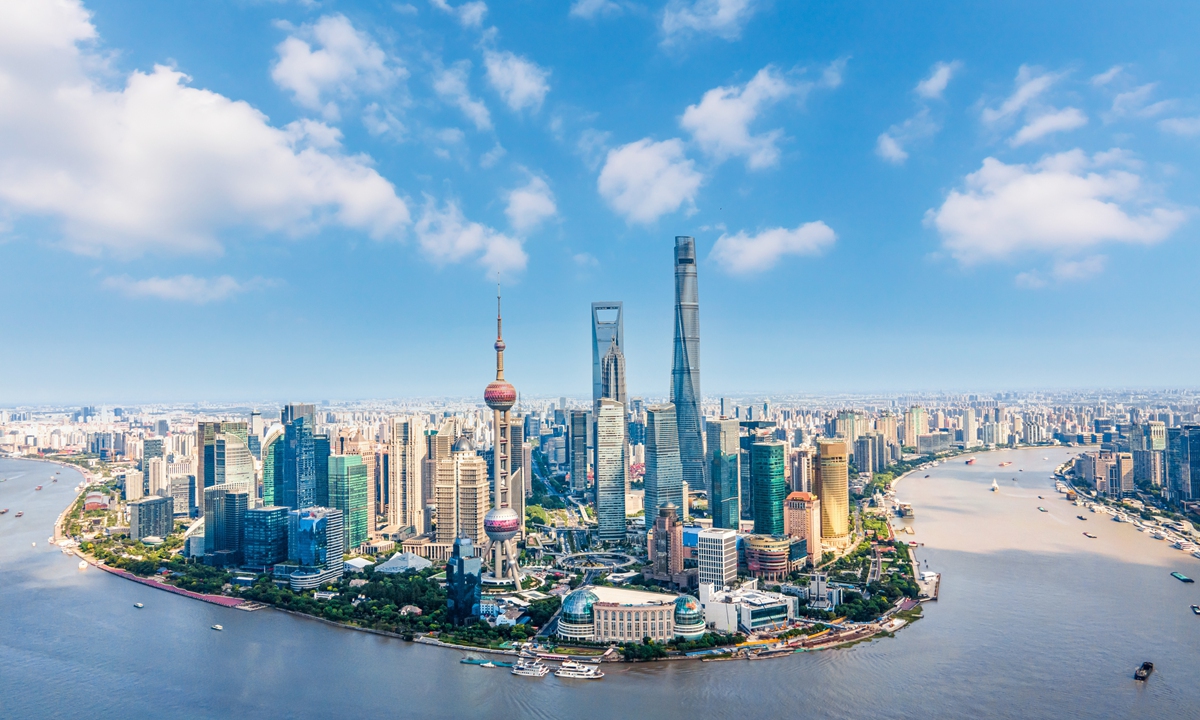
A view of the Lujiazui area in Shanghai Photo: VCG
Chinese President Xi Jinping has called for striving to break new ground in the high-quality development of China's service sector, according to the Xinhua News Agency on Wednesday.
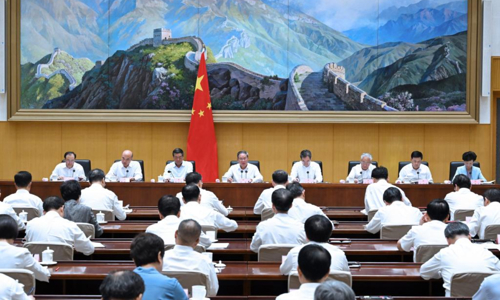
Xi, also general secretary of the Communist Party of China (CPC) Central Committee and chairman of the Central Military Commission, made the remarks in an instruction conveyed at a national conference on the service sector held in Beijing from Tuesday to Wednesday.
China's service sector has steadily expanded in scale and continuously improved in quality and efficiency since the 18th National Congress of the CPC, playing an important role in supporting industrial upgrading, meeting people's livelihood needs and driving job growth, according to Xi.
Underscoring demand-driven development, reform breakthroughs, technology empowerment as well as opening up and cooperation, Xi called for carrying out capacity-expanding and quality-upgrading initiatives in the service sector.
Efforts must be made to advance producer services toward greater specialization and the higher end of the value chain, foster high-quality, diverse and accessible consumer services, and build more "China Services" brands, he said.
Urgent priority
The call by the top Chinese leader came as a series of government meetings have stressed the importance of expanding and upgrading the country's service sector since earlier this year.
In this year's Government Work Report, delivered at the fourth session of the 14th National People's Congress in March, it is stipulated that "We will enhance the capacity and quality of the service sector" and "promote the development of producer services such as financial services, information technology, modern logistics, intellectual property services, and inspection and testing." The government said it will also "work to boost the quality, diversity, and accessibility of consumer services."
According to Xinhua, it is the first time that the Chinese government mentioned enhancing the capacity and quality of the service sector. It is also the first time that cultivating the "China Services" brand is included in the Government Work Report.
In the outline of the 15th Five-Year Plan, it is also noted that the country will comprehensively improve the efficiency and competitiveness of the service sector.
Analysts noted that the push to further improve the high-quality development of the country's fast-growing services sector in spring time aligns with overall national policies and strategies. Given the current state of China's economic development, and the expanding service sector, the push in capacity and quality enhancing has become an urgent priority and will inject new momentum into China's economic growth, create new opportunities for the global companies, and bring tangible benefits to foreign visitors to China.
Luo Zhiheng, chief economist and head of the research institute at Yuekai Securities, told the Global Times on Wednesday that the importance of service sector is becoming increasingly evident.
Developing the service sector is essential for meeting the evolving consumption demands of residents and boosting the household consumption rate. It serves as a key support for advancing industrial upgrading and further enhancing the competitiveness of the manufacturing sector. It is also crucial for stabilizing employment and optimizing the job market structure, while expanding international trade and economic cooperation and strengthening economic resilience, Luo said.
"As the first year of the 15th Five-Year Plan period (2026-30) unfolds, improving people's livelihoods has become a key policy priority, with boosting consumption forming a central part of that effort," Li Yong, an executive council member of the China Society for WTO Studies, told the Global Times on Wednesday. He noted that compared with goods consumption, services consumption deserves greater attention and offers more room for a breakthrough.
Li stressed the service sector should not be viewed simply as a tool to boost domestic demand, but as a broader driver of national development. The expert said consumer services are closely tied not only to consumption, but also to improving living standards.
On producer services, which are an indispensable part of a modern industrial system, Li noted that services such as design, technical support, consulting, and digital solutions are not peripheral to manufacturing, but a key part of a stronger industrial ecosystem that underpins industrial independence, security, and competitiveness.
"Without them, the foundation for industrial upgrading would remain incomplete," Li said.
Experts pointed out that in recent years, the service sector has developed steadily, presenting broad opportunities for both domestic and foreign companies.
In 2025, China's service sector delivered an impressive performance. Its value added exceeded 80 trillion yuan for the first time, accounting for 57.7 percent of GDP, according to Xinhua. The sector's contribution to national economic growth also reached 61.4 percent, up 3.7 percentage points from 2024, maintaining a dominant position in the national economy for 11 consecutive years.
Also in 2025, service consumption accounted for 46.1 percent of per capita consumption expenditure of urban and rural residents, according to Xinhua. The National Development and Reform Commission, the country's top economic planning agency, predicted that during the 15th Five-Year Plan period, the scale of the service sector will exceed 100 trillion yuan.
A manager with an artificial intelligence company Beijing Zhongguancun Kejin Technology Co told the Global Times on Wednesday that the call to further expand and enhance the quality of the service sector greatly lifted the confidence of tech companies working to empower the service sector.
The policy signal is very clear in tapping technology to empower services, and we expect relevant demand in smart producer services and consumer services to be unleashed at a faster pace next, the manager said.
As China continues to expand and improve the quality of the service sector, analysts said there will be more opportunities for foreign companies investing in China and better services for foreign tourists.
"The concept of 'Service in China' is increasingly paired with 'Made in China' to signify a strategic shift toward high-value integration. Deeper opening-up of the service sector will unlock the potential of the modern service industry, which is the largest source of employment and growth," Denis Depoux, global managing director of German management consultancy Roland Berger, told the Global Times on Wednesday.
Last year's Business Confidence Survey that was jointly published by Roland Berger and the European Union Chamber of Commerce in China found that 73 percent of companies will reinvest profit in China amid increasing localization trend. With further opening-up in the service sector, it will attract more foreign investment and continued localization against the backdrop of global economic and trade rule restructuring, Depoux noted.
Serving long-term needs
The push toward high-quality development of the service sector aligns closely with the country's long-term needs.
Provisions related to long-term care insurance and the silver economy in the Government Work Report and the 15th Five-Year Plan can all be understood within the framework of service consumption, Li said. They show that efforts to boost consumption are no longer centered solely on traditional goods spending, but increasingly on more targeted institutional support and service supply to meet emerging social needs including the country's ageing demographics, he said.
Luo pointed out that further promoting the high-quality and efficient development of the service sector could be pursued through three dimensions of policy optimization.
These pathways include expanding service consumption demand through multiple channels, such as raising household income and expectations, optimizing holiday and leave systems to free up time and space for service consumption, and accelerating urbanization to strengthen the foundation of consumption scenarios, Luo said. Other measures involve improving the institutional environment, which includes strengthening intellectual property protection and advancing the construction of a service sector standard system, as well as optimizing fiscal and tax systems.
RELATED ARTICLES