IN-DEPTH / IN-DEPTH
From cure to care: China's first AI hospital shows how artificial intelligence could connect diagnosis, treatment and long-term health management
By Published: Apr 09, 2026 11:56 PM

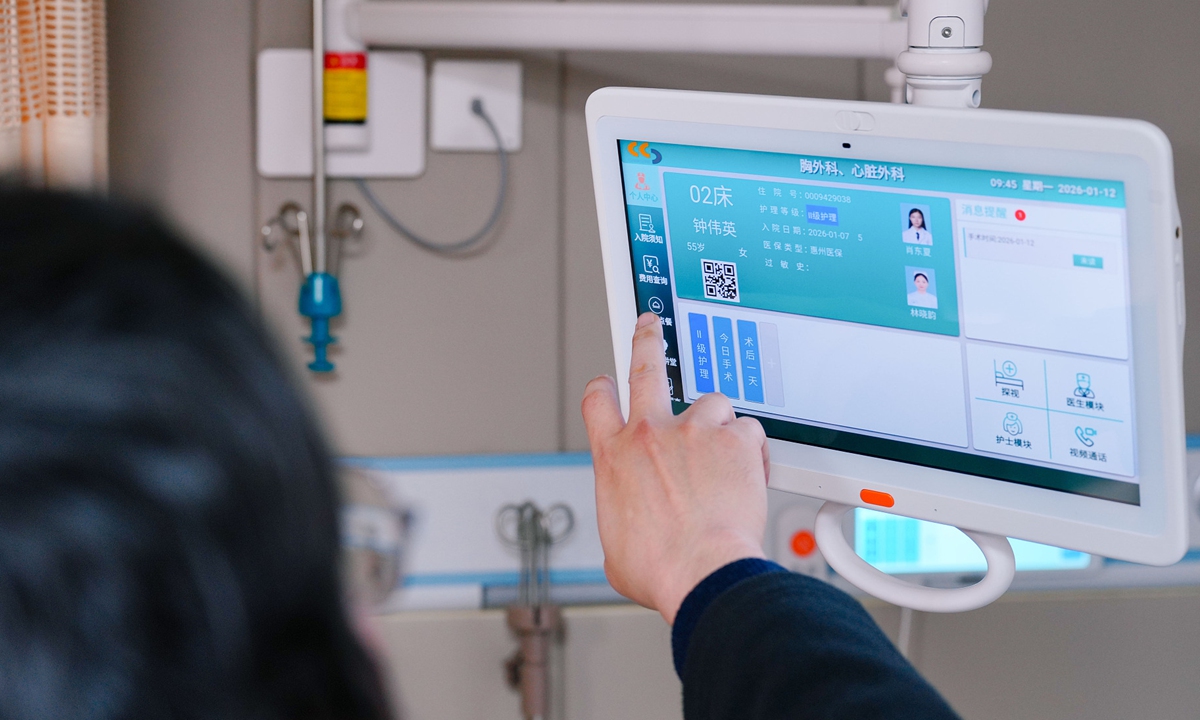
A patient uses a smart bedside terminal at a hospital in Huizhou, South China's Guangdong Province, where AI supports diagnosis, follow-up care and other medical services. Photo: VCG
Imagine seeing a doctor before you even step into a hospital.
A patient uploads medical records and symptoms on a phone, and AI provides initial triage and risk alerts. By the time the patient arrives, the doctor already has a structured case summary. After treatment, the system continues with follow-up reminders and medication alerts, turning fragmented care into a more connected process.
For many, such a scenario may still sound futuristic. In China, however, it is moving more quickly from vision to reality.
The country recently took a step in that direction with the launch of its first AI hospital in Boao, South China's Hainan Province, on March 26, the Xinhua News Agency reported. On the same day, a consensus on AI hospitals was released during the 2026 Zhongguancun Forum (ZGC Forum) in Beijing, offering the first internationally recognized definition of an "AI hospital," according to news outlet china.com.cn.
According to the consensus, an AI hospital is a new type of smart healthcare model in which AI is embedded into the system itself, linking offline medical expertise with the broader reach of online services to deliver more proactive and continuous care.
Meanwhile, concepts such as AI hospitals, AI doctor assistants, intelligent follow-up systems and AI-assisted diagnosis have been gaining ground in hospitals and healthcare settings across China.
This latest wave of change is not unfolding in isolation. In November 2025, China's National Health Commission and other relevant authorities issued a guideline on promoting and regulating the application of AI in healthcare, calling for AI to support continuous services across prevention, diagnosis, rehabilitation and health management.
In other words, China's push to bring AI into healthcare is no longer limited to scattered experiments by individual hospitals or companies. Under policy guidance, it is moving toward a more systematic and better regulated phase.
As AI enters hospitals, works alongside doctors and reaches patients more directly, what exactly will it change? As the technology advances rapidly, how should standards, regulation, accountability and ethical boundaries keep pace?
Super AI hospital
"Instead of patients searching everywhere for medicine, the right medicine can now 'find' the right patients," Zhang Bangqun, general manager of the Super AI Hospital in Boao, said in describing the significance of the new hospital.
The hospital, formally named Hainan Boao Super Digital Intelligence Hospital Management Co, is located in Boao Lecheng International Medical Tourism Pilot Zone. According to news outlet China City Network, the project was jointly funded by several domestic companies, with core technical support provided by related firms.
In Zhang's view, the most immediate change brought by the hospital is not simply the insertion of AI into a hospital setting, but an attempt to reorganize the way patients gain access to medical resources.
"In the past, patients who wanted access to the world's latest specially licensed drugs and medical devices might have had to visit multiple hospitals and wait for months. Now, AI helps find them, match them and track them," he told the Global Times.
According to materials provided by the hospital to the Global Times, the Super AI Hospital has built an AI hospital intelligence network system and a MaaS (Mobility-as-a-Service) results promotion platform, in an effort to connect the entire chain from technology research and development to clinical application.
Relying on core modules embedded in the platform, including "thousand-disease agents," "thousand-hospital agents" and an AI assistant for specially licensed drugs and medical devices, the system can track the latest global drug and device information around the clock, identify patients with relevant indications through intelligent assessment, and match them with more suitable treatment plans.
At the same time, a related app connects providers and users of medical AI scenarios, seeking to move more high-quality technologies from the laboratory into real-world medical settings and reduce the extra burden patients face due to information gaps and cross-regional treatment-seeking.
AI hospitals are also taking root in fertile ground. In service terms, the hospital has adopted a three-step model: local consultation, treatment in Lecheng and home follow-up. The idea is to reduce unnecessary travel while improving the flow of medical resources, according to Zhang.
Approved by the State Council in 2013, the Lecheng pilot zone is the country's only special medical zone on the southern tropical island of Hainan, according to Xinhua. Today, more than 30 medical institutions have established operations in the pilot zone, including top-tier hospitals from Shanghai and East China's Shandong Province, as well as other renowned healthcare providers from China and abroad, the Global Times learned from the pilot zone.
Drawing upon its special policy advantages, the pilot zone has become a key gateway for the entry of global medicines and medical devices not yet approved elsewhere in China, according to the pilot zone. Xinhua reported in January that more than 200,000 patients had benefited from Lecheng, which had introduced more than 500 innovative medicines and medical devices approved overseas but not yet available domestically.
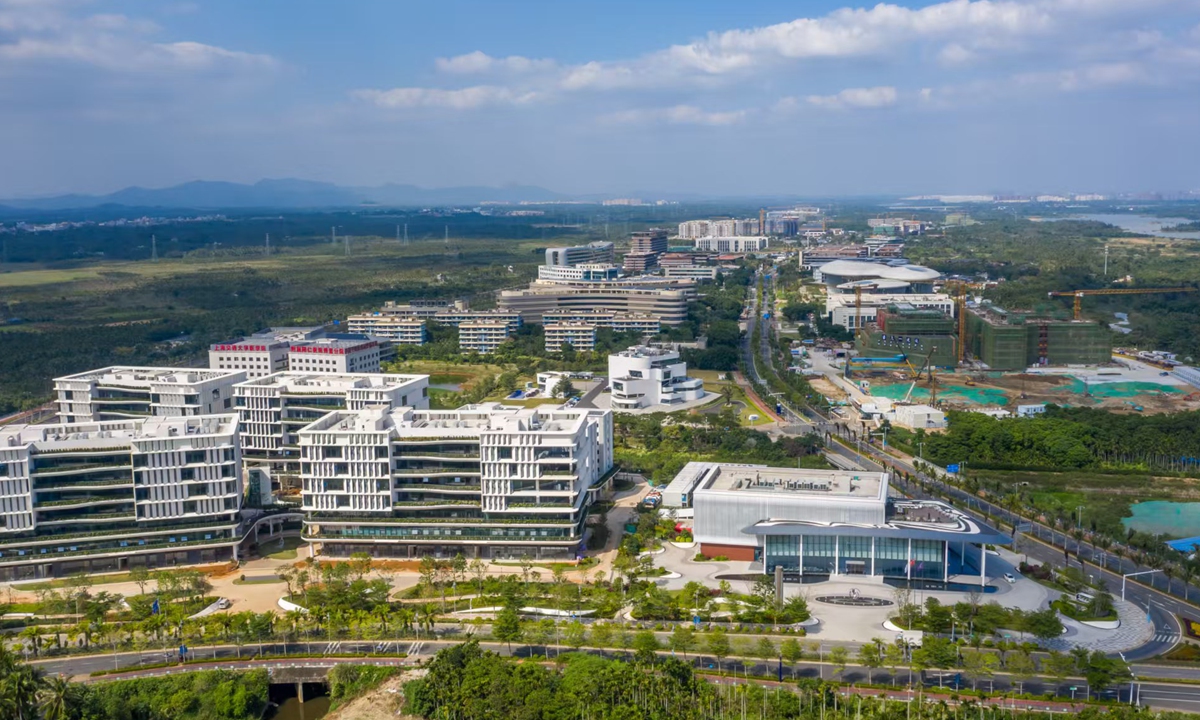
The Boao Lecheng International Medical Tourism Pilot Zone in South China's Hainan Province Photo: VCG
Defining new trend
In recent years, various forms of "AI hospitals" have been emerging one after another. But what kind of AI hospital can truly be recognized across the field as an ideal model?
The International Consensus on AI Hospitals was released at the 2026 World Digital Health Forum during the ZGC Forum in Beijing, offering what organizers described as the first internationally recognized definition of an "AI hospital," the Global Times learned from the organizer of the forum.
The event was co-hosted by the Chinese Academy of Engineering and Tsinghua University, and attended by more than 700 representatives, including 10 academicians, 40 hospital presidents and experts from countries such as the US, the UK, Italy and Indonesia, china.com.cn reported.
According to the consensus, the core of an AI hospital lies in the deep integration of artificial intelligence into every stage of medical service, combining the professional strengths of physical hospitals with the broad reach of online platforms, so that patients can receive far more continuous care than under traditional models.
Yu Rongshan, deputy director of the National Institute for Data Science in Health and Medicine, School of Medicine of Xiamen university and one of the contributors to the consensus, told the Global Times that, compared with AI-enhanced physical hospitals, many hospitals have already applied AI in areas such as image recognition, auxiliary diagnosis and surgical planning, significantly improving accuracy and efficiency. However, their service structure still centers on the physical hospital campus, with AI functioning mainly as a tool embedded into existing processes.
The consensus notes that traditional healthcare starts when patients actively seek medical help - that is, when they feel unwell and decide to go to the hospital. AI hospitals, by contrast, are meant to fundamentally change this logic. Relying on smart wearables and home health terminals, such systems can carry out around-the-clock health monitoring, detect abnormal signals before symptoms fully appear.
In other words, patients would no longer go to the hospital only after falling ill, but could instead gain access to continuous, proactive and intelligent health services at any time.
At the same time, the relationship between online and offline services in an AI hospital is not just one of simple information exchange, but part of an interdependent and evolving ecosystem, according to the consensus.
For patients, the most direct change would be that whether they seek treatment at a hospital, through a mobile phone, or at a community health center, they can access the same complete health record and receive the same connected service.
They would no longer need to carry a stack of paper reports from one institution to another or provide all of their medical history each time they visit a new provider.

The Boao Lecheng International Medical Tourism Pilot Zone in South China's Hainan Province Photo: VCG
More equitable, inclusive healthcare system
From AI-assisted diagnosis to smart health platforms, China is stepping up efforts to integrate AI into its evolving digital healthcare ecosystem, with the aim of improving efficiency and expanding access to quality medical services.
According to Xinhua, the outline of the country's 15th Five-Year Plan (2026-30), adopted on March 12 at the national legislative session, stresses the need to secure a leading strategic position in AI industrial applications from 2026 to 2030.
This year's government work report also pledged to "advance and expand the AI Plus Initiative" and "encourage large-scale commercial application of AI in key sectors and fields," while identifying biomedicine as one of the country's emerging pillar industries.
AI has already made solid progress in China's healthcare sector. As of May 1, 2025, the country had released around 300 medical large models, while county-level remote medical imaging services had handled more than 68 million cases, making AI an increasingly important tool for primary-level healthcare, Xinhua reported.
Yet the rapid expansion of medical AI has also brought new questions into focus.
The AI consensus also notes that AI hospitals represent an ideal healthcare model for the AI era, rather than something that has already been fully achieved in reality. In a report published by the Guangming Daily, some experts warned that excessively detailed AI-generated medical reports may burden patients with too much information and in some cases heighten anxiety.
Though upfront investment required for AI hospitals is undoubtedly substantial, Wang Xiaobin, an expert in healthcare industry, believes that once these hospitals are fully up and running, they could help reduce patients' waiting time as well as travel time and costs, not to mention hospitals' labor, management and other operating costs to a certain extent, the China Youth Daily reported.
"The fundamental goal of AI hospitals is to harness digital technology to build a fairer and more inclusive healthcare system for all, so that quality medical resources can benefit everyone," Wang said.
The consensus also states that the fundamental goal of AI hospitals is to harness digital technology to build a more equitable and inclusive healthcare system, so that quality medical resources can truly benefit everyone.
"The invention of vaccines meant infectious diseases were no longer the fate of the poor. The spread of antibiotics enabled ordinary families to survive deadly infections. And the establishment of public health systems turned clean drinking water and basic medical care from privileges enjoyed by a few into everyday necessities for the many, Yu said, "throughout history, every major technological revolution has profoundly expanded access to health rights."
RELATED ARTICLES