Ceasefire deal in jeopardy on Day 1 as Iran closes Hormuz following Israel strikes against Lebanon
China says Lebanon's sovereignty and security should not be violated
By and Li Yu Published: Apr 10, 2026 12:22 AM

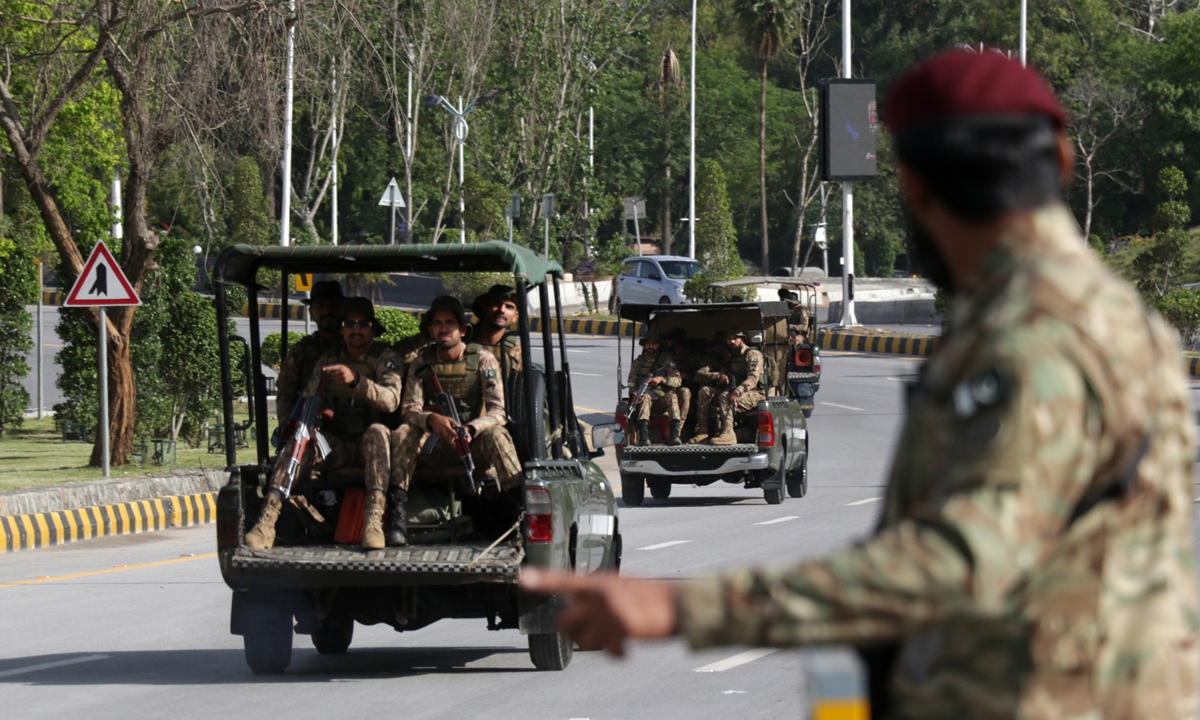
Pakistani security forces stand guard on April 9, 2026, in Islamabad as authorities ramp up security measures ahead of the upcoming US-Iran negotiations. Photo: VCG
The fragile calm that followed the US-Iran ceasefire began to unravel almost as soon as it took hold, raising fresh doubts about the durability of the agreement. On Wednesday local time, Israel launched what appeared to be its most extensive airstrike campaign against Lebanon, with reports indicating hundreds were killed or injured.
Tehran swiftly condemned the strikes as a breach of the ceasefire, announcing the closure of the Strait of Hormuz and warning of possible military retaliation. In a sign of the uncertainty surrounding diplomatic efforts, Iran's ambassador to Pakistan briefly posted, then deleted, a message on X about Iranian delegation's arrival in Islamabad, an episode that underscored how tenuous the path to de-escalation remains.
"Lebanon's sovereignty and security should not be violated. Civilians and their property must be protected. We call on relevant parties to stay calm and exercise self-restraint and deescalate the situation in the region," Chinese Foreign Ministry spokesperson Mao Ning said on Thursday in response to media inquiry over the Israeli strike against Lebanon.
In response to another question on whether China believes Lebanon should be included in the ceasefire agreement that has already been reached, Mao said China hopes relevant parties will take the temporary ceasefire arrangement as an opportunity to resolve disputes through political and diplomatic means and put an end to the conflict.
Strike and spats
Hours after US announcement of the two-week ceasefire deal with Iran on Wednesday, Israeli forces launched airstrikes in Lebanon, which killed 254 and injured 1,165, according to Al Jazeera, citing data from Lebanon's Civil Defence. The media outlet highlighted "100 air strikes in 10 minutes across Lebanon" in its headline.
The Israeli military said the attack was its largest coordinated assault on Lebanon since it started a new military operation in the country on March 2, targeting "more than 100 Hezbollah command centers and military sites," Al Jazeera reported.
Lebanese Prime Minister Nawaf Salam announced that Thursday, April 9, will be observed as a national day of mourning for the victims and injured. He added that he remains in contact with Arab leaders and international officials to step up Lebanon's political and diplomatic efforts aimed at halting the Israeli attacks, the Xinhua News Agency reported.
Iranian President Masoud Pezeshkian wrote in an X post on Thursday that renewed aggression by Israel against Lebanon blatantly violates the initial ceasefire. "Such actions signal deception and non-compliance, rendering negotiations meaningless. Our hands remain on the trigger. Iran will never forsake its Lebanese brothers and sisters."
The Iranian Revolutionary Guard Corps (IRGC) accused the US and Israel of violating the ceasefire deal, and warned that it will respond if Israel does not stop the assault, Al Jazeera reported, citing Iran's state-owned TV channel.
In an X post Wednesday, Iran's Foreign Minister Abbas Araghchi said the terms of the ceasefire were "clear and explicit: the US must choose - ceasefire or continued war via Israel. It cannot have both."
"The world sees the massacres in Lebanon. The ball is in the US court, and the world is watching whether it will act on its commitments," Araghchi said.
In addition, regional countries, including Qatar, Syria, Egypt and Turkey, have publicly condemned Israel's strikes against Lebanon, Al Jazeera reported.
French President Emmanuel Macron on Wednesday also condemned Israel's latest strikes on Lebanon, stressing that "Lebanon must be fully covered by" the Middle East ceasefire. In a post on X, Spanish Prime Minister Pedro Sanchez said Netanyahu's "contempt for life and international law is intolerable" in light of the attacks.
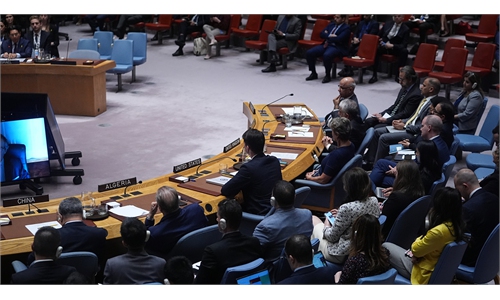
UN Secretary-General Antonio Guterres also condemned Israel's strikes across Lebanon, warning of a rising civilian toll and risks to regional ceasefire efforts, Anadolu Agency reported.
In a joint statement issued in the early hours of Thursday, foreign ministers of Australia, UK, Brazil, Colombia, Indonesia, Jordan and Sierra Leone called for an "urgent end" to hostilities in Lebanon, per Xinhua.
Zhu Yongbiao, a Middle East affairs expert at Lanzhou University, told the Global Times on Thursday that Israel's strategic objective is to completely overthrow Iran's current regime, and reshape its strategic deterrence across the Middle East. However, Iran's capacity for resistance have thwarted these goals.
As the US seeks to extricate itself from the Middle East and avoid being dragged into a quagmire of war, Israel is attempting to obstruct and disrupt the ceasefire negotiation process, Zhu added. "These actions also serve to 'legitimize' Israel's control over certain Lebanese territories it previously seized."
The Soufan Center, a New York-based think tank, warned on Thursday that Israeli strikes on Lebanon on Wednesday risked the deal falling apart, per AP. It wrote in an analysis that "Israel's strikes can be understood both as an effort to drive a wedge between Iran and its proxies and as a response to being allegedly sidelined in the original ceasefire discussions."
US Vice President JD Vance on Wednesday said, "ceasefires are always messy." He claimed that the US never promised Lebanon would be included in the ceasefire agreement, chalking that up to a "reasonable misunderstanding" between the parties, CBS reported.
Vance told media that Israel had agreed to "check themselves a little bit in Lebanon" to support negotiations, per Bloomberg.
Stalling tactic?
Despite the White House on Wednesday confirming that US Vice President JD Vance will lead the US negotiating team in talks with Iran, US President Donald Trump issued a statement on Truth Social on Thursday insisting that his surge of warships and troops will remain around Iran "until such time as the real agreement reached is fully complied with."
Citing US military officials, The New York Times on Sunday reported that several hundred US Special Operations forces have arrived in the Middle East, joining thousands of Marines and Army paratroopers in a deployment "meant to give President Trump additional options to expand the monthlong war with Iran."
US officials also disclosed that the Nimitz-class aircraft carrier USS George H.W. Bush and its accompanying warships are deploying to the Middle East, joining the USS Abraham Lincoln and the USS Gerald R. Ford carrier strike groups in the region, the Wall Street Journal said last week.
For the Strait of Hormuz, the fate is still unclear. Although the previous ceasefire announcement from the US suggested the chokepoint is going to be reopened fully, when Israel attacked Lebanon after the truce deal, the IRGC halted all the passages through the Strait of Hormuz, Al Jazeera reported.
According to ship-tracking data compiled by Bloomberg, just three ships were observed leaving the region on Wednesday. More than 800 freighters are stuck inside the Persian Gulf, mostly waiting to leave.
The White House press secretary Karoline Leavitt said Wednesday that ceasefire requires a "free" reopening of the Strait of Hormuz, which includes no tolls imposed by Iran, according to PBS.
Another key dispute is that Iran's 10-point truce plan include the acceptance of Iran's nuclear enrichment rights, while the US demand Tehran to surrender its stockpile of enriched uranium.
Before the talk, the US side has also threatened Iran on the nuclear issue. US defense chief Pete Hegseth said on Wednesday that the dismantling of Iran's nuclear program has "always been non-negotiable."
"Both sides had previously agreed to conduct talks in Islamabad, indicating their continued desire to reach a deal. However, the US and Iran hold fundamentally different views on the nature and content of any peace agreement," Ding Long, a professor at the Middle East Studies Institute of Shanghai International Studies University, told the Global Times on Thursday.
Iran seeks a once-and-for-all resolution to all its issues with the US, including the thorniest nuclear issue and the sanctions. However, the US appears to be avoiding the heavy issues and focusing only on the lighter ones, Ding said.
According to The New York Times, 15-point proposal offered by US mediators, only a cease-fire was on offer, and Iranian officials want to ensure a formalized end to hostilities that is more permanent.
"With the US continuously reinforcing its military forces in the region, it is becoming hard - not just for Iran, but for the whole world - not to doubt America's true sincerity. Many wonder if these negotiations are a stalling tactic," said Ding.
RELATED ARTICLES