Spanish PM’s China visit highlights steady bilateral ties; Sanchez spotted visiting multiple tourism sites
Frequency of his visits noted by Spanish media
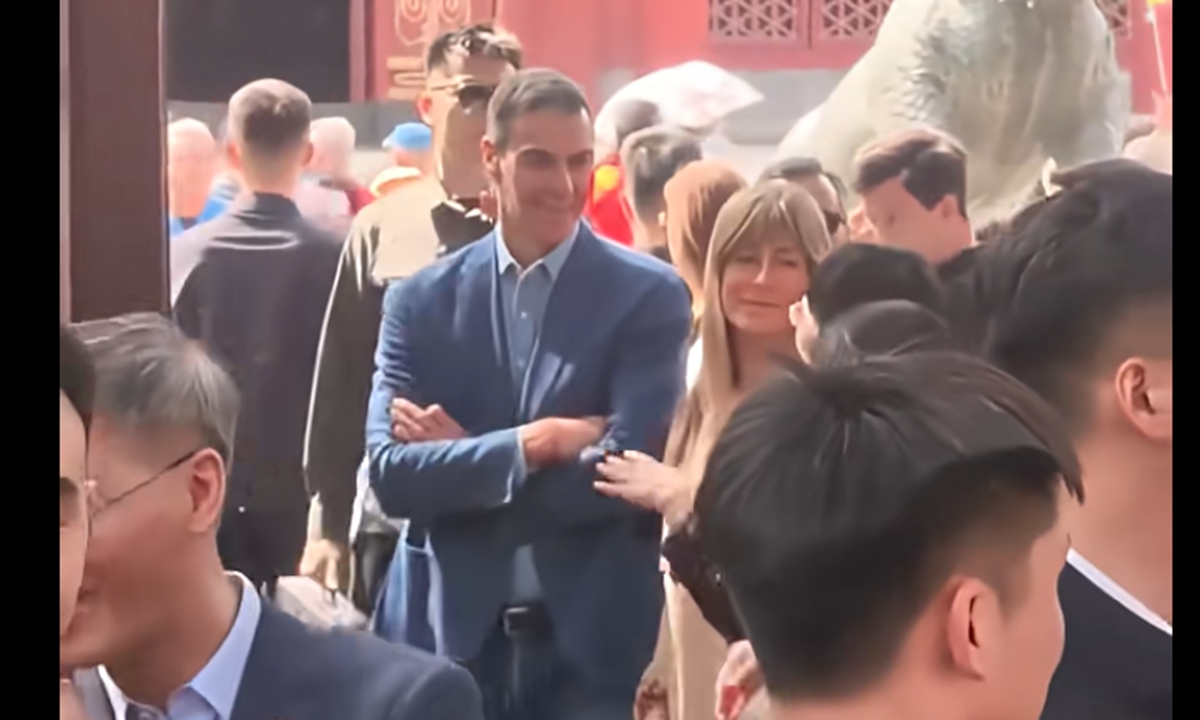
Tourists spot Spanish Prime Minister Pedro Sanchez at the Summer Palace in Beijing on April 12, 2026. Photo: Screenshot from chinanews.com
On a balmy spring weekend, Spanish Prime Minister Pedro Sanchez, currently on his fourth visit to China within four years, was spotted by tourists visiting Beijing's Drum Tower, the Summer Palace and Shichahai lake. Experts said the visit underscores the continuity and stability of high-level exchanges between China and Spain, and expressed optimism that Sanchez's trip is expected to usher in a new chapter of bilateral relations.
In a video released by Beijing Radio and Television Station (BRTV) filmed by tourists, Sanchez appeared smiling among the crowds at the Summer Palace on Sunday, sporting a blue jacket and jeans. The report also said that he also visited the Drum Tower the previous day.
Earlier on Saturday, Sanchez and his wife arrived in Beijing, kicking off a five-day official visit to China, according to a video released by China News Service on its official WeChat channel.
When asked about the arrangement and China's expectations for the visit, Chinese Foreign Ministry spokesperson Mao Ning said during a press conference on April 8 that the visit will provide another opportunity for China and Spain working together to deepen strategic mutual trust, have closer exchanges and cooperation, and step up coordination on multilateral affairs, so as to bring the China-Spain relations to a new height and make a greater contribution to world peace and stability.
Spanish daily El Mundo compared Sanchez's visit with the frequency of trips to China made by other European leaders, saying, "No other European leader has visited this Asian giant as many times during the same period," according to a report on Sunday.
Cui Hongjian, a professor at the Academy of Regional and Global Governance at Beijing Foreign Studies University, told the Global Times that a striking characteristic of China-Spain relations in recent years has been their steadiness, saying that Sanchez's repeated visits to China serve as a vivid illustration of this trend and highlights the pivotal steering function of high-level interactions in bilateral ties.
"Diplomatic relations between the two countries are not improvised. They are the result of many years of work," Jordi Bacaria, an expert in international relations and professor emeritus at the Autonomous University of Barcelona, told the Xinhua News Agency in an interview.
Sanchez's current visit to China also captures global media attention. Reuters reported that Sanchez is making his fourth trip "as Madrid seeks to build on its commercial ties with the world's second-largest economy."
Sanchez's visit eyes boosting Spanish exports and ensuring that Chinese investment in Spain result in both technology transfer and integration into local value chains that go beyond the simple assembly of parts, according to Spanish newspaper La Razon.
According to data from the General Administration of Customs of China, the total import and export volume of commodity trade between the two countries exceeded $55 billion in 2025, a year-on-year increase of 9.8 percent.
Spanish news outlet La Vanguardia reported that Spain has also identified the promotion of deeper technological and innovation cooperation as a top priority for this trip. Spanish newspaper El Periodico reported that prominent among the Spanish business delegation are representatives from the technology, energy, telecommunications and automotive sectors.
According to Spanish media outlets, Sanchez will formally kick off his official schedule on Monday with visits to Tsinghua University, the Chinese Academy of Sciences, and the headquarters of Xiaomi. During his stay in China, he will also engage with Chinese investors to advance their business presence in Spain, and hold talks with representatives from a range of innovative enterprises as well as officials of the EU-China Chamber of Commerce.
Zhao Junjie, a senior research fellow at the Institute of European Studies at the Chinese Academy of Social Sciences, told the Global Times on Sunday said that the special emphasis on examining China's technological innovation during the itinerary reflects Sanchez's pragmatic approach, as well as his aspiration for China-Spain relations to reap even more new fruits. China and Spain enjoy vast prospects in digital economy sectors such as artificial intelligence, big data and 5G technology, he added.
The green economy likewise represents a sphere in which both sides can engage in in-depth exchanges in the future, according to Zhao.
El Mundo has linked the Spanish prime minister's current visit to China with the trade protectionism pursued by the US and the strained state of EU-US relations, saying that the Spanish government maintains its roadmap, pointing out that in such an uncertain international context, with wars challenging the international order, it is necessary not to focus solely on the US; one must keep an eye there, but also on other pillars such as China, India, Brazil
In this regard, it is crucial to consider how Spain can use this strategy to influence the EU's stance toward China, La Razon reported, citing Mario Esteban, a principal researcher at the Elcano Royal Institute and professor at the Autonomous University of Madrid.
Several European leaders have visited China since the beginning of 2026, including Irish Taoiseach Micheal Martin, Finnish Prime Minister Petteri Orpo, British Prime Minister Keir Starmer and German Chancellor Friedrich Merz.
As US policy toward Europe undergoes further change, the greatest pressure facing Europe now comes increasingly from the US. In response, many European countries have been adjusting their policies, and more are expected to do the same. The direction of this shift is essentially one of rebalancing: reasserting the importance of economic ties with China and seeking more dialogue with Beijing as a way to cope with pressure from Washington. From Europe's perspective, this is the only way to maintain a more balanced and advantageous diplomatic position, Cui said.
RELATED ARTICLES