China ensures 15-minute medical access, to build tiered healthcare by 2030: official
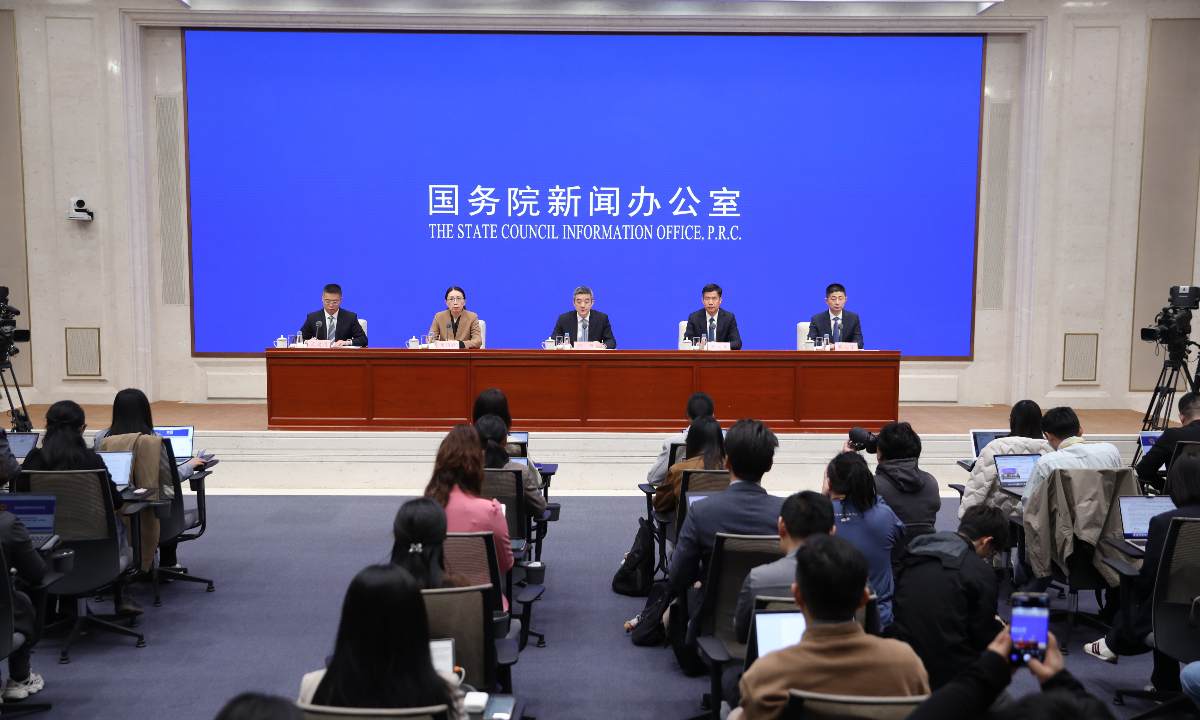
The State Council Information Office holds a policy briefing on the measures rolled out by the General Office of China's State Council to speed up the development of a tiered diagnosis and treatment system on April 13, 2026. Photo: IC
China has ensured over 90 percent of Chinese residents have access to medical services within 15 minutes and aims to establish a tiered diagnosis and treatment coordination mechanism by 2030, China's healthcare authority announced on Monday at a policy briefing on measures recently rolled out to accelerate the development of a tiered diagnosis and treatment system and make healthcare more accessible and convenient for the public.
China's State Council recently released a set of measures that focus on encouraging people to seek initial diagnosis at grassroots-level medical institutions, especially for common and chronic diseases, while directing top-tier hospitals to focus on treating severe, critical and complex cases, Xinhua reported.
At present, localities across China are promoting the development of tightly integrated medical alliances. According to Li Dachuan, deputy director of the Department of Medical Administration at China's National Health Commission, tightly integrated medical alliances refer to arrangements in which leading hospitals partner with primary-level healthcare providers to share resources and expertise and work in coordination, improving the public's access to quality healthcare services at the primary level.
To address the bottlenecks in promoting tightly integrated medical alliances, such as weak coordination and poor connectivity in some regions, the measures rolled out have put forward a series of substantive steps. They clarify the functional roles and structural layout of medical and health institutions at all levels within the alliances, emphasize requirements for improving quality and expanding coverage, and further specify the concrete scope of medical resource sharing within tightly integrated medical alliances, Li said at the policy briefing.
In terms of promoting the quality and expansion of tightly integrated medical alliances, China is promoting pilot programs of tightly integrated urban medical groups across 81 cities nationwide. While existing urban medical groups will further enhance their quality and efficiency based on current progress, the development of tightly integrated county-level medical communities is expected to achieve full coverage across counties, with the goal of establishing a coordinated tiered diagnosis and treatment mechanism by 2030, Li said.
Meanwhile, China will boost resource sharing within medical alliances by building centralized diagnostic and drug supply centers, promoting prescription circulation, and strengthening quality oversight led by major hospitals, according to Li.
Zheng Zhe, deputy director of China's National Health Commission, said at the policy briefing that the development of China's tiered diagnosis and treatment system is shifting from laying a solid foundation to a stage focused on improving quality and efficiency.
According to Zheng, China has significantly improved accessibility to healthcare services nationwide. More than 1.1 million medical and health institutions now cover both urban and rural areas, with basic healthcare services reaching 1.4 billion residents. Over 90 percent of the population now have access to medical service facilities within 15 minutes, Zheng said.
In addition, China has strengthened primary-level healthcare services by expanding services, upgrading facilities, and deploying over 10,000 graduates to rural areas through targeted training and staffing programs, Zheng said.
According to Zheng, China's tiered healthcare system is taking shape, with primary-level medical and healthcare institutions handling 5.56 billion visits in 2025 and accounting for 52.6 percent of all consultations. Both the number and proportion of primary-level visits have increased for five consecutive years. The number of two-way referrals nationwide has continued to grow, rising by nearly 50 percent compared with 2020, making referrals between higher- and lower-level institutions more convenient for patients.
During China's 14th Five-Year Plan (2021-25), the country has made notable progress in building its healthcare system. Both the overall scale and service capacity of hospitals, as well as the level of primary healthcare services, have seen significant improvement, Zhu Hongming, Director General, China National Health Development Research Center, told the Global Times during an exclusive interview in January.
Zhu said that while China's health sector continues to make steady progress, it is also facing multiple, very real challenges.
"In response to these issues, relevant departments have already identified the building of a 'high-quality and efficient integrated service system' as a key direction in the preliminary research for the 15th Five-Year Plan (2026-30)," Zhu said.
Going forward, cities or counties will serve as the basic units, with county-level medical communities, tightly integrated urban medical groups, specialty- and disease-specific alliances, and telemedicine collaboration mechanisms used to break down institutional barriers and form a coordinated service network.
Global Times
RELATED ARTICLES