US-led critical mineral ‘small circles’ questioned by analysts for feasibility, commercial viability
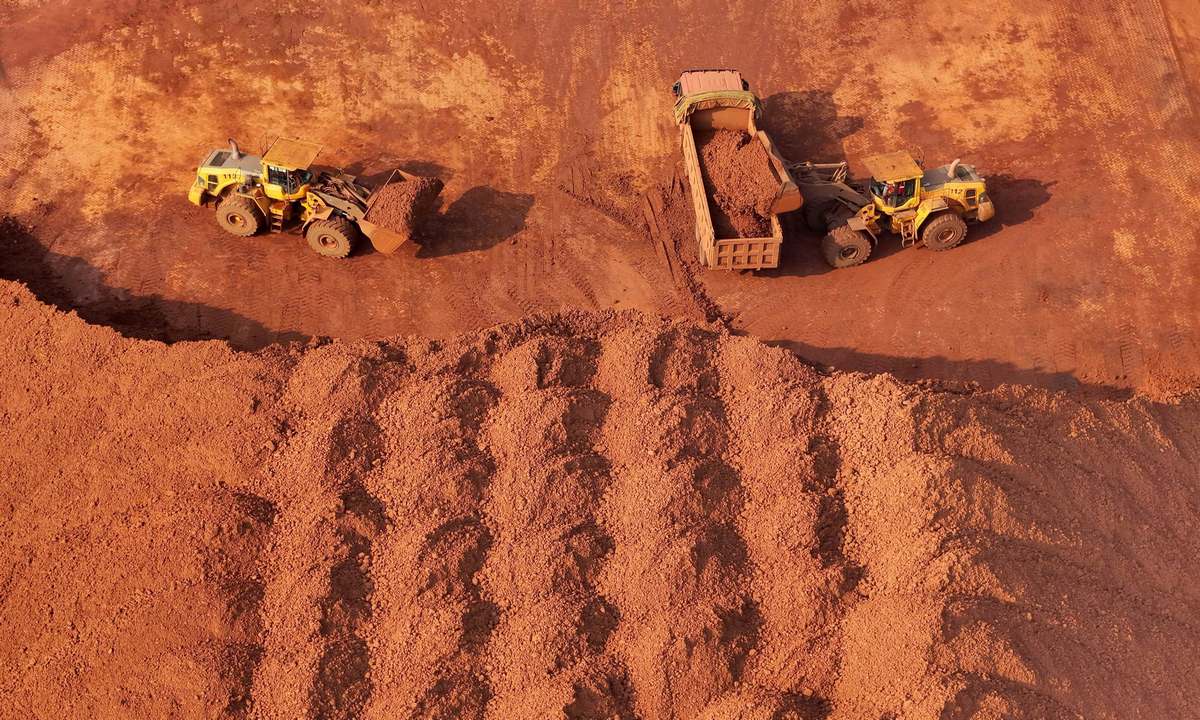
Rare earth resources Photo: VCG
Australia and the US have stepped up funding for critical minerals cooperation, the latest Western effort to reshape supply chains along geopolitical lines. However, Chinese analysts cautioned that replacing China's entrenched role in the global industrial chain is far more complex than scaling up financing or forming exclusive political "small circles."
Australia said on Sunday that it and the US have committed more than A$5 billion ($3.5 billion) to back a range of critical mineral projects, nearly double the amount pledged when the two countries struck a co-operation agreement six months ago, Reuters reported.
According to the report, the funding seeks to support Australian ventures to develop and refine metals vital to industries including defense, advanced manufacturing and the energy transition, a market that has long been dominated by China.
The two countries agreed in October last year to each provide at least $1 billion in investments toward an A$8.5 billion pipeline of priority critical mineral projects across the two countries over the subsequent six months.
At the time, the two sides said that the cooperation would support the reindustrialization of America's high-tech manufacturing base, while helping to "counter China's export dominance and ensure Western supply-chain resilience."
The move reflects a broader US-led push to realign critical minerals supply chains along geopolitical lines, a strategy widely questioned by industry analysts for its feasibility and commercial viability.
Despite a degree of complementarity between the US and Australia - with Australia being rich in resources and the US providing capital and demand - significant challenges remain, including gaps in refining technology, higher production costs and long project lead times, Song Guoyou, deputy director of the Center for American Studies at Fudan University, told the Global Times on Monday.
"The US is not lacking in rare-earth resources, but its current technological capabilities are insufficient to consistently produce high-quality products at competitive costs," Song said. These "small-circle" arrangements prioritize geopolitical objectives over industrial efficiency, making it difficult to achieve their stated goal of reducing reliance on China in the short term, according to Song.
Australia has a vast supply of critical minerals such as rare earths, but China has mastered the technically difficult refining process, the Reuters report noted.
Industry data further underscores this structural gap. China is the leading refiner for 19 of the 20 strategic minerals tracked by the International Energy Agency, with an average market share of about 70 percent, according to the executive summary of its Global Critical Minerals Outlook 2025, a dominance the agency reiterated in a commentary this January.
US policy debates also point to a long-term challenge. A recent article by the Wilson Center, a Washington-based policy think tank, said that the US strategy to rebuild critical minerals supply chains "remains incomplete," noting that most mining projects take a decade or more to come online and that restoring downstream capacity will require sustained policy support across multiple administrations.
Meanwhile, Western economies are pressing ahead with further efforts. The US and EU are nearing a cooperation agreement spanning the full critical minerals value chain from exploration and extraction to processing, refining, recycling and recovery, Bloomberg reported on Friday.
The potential deal would include incentives such as minimum price guarantees, long sought by Western miners, that could favor non-Chinese suppliers, according to the report, which cited an "action plan."
Current global reference prices for many critical minerals are largely shaped by China, reflecting its dominant role both in physical supply and price discovery, according to a Reuters analysis published in February.
Meanwhile, different Western groupings are taking shape. France recently signed a critical minerals cooperation roadmap with Japan, while Japan, France and Canada have explored alternative approaches to US-led initiatives, which analysts said may reflect differing interests and internal divergences among these groupings.
Song cautioned that bloc-based approaches driven by geopolitical considerations could undermine market efficiency. "Such practices risk disrupting the normal functioning of global industrial and supply chains, leading to fragmentation and inefficiency, and ultimately weakening their resilience and stability," he said.
When asked about rare-earth supply issues on Thursday, He Yadong, a spokesperson for China's Ministry of Commerce, said that China is always committed to maintaining the security and stability of global industrial and supply chains.
"China fully takes into account the reasonable demands and concerns of the global civilian sector, including the US, and actively facilitates compliant trade," the spokesperson said, noting that export applications meeting the conditions for legitimate civilian use will be approved in accordance with the law.
In response to a US-led critical minerals trade alliance proposed in February, Foreign Ministry spokesperson Lin Jian said that "an open, inclusive international trade environment beneficial to all serves the common interests of all countries," adding that "all parties have the responsibility to play a constructive role in keeping the global industrial and supply chains on critical minerals stable and secure."
"China opposes any country setting up exclusive blocs to disrupt the international economic and trade order," Lin said.
RELATED ARTICLES