China-Russia veto helps curb Hormuz crisis, ceasefire key to solution: Chinese expert
By and Zhang Han Published: Apr 17, 2026 11:34 PM

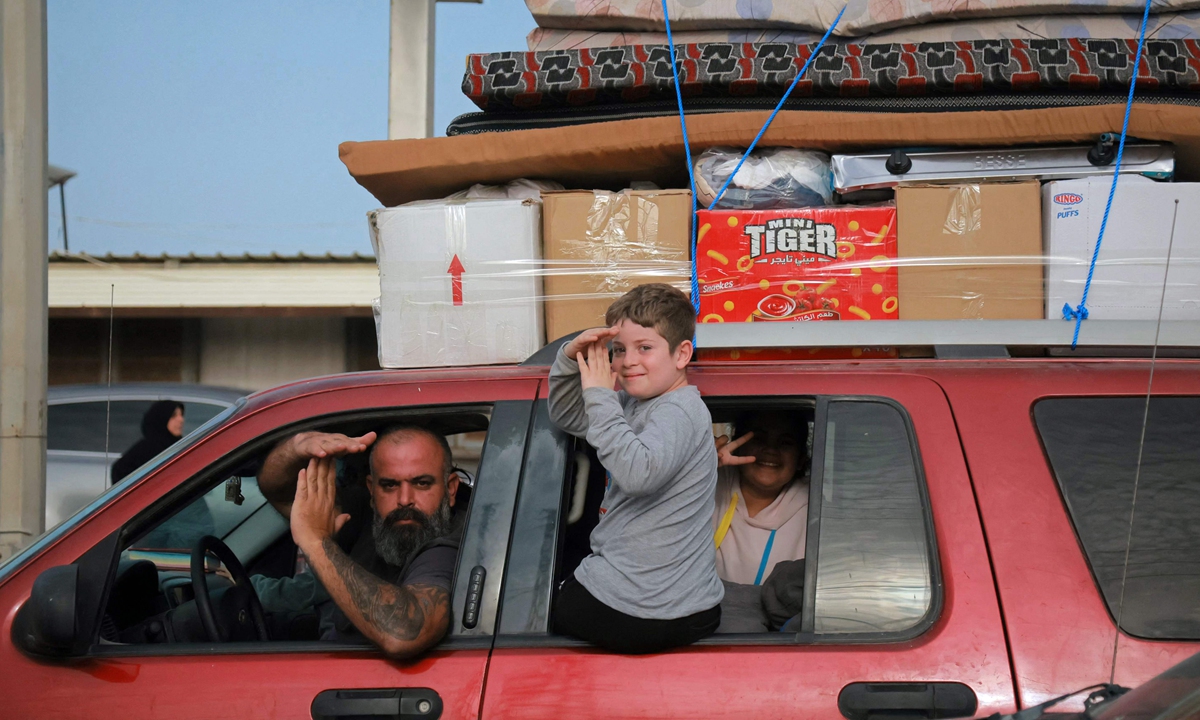
Displaced residents travel through the Qasmieh area as they gesture on the way back to their homes in southern Lebanon, on April 17, 2026. A 10-day ceasefire between Israel and Lebanon went into effect on the day, potentially removing a major stumbling block in the ongoing peace talks between the US and Iran, according to the New York Times. Photo: VCG
"China's vote represents a choice responsible for peace and for the people of the region. It stands on the right side of history and will stand the test of history," China's Permanent Representative to the United Nations Fu Cong said on Thursday local time, as he reaffirmed Beijing's veto of a Security Council draft resolution on the Strait of Hormuz at a tense UN General Assembly meeting. Fu said the move helped prevent further escalation, created conditions for a temporary ceasefire, and opened the door to dialogue and negotiations.China and Russia vetoed the draft on April 7 in the Security Council. The initial Bahrain-backed proposal would have authorized countries to use "all necessary means" to ensure transit through the Strait of Hormuz and deter attempts to close it, wording seen by many as potentially legitimizing the use of force and risking further escalation, according to media reports.
While on Friday, Iran's Foreign Minister Araghchi said on X that "in line with the ceasefire in Lebanon, the passage for all commercial vessels through Strait of Hormuz is declared completely open for the remaining period of ceasefire."
After Iran's announcement on Friday, US President Donald Trump thanked Iran. "Iran has just announced that the Strait of Hormuz is fully open and ready for full passage. Thank you," Trump wrote on Truth Social.
The UN General Assembly on Thursday held the tense session to examine the April 7 vetoes cast by China and Russia on a Security Council draft resolution concerning the Strait of Hormuz, a strategic waterway whose instability has rattled global markets.
Addressing the meeting, Fu said Beijing attaches great importance to the draft resolution submitted by Bahrain on behalf of Gulf States and fully understands their concerns. At the same time, he stressed that any Security Council action should serve de-escalation, not provide a veneer of legitimacy for unauthorized military operations or grant a license for the use of force, which could further inflame tensions and add fuel to the fire, leading to an escalation of the conflict.
Russian Deputy Permanent Representative to the UN Anna M. Evstigneeva also explained Moscow's veto, saying the Council had been invited "to give a green light" to certain protective measures under the pretext of ensuring freedom of navigation. She warned that such language would have amounted to "a carte blanche" for the continuation of current actions and further escalation. Iran's Ambassador Amir Saeid Iravani said the vetoes cast by China and Russia were "timely, justified and necessary," according to the UN release.
China and Russia were justified in vetoing the UN Security Council resolution, as the move helped prevent the Strait of Hormuz crisis from spiraling further. The root of the crisis lies in the conflict itself, and the key to resolving it is a ceasefire and an end to the fighting. By contrast, the US and some states treated Iran's blockade of the strait as the core issue, when it was only a symptom rather than the cause, Sun Degang, director of the Center for Middle Eastern Studies at Fudan University, told the Global Times.
The subsequent temporary US-Iran ceasefire, brokered by Pakistan with broad support, quickly eased tensions around the strait, further showing that the blockade was a result of the conflict, Sun said. He added that the veto also helped prevent the Security Council resolution from being misused, reflecting the sense of responsibility expected of major powers.
The Thursday meeting was convened pursuant to Resolution 76/262, adopted on April 26, 2022, which mandates that the President of the General Assembly convene a formal meeting within 10 working days whenever a permanent member of the Security Council casts a veto, according to a release from the UN website.
According to Yuyuan Tantian, a social media account affiliated with state broadcaster CCTV, China last exercised its veto two years ago, when the US tabled a draft Security Council resolution on a Gaza ceasefire. UN statistics showed that China has used its veto only 22 times out of 329 in the UN's history, accounting for less than 7 percent.
The account also cited Gong Xiaosheng, China's former special envoy on Middle East affairs, as saying that Security Council authorization carries the highest level of endorsement under international law, and that Beijing is extremely cautious whenever it chooses to use its veto. China does not lightly deny any party the opportunity to make its voice heard at the United Nations.
Since the outbreak of the conflict, China has continued to push for de-escalation while maintaining an objective and impartial stance, calling for space to be preserved for peace and negotiations. As the world's largest oil importer, China has a vital interest in safe passage through the Strait of Hormuz, but has held its ground based on the merits of the issue and the broader regional situation, Ding Long, a professor at the Middle East Studies Institute of Shanghai International Studies University, told the Global Times.
The tensions in the Strait of Hormuz did not arise from Iran alone, but from Iranian retaliation following US and Israeli military actions. In such a highly sensitive situation, any attempt to use force to contest control of the strait would be counterproductive, harming all parties, jolting the global economy, and undermining both navigational safety and regional stability, said Ding.
Also on Friday, French President Emmanuel Macron and British Prime Minister Keir Starmer co-chaired a meeting of around 40 so-called "non-belligerent" countries on Friday to discuss efforts to secure the Strait of Hormuz, AFP reported.
The closure of the vital waterway — now subject to both an Iranian blockade and a retaliatory US one — has triggered what some describe as the worst oil price shock in history. The Paris meeting, attended in part via video conference, was the latest effort by countries not directly involved in the conflict to limit the fallout from a war they neither started nor joined, per AFP.
Ding also noted that convening the meeting underscores the urgency surrounding the Strait of Hormuz, while focusing only on the surface issue of navigation security, without addressing the root causes and while continuing to fuel tensions, will only make a solution to the strait's security and freedom of navigation more elusive. Only by addressing both the symptoms and the root causes, as China has advocated, can the problem be truly resolved.
RELATED ARTICLES