Foreign leaders explore China in new, diverse ways; Multi-point itineraries help dispel old stereotypes, reveal co-op potential: Chinese expert
By Zhang Yuying and Published: Apr 20, 2026 11:44 PM

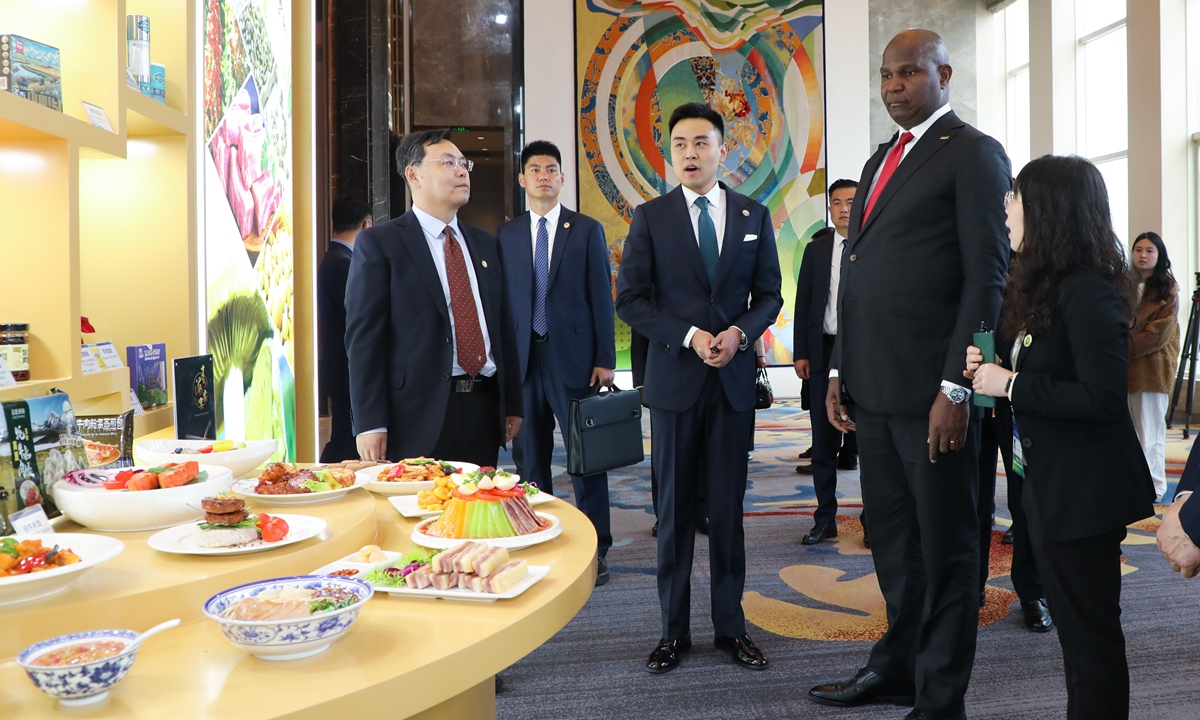
Mozambican President Daniel Chapo visits an investment roundtable in Xining, Northwest China's Qinghai Province on April 20, 2026. Photo: cnsphoto
From learning about the advanced experiences in green mining development in Qinghai and joining villagers in the Anzhao dance, to trying his hand at operating a crane in Central China's Hunan Province, visiting Mozambican President Daniel Chapo's China itinerary moved well beyond the traditional Beijing-Shanghai route, highlighting how recent foreign leaders' visits to China are becoming more diverse, immersive and closely connected to the country's wider development landscape.Chapo's decision to begin his trip in Central China's Hunan Province and continue it in Northwest China's Qinghai comes amid changes noted by Chinese media and analysts in the way foreign leaders are experiencing China as the country enters a busy diplomatic season with more visiting dignitaries.
Vietnamese top leader To Lam, for example, traveled nearly 12 hours by high-speed rail across northern, central and southern China, while Spanish Prime Minister Pedro Sanchez visited Xiaomi's headquarters during his April trip. This kind of multi-point observation helps dispel old stereotypes about China while enabling foreign leaders and overseas audiences to gain a better understanding of the country's modernization path and identify more concrete opportunities for cooperation, according to Chinese analysts.
Diverse arrangements
Chapo, who is on his first visit to China from April 16 to 22 since he took office, arrived in Beijing on Monday, per Xinhua. This came after his itinerary in Xining of Northwest China's Qinghai Province on Monday, where he toured Western Mining group and Qinghai copper Co., Ltd. to learn about Qinghai's advanced experience in non-ferrous metal smelting and green mining development, per Qinghai Daily.
One day earlier, he visited the Qinghai clean energy and green computing scheduling center to get an understanding of Qinghai's advantages in clean energy resources and the achievements in the development of the green computing power industry, the China News Service reported on Monday.
On the same day, a warm moment unfolded in Banyan village of Huzhu Tu Autonomous County in Qinghai, as Chapo smiled and uttered "Thank you" in Putonghua after he exchanged gifts with local villagers, according to another report by the China News Service on Monday.
According to Xinhua, apart from experiencing the local culture, Chapo also learned about local achievements in poverty alleviation and rural revitalization. Writing on his X account, Chapo noted the visit showed a concrete example of how structured policies can transform realities and create opportunities for all.
Yang Baorong, director of African Studies of the Institute of West Asian and African Studies at the Chinese Academy of Social Sciences, told the Global Times that the Qinghai leg of the visit carries broader significance from a development perspective. Mozambique is rich in oil and gas resources, but like many resource-dependent African countries, it faces the challenge of turning resource advantages into balanced nationwide development.
Qinghai has made notable progress in clean energy, photovoltaics and other emerging sectors through national planning and the western region development strategy. Its experience may offer Mozambique a useful reference for pursuing industrial upgrading and more coordinated growth, Yang said.
Making Central China's Hunan Province as his first stop in China, Chapo also got some hands-on experience with China's new energy technology on Saturday, trying out an electric reach stacker at an industrial park in Changsha.
The recent period has witnessed a greater diversity in the itineraries of foreign leaders on visits to China. "Muy bien (very good)," said Sanchez on April 13 as he sat behind the wheel of a new EV model at the headquarters of China's tech giant Xiaomi in Beijing. Per on-site footage released by Xinhua, Sanchez broke into a smile while sitting in the driver's seat, as Lei Jun, founder and chairman of Xiaomi, walked him through a detailed introduction.
In February 2026, cameras captured German Chancellor Friedrich Merz clapping and nodding in approval as he watched boxing and martial arts performances by robots when visiting Chinese humanoid robot company Unitree Robotics in Hangzhou.
Yang noted that visits to different regions of China can also be aligned with the specific development needs of different countries. For African and other developing nations, the focus may be on China's experience in regional coordination, poverty alleviation, clean energy and basic industries, which offers practical reference for tackling uneven development.
Meanwhile, for developed countries such as Spain and Germany, attention is more likely to center on high technology, advanced manufacturing and the "new three" industries, opening the door for higher-level cooperation along global industrial chains and underscoring China's growing role in innovation and emerging sectors, he said.
Realistic insight
In the spring of 2026, as vitality sweeps across China, a growing number of foreign leaders have paid successive visits, marking a new upsurge of China visits since the start of the year. What continues to draw foreign leaders to China is the stability, continuity and predictability of its development, analysts said.
Wang Yiwei, director of the Center for European Union Studies at Renmin University of China, told the Global Times on Monday that in a world marked by growing uncertainty, China's consistent policies, clear long-term planning and strong capability to get things done offer a rare sense of direction and confidence.
That is why many foreign leaders want to see China firsthand. What they are looking at is not just a single project or city, but how China has built on industrialization to drive digital, green and smart transformation, and what institutional strengths and governance experience lie behind its sustained development momentum, Wang said.
Departing Beijing on Thursday by high-speed train for South China's Guangxi Zhuang Autonomous Region, General Secretary of the Communist Party of Vietnam Central Committee and Vietnamese President To Lam kept the curtains open throughout the journey to observe the scenery, and noticed China's high level of urbanization, according to Xinhua.
Though traveling through only a handful of provinces, one can witness balanced development across regions, which is a strong illustration of China's sound progress in advancing coordinated regional growth, To Lam said, per Xinhua.
Uruguayan President Yamandu Orsi, during his February visit to China, toured the Museum of the Communist Party of China upon arriving in Beijing. In a post on Instagram, Orsi described the exhibition as offering a comprehensive journey through the country's historical development, featuring thousands of images, cultural relics and audiovisual materials that combine heritage, technology and historical memory.
The more foreign leaders travel across China and visit a wider range of cities, the better they can understand the country beyond old stereotypes and ideological filters. Such visits help replace one-dimensional impressions with a fuller and more realistic view of China, Song Wei, a professor at the School of International Relations and Diplomacy at Beijing Foreign Studies University, told the Global Times on Monday.
"This is also part of genuine civilizational exchange," Song said. For a long time, many countries understood China and the Global South through narrow Western narratives, often producing biased or incomplete perceptions. As China opens up further and new media offers more direct access, there is a growing need to view China and the Global South in a more objective, multidimensional and balanced way, she said.
RELATED ARTICLES