How mutual commitment of Xizang and medical aid workers improves local healthcare
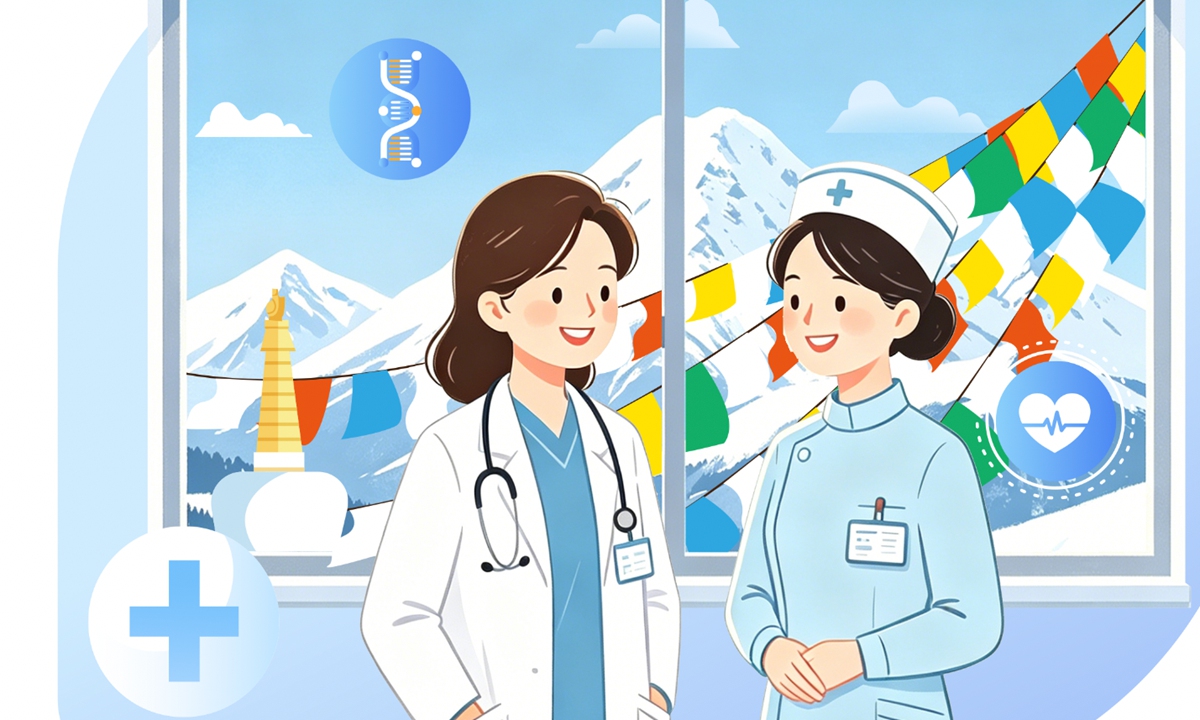
Illustration: Chen Xia/GT
Editor's Note:National support for Xizang's development has yielded remarkable achievements. Over the decades, numerous volunteers from across the country have come to Xizang, making indispensable contributions to the autonomous region's growth. Their efforts focus on various fields such as education, healthcare and infrastructure. Despite harsh conditions, these volunteers persevere in their roles, writing chapters of endeavor on the snowy plateau. Each diary they pen serves as a vivid testament to the building of the Chinese national community. Against this backdrop, the Global Times launches the "My Xizang Diary" series, presenting firsthand reflections from these dedicated volunteers. This is the fourth piece of the series.
My work badge from the People's Hospital of Xizang Autonomous Region is hanging by the window in my office in Beijing. Every time I look at it, I am reminded that I was once a member there - and that I will always regard it as another "home." In 2015, as one of the first members of the "group-style" medical assistance program to Xizang, I set foot on this remarkable land for the first time. More than a decade has passed. The badge has gradually faded in the sunlight, yet it has become ever clearer in my memory.
Xizang, like a magnet, has always held an irresistible pull for me. Whenever I hear that local departments have made progress, that medical staff have improved their capabilities, or that equipment has been upgraded, I feel genuinely happy for them.
What makes me most proud is that, with the support of the national and regional health commissions, through close collaboration with colleagues in the local laboratory, and through the collective efforts of successive teams of medical aid workers to Xizang, we achieved three signature milestones for this "home" on the snowy plateau.
In July 2015, the "group-style" medical assistance program for Xizang was officially launched. Peking Union Medical College Hospital took the lead in forming a medical team to support the People's Hospital of Xizang Autonomous Region, and the clinical laboratory department where I worked was assigned the first batch of tasks. I knew immediately that I should step forward. Facing family concerns, it was my father's simple yet resolute words that gave me strength: "Family matters are small; matters of the state come first." With that, I departed for Xizang in August.
After arriving, and based on extensive research into local disease patterns, patient conditions and the capabilities of the laboratory department, I decided - serving as deputy director of the clinical laboratory department - to build a highly skilled clinical laboratory team for the plateau. I set three goals: to establish a high-standard gene amplification testing laboratory, to found a regional clinical testing center, and to build a laboratory that would meet international accreditation standards.
The first milestone was raising standards. Through close communication, consensus-building, and teamwork with local colleagues, the clinical gene amplification testing laboratory of the People's Hospital of Xizang Autonomous Region passed the technical evaluation of the National Health Commission in 2016, becoming the first of its kind in Xizang to do so. A 48-year-old patient, Daqiong, had suffered from tuberculosis for nine months without improvement. Through gene amplification testing, it was quickly determined that she was resistant to rifampicin. After her treatment was adjusted, her condition improved rapidly. Previously, testing relied mainly on bacterial culture, which took at least a month; now, it takes only two hours.
The second was expanding capacity. With support from national and regional health authorities, the Xizang autonomous region clinical laboratory center was established, filling the country's last remaining gap in provincial-level clinical laboratory centers. Boxes of external quality assessment samples - nicknamed "small blue boxes" - were sent to over 100 laboratories across 74 counties in Xizang, with results transmitted back to Lhasa through a digital platform. Behind this process lies the gradual standardization of quality across the plateau, as well as the overall enhancement of regional medical capacity.
The third was advancing international-standard management. ISO 15189, an internationally recognized standard for medical laboratory quality management, posed immense challenges in a region with limited resources and technical capacity. The team member often encouraged one another: "Do our best, without rushing for quick results. Even if we don't see the final outcome before we leave, the seeds we plant will take root."
It took more than three years to make this possible. Establishing an international-standard laboratory on the plateau required a committed team capable of sustaining high standards over time. After my initial assignment ended in 2016, I returned to Xizang seven times, organizing training sessions and inviting experts to teach. At the same time, successive teams of laboratory specialists continued the work, steadily improving local capabilities.
On November 7, 2018, the laboratory finally passed ISO 15189 accreditation. When the news came, applause and cheers broke out simultaneously in the clinical laboratory departments of both Peking Union Medical College Hospital in Beijing and the People's Hospital of Xizang Autonomous Region, more than 2,000 kilometers apart. Even now, recalling that moment, I cannot hide my excitement: "We did it. The highest-altitude laboratory in the world to meet international standards has been built on the snowy plateau."
More than a decade later, laboratory medicine in Xizang has entered a virtuous cycle of development, reaching the average level of tertiary hospitals in central and western China. From isolated breakthroughs to system-wide development, from external support to endogenous capacity-building, a clearer path has emerged.
Practice has shown that the "group-style" medical assistance program has not only transformed departments and hospitals, but has also reshaped the overall landscape of healthcare services in high-altitude regions. The establishment of high-standard laboratories is not only a testament to technological progress, but also a vivid example of how institutional strengths and governance capacity can be translated into tangible results.
Over the years, the model of "one person aiding Xizang, the whole department supporting Xizang" has gradually become the norm. Major hospitals across the country have continuously dispatched personnel in relay fashion. Scientific research, technical applications, and training programs have been extended to and shared with Xizang. More local doctors are going out to learn and returning with new expertise. Medical assistance is no longer just about bringing something in, but more importantly about leaving something behind. The "group-style" approach is opening a new chapter of medical cooperation and shared development.
Looking ahead, this process will continue. As high-quality medical resources continue to reach lower-level and underserved areas, as standards systems are further improved, and as talent cultivation mechanisms become more robust, healthcare services in Xizang are moving toward greater balance and standardization. With system-building as the foundation, sustained investment as momentum, and coordinated mechanisms as drivers, the development of healthcare on the plateau is shifting from catching up to leaping forward.
I also deeply respect these local doctors and nurses, who continuously hold themselves to higher standards and strive to improve their professional skills.
Looking back at this ongoing relay of medical aid to Xizang, it is precisely the successive waves of medical workers from across China who have journeyed to the plateau with dedication and selflessness, together with the mutual efforts and two-way commitment of local medical professionals, that have transformed medical aid to Xizang from a task into a shared cause. Regardless of where they come from, everyone shares the same aspiration - to provide better and more accessible healthcare for the people in Xizang, and to make the protection of life on the snowy plateau stronger and more compassionate.
The author is former director of the Clinical Laboratory Department at Peking Union Medical College Hospital. In 2015, she was among the first batch of "group-style" medical aid experts sent to work in the Clinical Laboratory Department of the People's Hospital of Xizang Autonomous Region. opinion@globaltimes.com.cn
RELATED ARTICLES