China’s blueberry production sees strong growth, driven by constant technological advances
Small fruit, big benefits
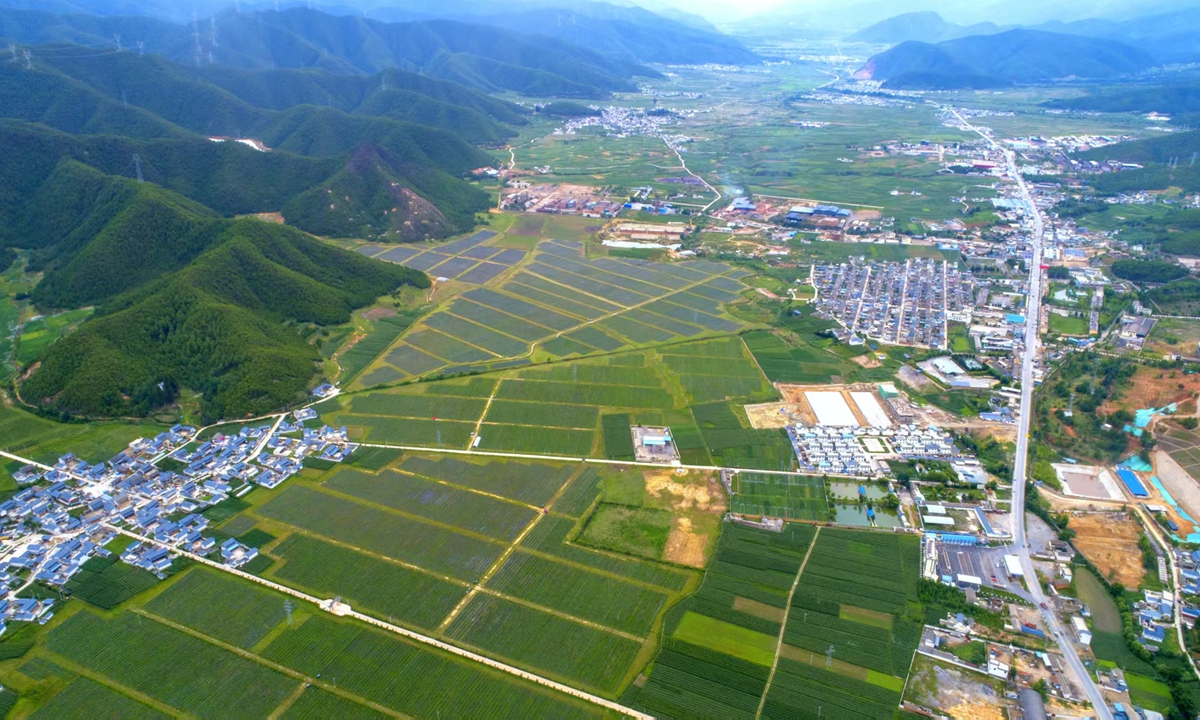
Aerial view of the blueberry industry site in Lanping, Yunnan Province. Photo: Courtesy of Lanping County Agricultural, Tourism and Cultural Development Co
In a cold-chain warehouse at a major fruit market in Shanghai, blueberries freshly shipped from Southwest China's Yunnan Province are swiftly sorted and sent to supermarkets and e-commerce channels. Once seen as a premium import, the fruit is increasingly common on everyday shopping lists, as rising domestic output has pushed prices down.
"The change has been striking in recent years," a fruit wholesaler in Shanghai told the Global Times, noting market supply has surged and prices have fallen. "With more being grown and prices becoming more affordable, demand has picked up." He said that 12 boxes of 18-mm blueberries now sell for 98 yuan ($14), a price that would have been hard to imagine a few years ago, reflecting rapid expansion on the supply side.
Ye Yufei, a 26-year-old office worker in Beijing and a self-described blueberry lover, told the Global Times she ordered 16 boxes in a single week. "It used to feel pricey, now I snack on them," she said. The shift from an occasional treat to a daily staple reflects not just lower prices but the rapid growth of China's domestic blueberry industry.
China has become one of the world's leading blueberry growers. Since 2020, China's blueberry output has ranked first globally and continued to grow, hitting 810,000 tons in 2025.
Yunnan Province has played a particularly prominent role in this expansion. Just over a decade ago, blueberries in Yunnan were a niche crop grown on a small scale. Today, roughly three out of every 10 blueberries in China come from the province. In 2024, Yunnan's blueberry exports surged 25 times year-on-year, accounting for about half of the national total, and its output reached 280,000 tons in 2025, or 30 percent of the country's total, according to the Department of Commerce of Yunnan.
Standardized agriculture
"In the past, China's blueberry market relied on imports from countries like Chile and Peru, with high costs from shipping, customs clearance and cold chain logistics keeping retail prices elevated," Yang Yaohong, head of a blueberry base in Lanping, Yunnan, told the Global Times.
Now, with upgraded cultivation technology and an off-season harvest window from November to April, Yunnan blueberries have begun to replace imported blueberries, Yang said.
"Our highland blueberries in Yunnan grow at higher altitudes with greater temperature differences, allowing sugars to accumulate more fully, resulting in lower acidity and a purer sweetness," Yang said. "The berries are firmer and crisper, with a richer bloom and higher anthocyanin content."
The price drop on the market driven by large-scale output has not hurt profits, local traders told the Global Times. With more consumers buying and word-of-mouth spreading, sales have kept on rising.
If early harvests give Yunnan blueberries a head start, technological upgrades make that edge sustainable.
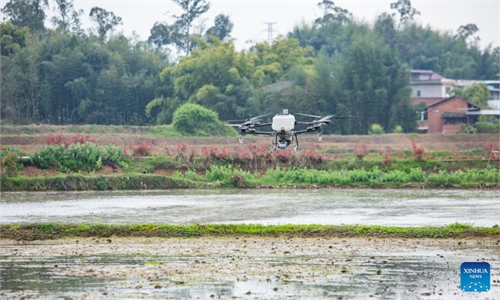
Yang said the surge in output and quality in recent years has been driven by the adoption of a modern farming system - from virus-free seedlings and substrate cultivation to integrated water-fertilizer drip irrigation and green pest control - shifting production from traditional open-field methods to standardized, precision agriculture.
Patents for the "floral-aroma" blueberry varieties widely grown in Yunnan were long held by an Australian company, with high licensing fees constraining the industry. In 2019, Chinese scientists developed Lanmei No 1, the first commercially viable variety with full domestic intellectual property rights, breaking the monopoly and helping cut down production costs and retail prices, according to the Department of Commerce of Yunnan.
"Our cultivation is supported by government-backed agricultural expert teams, with additional guidance from leading international firms and specialists, including Spain's Sebastian and the UK's Leon C.G. Jahae," Yang said. "We also work with the Alpine Economic Plants Institute under the Yunnan Academy of Agricultural Sciences, as well as Yunnan Agricultural University and Dali University, to develop premium highland varieties and refine cultivation techniques."
Yang added that China's fresh-produce logistics network has become highly efficient, with blueberries in Yunnan picked and shipped immediately and delivered via short-distance cold-chain logistics. Consumer Ye said tht blueberries she ordered in Beijing can arrive by the next day at noon.
Supply chain expansion
China's blueberry export sector has undergone a dramatic transformation during the past three years. China's blueberry exports skyrocketed by 602 percent between 2023 and 2025, starting to transform global trade, according to Freshfruitportal.com.
Supported by favorable policies and a more complete industrial chain, Chinese blueberries are now reaching global markets. Customs data show exports from Yunnan have expanded in recent years, with berry products flown to markets such as Singapore and Japan. In 2024, exports overseen by Mengzi Customs alone exceeded 1,400 tons.
"Our base now supplies premium highland blueberries through established export channels, with standardized sorting, cleaning and cold-chain packaging," Yang said. "In the 2025 season, we began exporting to Singapore, where our naturally grown, residue-free fruit with high sweetness has been well received and acclaimed by our overseas consumers."
"We are expanding into high-end markets in the Middle East, Hong Kong, Macao, Japan and South Korea, aiming to bring Lanping's highland blueberries to more customers overseas, while building a strong local brand through agri-tourism integration," Yang said.
Bian Yongzu, executive deputy editor-in-chief of Modernization of Management magazine, told the Global Times that Yunnan's growing role is closely linked to China's opening-up policy. Once a border province, it is now a gateway to Southeast Asia and South Asia, with rising connectivity and policy support boosting its global profile and helping products like blueberries reach overseas markets.
He added that China's technological and industrial strengths underpin the sector's growth, from improved cultivation methods to support from manufacturing and agricultural inputs, enabling higher quality and efficiency.
Bian noted that better logistics and expanding services - from cold chain to exhibitions and tourism - have accelerated global access and boosted the international visibility of Yunnan's specialty products.
China should continue to step up efforts to develop agriculture and the vast rural areas, promote integrated urban-rural growth, and ensure that policies aimed at strengthening agriculture, benefiting farmers, and enriching rural areas deliver greater outcomes, the central government's "No 1 document" for this year read.
Amid the ongoing reshaping of global food supply chains, China is evolving from a major consumer market into a key supplier of high-quality agricultural products. Chinese analysts say that blueberries are just one example, as more specialty products scale up, standardize and build brands, signaling a deeper shift in China's role in global agriculture landscape.
RELATED ARTICLES