Chinese netizens find French fashion brand Lemaire’s Qing Dynasty-style braid campaign offensive, apology lacks sincerity
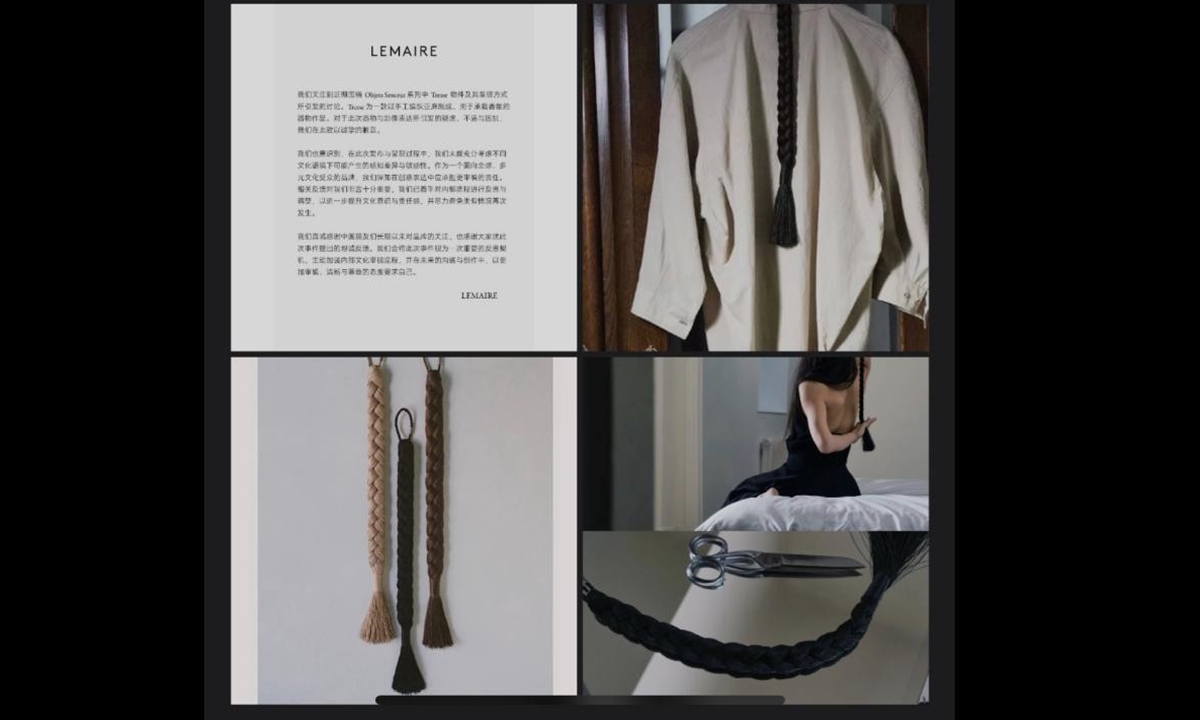
French fashion brand Lemaire issues an official apology in Chinese and English on April 26, 2026 after a promotional campaign for its Objets Senteur fragrance objects, featuring a long braid, sparked controversy and criticism among Chinese netizens. Photo: Screenshot from website
Chinese netizens have accused of French fashion brand Lemaire of misappropriating the historically humiliating symbol of "forced hair-cutting and clothing change"from the Qing Dynasty(1644-1911) after the brand released a promotional campaign for its Objets Senteur fragrance objects featuring a long braid recently. Although Lemaire issued an apology admitting it had "not sufficiently considered differences in perception and sensitivity across cultural contexts" on Monday, the brand failed to quell public outrage.
The controversy and criticism centered on a series of campaign images featuring an object named "Tresse," a braided linen piece said to be designed to hold fragrance. In the visuals shared on platforms including Instagram, the braid-like object was paired with elements such as a long gown and a pair of scissors. Some Chinese netizens interpreted such details as carrying historically sensitive connotations, referring to the image of people wearing queues (braided hairstyles) during the Qing Dynasty.
"We have taken note of the recent discussions surrounding the Tresse object and its presentation in the Objets Senteur collection," the brand said in its apology statement. "Tresse is a handcrafted braided linen object designed to hold fragrance. We sincerely apologize for any concern, discomfort, or distress caused by its depiction."
Lemaire acknowledged that it had "not sufficiently considered differences in perception and sensitivity across cultural contexts," adding that as a global brand, it bears responsibility for exercising greater care in its creative expressions. The company said it has begun reviewing its internal processes to improve cultural awareness and avoid similar incidents in the future.
The apology was issued amid mounting criticism from Chinese netizens as the images circulated online. Some netizens announced they would no longer support the brand, while others questioned the campaign's intent.
"Don't argue that we're overthinking it — don't you know what scissors placed like that imply? Haven't you learned history?" one netizen wrote. Another commented, "If a brand's campaign makes you uncomfortable, then it's intentional," suggesting the imagery could not be accidental.
Even after the apology was issued, public reaction from Chinese netizens remained largely critical. While some users said "removing the images and issuing a statement was a step in the right direction," many others argued that the response lacked sincerity. One netizen said the statement was "a cover-up," arguing that its reference to "differences in cultural context" lacked sincerity and implied that Chinese people were being overly sensitive. "Why not test the boundaries of other groups and see if they're sensitive?" the netizen wrote.
Others went further, accusing certain international luxury brands of borrowing from traditional Chinese aesthetics while showing insufficient respect.
Founded in 1991 in Paris by former Hermès creative director Christophe Lemaire, Lemaire is known for its minimalist design language. In 2018, Japan's Fast Retailing, the parent company of Uniqlo, acquired a minority stake in the label.
In recent years, the brand has expanded its presence in the Chinese market, opening its largest global flagship store on Shanghai's Wukang Road in January, followed by a new flagship in Beijing's Sanlitun in March 2026.
Global Times
RELATED ARTICLES