Russian scholars show interest in China’s AI tech, open-source models in Valdai Russian-Chinese conference in Shanghai
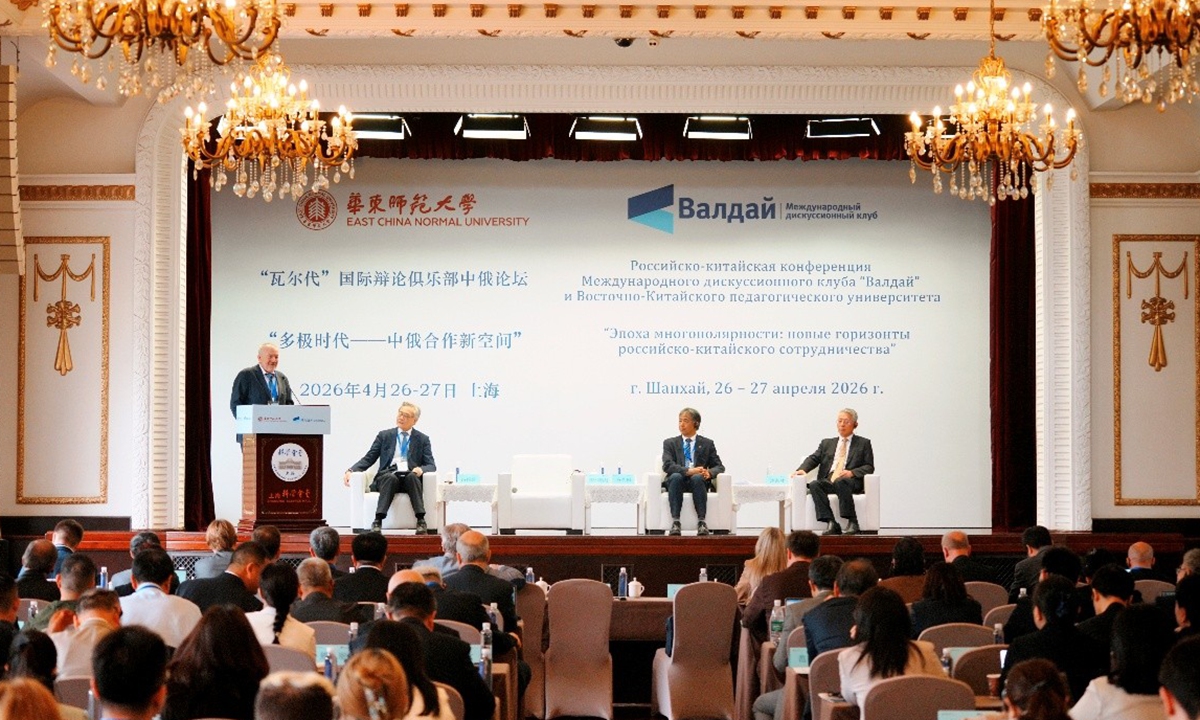
The Valdai Russian-Chinese Conference, organized jointly by the Foundation for Development and Support of the Valdai Discussion Club and East China Normal University, was held in Shanghai on April 27, 2026. Photo: Courtesy of East China Normal University
On a warm and pleasant Monday in Shanghai, a conference brought together 90 experts and scholars from China and Russia for in-depth, productive exchanges on the potential for bilateral cooperation. Many participants expressed interest in China's AI technology, particularly its open-source models in interviews with the Global Times, with some sharing that under GPU-related sanctions, Russia sees lessons in how China has optimized AI model training despite constraints.
Under the theme "The Era of Multipolarity: New Horizons of Russian-Chinese Cooperation." the Valdai Russian-Chinese Conference was held in the metropolis jointly by the Foundation for Development and Support of the Valdai Discussion Club and East China Normal University, contributing insights to advance China-Russia comprehensive strategic partnership of coordination for a new era.
Andrey Bystritskiy, Chairman of the Board of the Foundation for Development and Support of the Valdai Discussion Club, said in the opening remarks that the goals of China-Russia cooperation are clear, but both countries must work together to find common ground and pool their wisdom for the future in a rapidly and profoundly changing world.
The conference was held shortly after Russian Foreign Minister Sergei Lavrov's recent visit to China. At the invitation of Wang Yi, a member of the Political Bureau of the Communist Party of China Central Committee and Chinese foreign minister, Lavrov paid an official visit to China from April 14 to 15.
During his meeting with Wang, Lavrov said Russia is willing to work with China to maintain close high-level exchanges, deepen practical cooperation, and achieve mutual benefit and win-win results. Following the talks, the two sides jointly signed the 2026 consultation plan between the foreign ministries of the two countries, the Xinhua News Agency reported.
Feng Shaolei, director of the Center for Russian Studies at East China Normal University in Shanghai and moderator of the forum, told the Global Times that the 30-year development of the China-Russia strategic partnership of coordination has proven the foresight and sound judgment of decisions made three decades ago. "This relationship has demonstrated both stability and forward-looking vision," he said.
At the same time, Feng noted that the international landscape is undergoing profound transformation. Developments such as the rise of artificial intelligence, shifts in global power structures, and changes in major countries' domestic and foreign policies are reshaping the world in ways that were difficult to anticipate 30 years ago. Against this backdrop, he stressed the need for China-Russia cooperation to remain adaptive and responsive while staying grounded in its founding principles.
When discussing specific areas of China-Russia cooperation, technology and artificial intelligence were among the most frequently mentioned topics by participants in the conference.
"What I see now is that grassroots actors, companies, and small businesses are really looking forward to cooperating with China, especially because we are very interested in open-source models, such as DeepSeek," said Anna Sytnik, associate professor at the American Studies Department at St. Petersburg State University.
She noted that in the context of GPU-related sanctions, Russia sees areas it can learn from China, particularly in how China optimizes the training of AI models despite existing limitations.
Separately, Timofei Bordachev, Programme Director of the Valdai Discussion Club, told the Global Times that China's development, particularly in technology, benefits the rest of the world. "What China does, for example in technological development, is good for the global community because its new technologies are open. That is China's strength," he added.
According to data from China's Ministry of Commerce, citing statistics from the General Administration of Customs, China-Russia trade reached $39.045 billion in January and February 2026, up 12 percent year-on-year. Of this total, China's exports to Russia amounted to $18.294 billion, up 22.7 percent, while imports from Russia totaled $20.751 billion, up 4.1 percent.
However, the normal cooperation has been facing doubts, even smear from some Western media from time to time. Responding to views that China-Russia cooperation is driven mainly by external pressure, Feng told the Global Times that the deeper driving forces lie within the two countries themselves, including development needs, cooperation potential, and a shared pursuit of peace and stability.
This view was echoed by Alexander Lomanov, deputy director of the Institute of World Economy and International Relations of the Russian Academy of Sciences. He noted that history shows China-Russia relations are not fundamentally shaped by external factors alone. "Even if either country improves relations with the West, China-Russia ties will not regress," he said.
Lomanov also highlighted the importance of "discourse power" in international affairs, arguing that China and Russia can offer alternative development paths that promote diversity without imposing values on other countries. If Russia and China can build a model of mutual trust, equality and stability, it will serve as a source of global stability, he added.
Discussions at the conference also addressed practical challenges. Ding Xiaoxing, a research professor and deputy secretary-general of the Academic Committee at the China Institutes of Contemporary International Relations, noted several bottlenecks in China-Russia logistics cooperation, including insufficient overall transport capacity, limited infrastructure, and inefficiencies caused by differences in railway gauges, which lead to container backlogs. He also noted rising maritime shipping costs due to higher insurance and freight fees, as well as slow customs clearance processes and a lack of data connectivity.
To address these issues, Ding suggested expanding infrastructure investment, improving port capacity and promoting one-stop customs clearance, accelerating the development of digital customs systems, and enhancing third-party cooperation, including potential collaboration with ASEAN member states in developing Arctic shipping routes.
RELATED ARTICLES