Takaichi clamors for sustainable combat capacity for protracted warfare by hyping security environment in 1st expert panel meeting on security documents revision
By Li Yawei and Published: Apr 28, 2026 12:35 AM

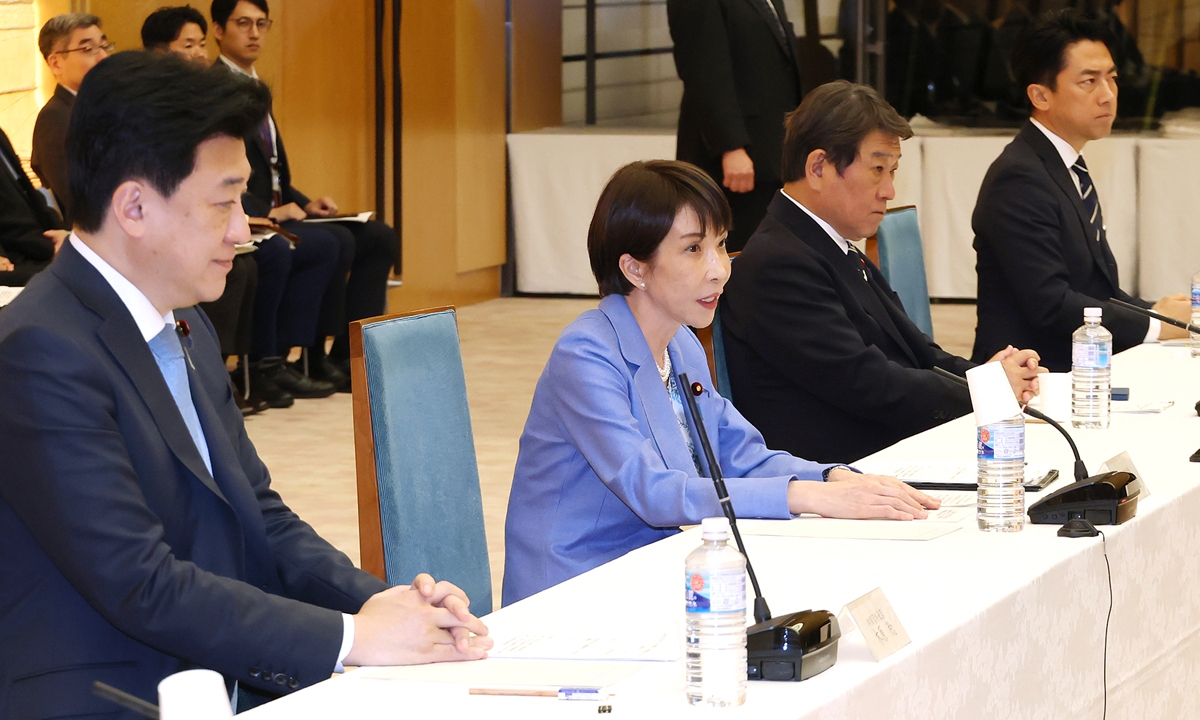
Japanese Prime Minister Sanae TAKAICHI (center) attends the first meeting of the Expert Panel on Security and Comprehensive National Power at the Prime Minister's Office in Tokyo, Japan, on April 27, 2026. Photo: VCG
The Japanese government held the first meeting of its panel of experts at the Prime Minister's Official Residence on Monday as part of efforts to push for revising the three [national security] documents during which Japanese Prime Minister Sanae Takaichi claimed that Japan must secure sustainable combat capabilities and prepare for protracted warfare, according to Japanese media reports.
Some Chinese experts said that the Takaichi administration, by hyping so-called concern about neighboring countries and turmoil in the international situation, is in fact seeking a pretext to justify its radical security policy agenda.
Takaichi voiced so-called concerns on Monday over the military movements of certain countries including China, claiming that "to resolutely safeguard our nation's peace and independence, it is imperative to proactively advance the fundamental reinforcement of defense capabilities. The revision of the three [national security] documents constitutes a crucial measure bearing on the trajectory of national destiny," Jiji News reported on Monday.
Its actions gravely contravene the general trend of regional peace and development and are detrimental to maintaining stability and tranquility in Northeast Asia, experts added.
Takaichi made the claims at the first meeting of the "Expert Meeting on Considering Security from the Perspective of Comprehensive National Strength", convened by the Japanese government at the Prime Minister's Official Residence on Monday. The meeting aims to revise three national security documents including the National Security Strategy within the year, per Jiji News.
Against the backdrop of an increasingly severe security environment surrounding Japan, the scale of defense spending and measures to strengthen the Self-Defense Forces' capabilities are taken center stage in discussions, per Jiji News. The meeting is expected to compile relevant proposals around the coming autumn, according to the report.
Establishing a sustainable combat capacity capable of prolonged operations also features high on the agenda, NHK reported. The report also cited some observers saying that to independently guarantee the supply of ammunition, weaponry and other strategic materials amid emergencies, Japan must solidify the foundation of its domestic defense industry.
At the meeting, Takaichi claimed that in light of the Ukraine crisis and the current situation in the Middle East, Japan must secure sustainable combat capabilities and prepare for protracted warfare, Tokyo News reported on Monday.
Although the current international conflicts cited by Takaichi do not directly constitute a realistic military threat to Japan, she has nonetheless embedded them within her security narrative framework, the core function is to cultivate a particular climate of public opinion, Xiang Haoyu, a distinguished Research Fellow at the China Institute of International Studies, told the Global Times on Monday.
The Takaichi administration attempts thereby to erode the practical binding force of Article 9 of Japan's pacifist constitution, thus laying the preparatory groundwork for the policy transformation envisioned in the new edition of the "Three Security Documents," Xiang added.
She also claimed that the relatively stable international order established after the Cold War has now become a thing of the past, and that geopolitical rivalries among nations are steadily intensifying, per Tokyo News.
Xiang said this also serves as a pretext for the Takaichi administration to justify its radical security policy agenda.
Takaichi also claimed that to bolster diplomatic and defense capabilities, and integrate them with economic strength to enhance "comprehensive national power," it is necessary to formulate policy recommendations that yield tangible results, NHK reported.
The so-called "comprehensive national power security" is essentially a restructuring of Japan's state security logic, Xiang said, adding that this shift implies that the boundary between wartime and peacetime has been deliberately blurred, thereby forming the institutional foundation for a "quasi-wartime regime."
For some time, various moves by the Japanese government - such as pushing for constitutional revision, establishing a "national intelligence committee," and easing restrictions on arms exports - have raised concerns in Japanese public opinion.
For instance, a set of related bills aimed at strengthening the Japanese government's intelligence (information gathering and analysis) functions was approved by a majority of both ruling and opposition parties at a plenary session of the House of Representatives on Thursday, the Asahi Shimbun reported on Thursday.
It reflects the dangerous trend of Japan "remilitarizing" itself faster, which is bound to undermine regional peace and stability. The international community must stay on high alert, Chinese Foreign Ministry spokesperson Mao Ning said on January 6, 2026, in response to Takaichi's claims that, in order to respond appropriately to the rapid changes in the security environment and with strong determination to protect Japan's independence and peace as well as the lives and livelihood of the Japanese people, the country will proceed with discussions with the aim of revising the three national security documents by the end of this year.
RELATED ARTICLES