China's 'artificial sun' advances toward industrialization as nuclear fusion included in 15th Five-Year Plan's key future growth frontiers
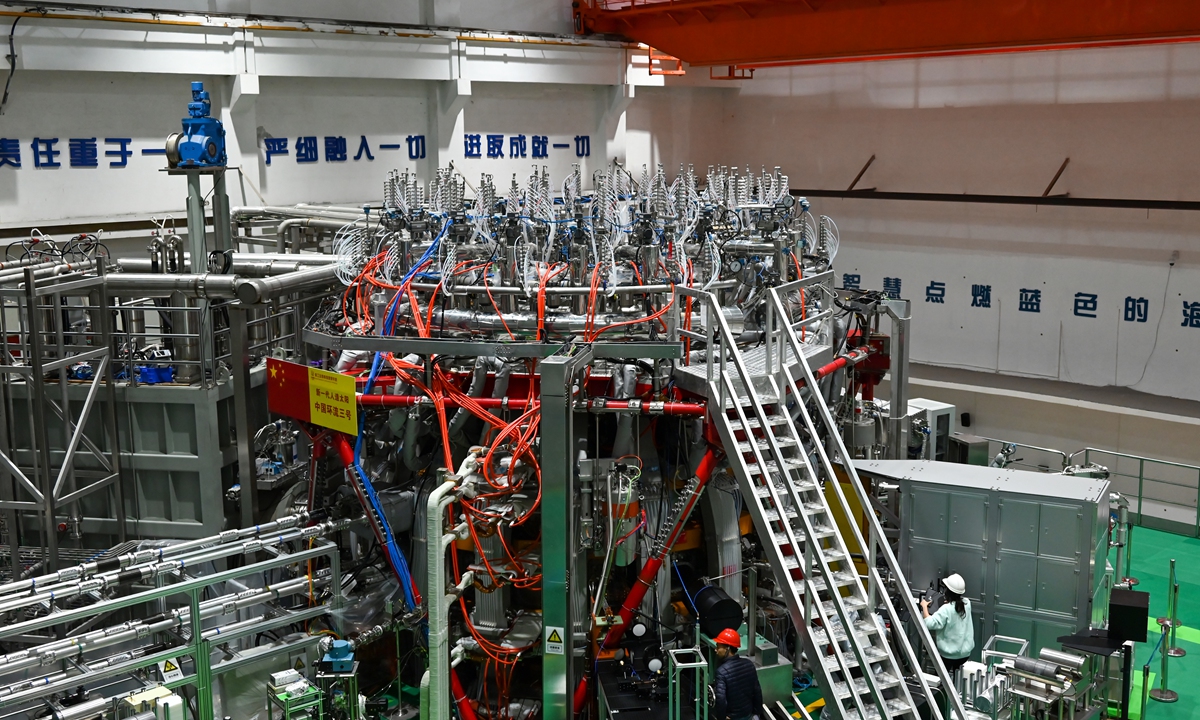
The "artificial sun" HL-3 at the CNNC Southwestern Institute of Physics in Chengdu, Southwest China's Sichuan Province. Photo: VCG
China's new-generation "artificial sun," HL-3, is accelerating toward industrialization as nuclear fusion has been identified as one of the future growth frontiers in the country's 15th Five-Year Plan, with key technological breakthroughs bringing the prospect of clean and potentially abundant energy a step closer to reality.HL-3 harnesses the same fusion principles that power the sun, releasing vast amounts of energy through nuclear fusion to advance clean energy development. It is currently China's largest and most advanced tokamak fusion experimental device, achieving the highest operational parameters of its kind, according to the official website of China National Nuclear Corporation (CNNC).
According to the Xinhua News Agency, China remains committed to developing nuclear power in a proactive, safe and orderly manner. "Controllable nuclear fusion" has been included in the country's major projects during the 15th Five-Year Plan period (2026-30).
Achieving controlled nuclear fusion on Earth is extremely challenging. It requires handling ultra-high temperatures, maintaining strong magnetic fields, and keeping hot plasma stable. Three key factors make this possible: plasma size provides space for confinement, plasma current maintains stability, and heating power supplies energy, Song Zhongping, a Chinese technology expert, told the Global Times on Wednesday, noting that the design of China's HL-3 focuses on balancing these three factors to move closer to stable fusion.
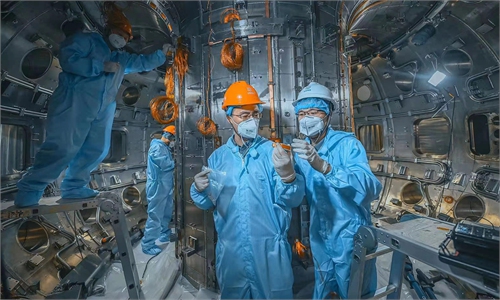
In terms of key components, the "first wall" is one of the most critical parts of the "artificial sun." It sits directly facing the super-hot plasma at the center, where temperatures are extremely high and particles constantly strike its surface. To withstand this harsh environment, it is made from three main metals: tungsten, copper, and stainless steel, the CCTV News reported on Wednesday.
Located on the innermost side of the vacuum chamber, the "first wall" acts as the very first line of defense against the plasma. It can be seen as a "close-fitting armor" for the fusion device, protecting the structure while allowing the experiment to run safely.
China has now achieved full independent capability in developing, manufacturing, and testing the "first wall." From materials and welding techniques to high-heat-load testing, its performance has reached a leading international level. This marks a major step forward in turning controllable fusion technology into practical clean energy.
Wang Qiuliang, an academician of the Chinese Academy of Sciences, noted that HL-3 has continued to set new records in recent years. In 2025, it achieved "dual hundred-million-degree" operation, with an ion temperature of 120 million degrees Celsius and an electron temperature of 160 million degrees Celsius. The fusion triple product reached the order of 1020, according to the website of CNNC.
The new-generation HL-3 is scheduled to achieve its first fusion ignition experiment around 2027, CCTV News reported.
A fusion ignition experiment means moving from relying on external heating to allowing the plasma to sustain itself, Wang Zhengxiong, a professor at the school of physics of Dalian University of Technology, told the Global Times on Wednesday. Wang added that at the start of a fusion reaction, external energy is used to heat the plasma, but the goal is for it to generate enough internal heat to keep "burning" without external input, forming a self-sustained process similar to how the sun produces energy, which can then be harnessed to generate electricity.
Song also noted that a fusion reaction must last long enough to sustain itself, with around 1,000 seconds often used as a key benchmark. Achieving conditions such as "100 million degrees for 1,000 seconds" means scientists can simulate the environment needed for future fusion reactors, marking a crucial step toward practical fusion energy, he said.
According to Bai Xingyu, deputy director at the Center for Fusion Science under the Southwestern Institute of Physics, the plan is to build a pilot experimental fusion reactor around 2035 and a demonstration reactor by about 2045, following a clear path from experimental reactor to demonstration reactor and eventually to commercial reactors, CCTV News reported.
In addition to China's HL-3, another "artificial sun" project in Hefei, East China's Anhui Province, the Experimental Advanced Superconducting Tokamak (EAST), is also pushing toward its next experimental goals while steadily advancing toward commercialization.
In January 2025, EAST achieved a "high-quality burn" lasting more than 1,000 seconds at a temperature of 100 million degrees Celsius for the first time, Xinhua reported.
RELATED ARTICLES