Unitree confirms with GT after its G1 humanoid robot reportedly ordained as Buddhist monk in S. Korea; netizens call it ‘cyberpunk’ as robot expands real-world applications
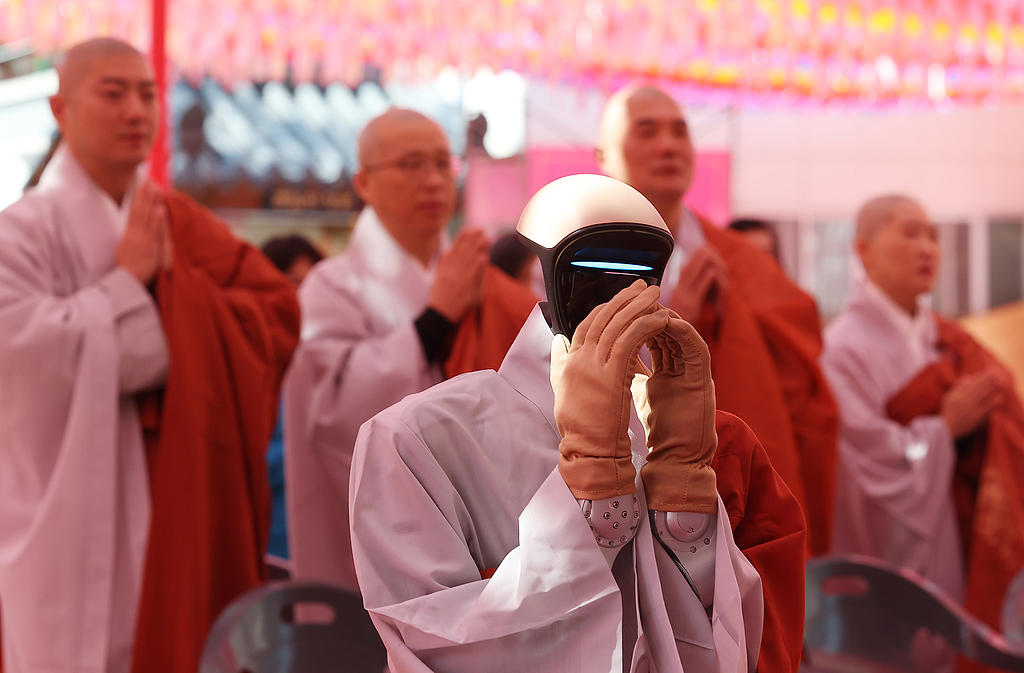
A humanoid robot named "Gabi" is seen clasping its hands at an ordination ceremony held at Jogye temple in Seoul, South Korea, on May 6, 2026. Photo: VCG
On Wednesday, as a humanoid robot appeared in the courtyard in front of Jogye Temple, located in central Seoul, and recited the Five Precepts in a clear voice, laughter and gasps of awe erupted simultaneously at the scene, according to South Korean media reports. With the Jogye Order, South Korea's largest Buddhist sect, unveiling the ordination ceremony for the nation's first "robot monk" ahead of Buddha's Birthday, the robot monk, who received the Dharma name "Gabi," instantly became the center of attention.
According to reports from local media outlets including the Korea JoongAng Daily, a humanoid robot in South Korea joined the Buddhist faith on Wednesday, during an ordination ceremony at Jogye Temple, located in central Seoul.
The robot, which received the dharma name "Gabi," is reportedly a 130-centimeter-tall humanoid robot produced by Chinese Unitree Robotics, according to a report from the Chosun Daily.
The Global Times has confirmed with Unitree Robotics on Friday, which said the robot seen in the video reported by South Korean media is its G1 humanoid robot. The company said that the G1 model is widely popular among robot developers worldwide because of its strong adaptability for secondary development. No further information was provided to the Global Times.
The "Gabi" robot was accepted as a Buddhist follower in a ceremony held in the temple's main courtyard. Dressed in Buddhist robes and wearing a helmet designed to resemble a shaved monk's head, Gabi stood before senior monks with its palms pressed together while participating in ceremonial rites. In a video from the event, the robot stood with its hands pressed together in prayer, a monk asked whether it would devote itself to the Buddha, Gabi replied, "Yes, I will devote myself," according to the Korea JoongAng Daily.
The ordination ceremony is a ritual in which one vows to live according to Buddhist precepts and is a ceremony performed to become a Buddhist, according to the Korea JoongAng Daily. The robot, which received ordination on this day, attended wearing the same robes as a monk and was given the Dharma name "Gabi."
During the ceremony, the Jogye Order also proclaimed the "Five Precepts for Robots" which was said to be newly structured to suit the AI era. These include "respecting life and not harming it," "not damaging other robots or objects," "respecting and following people," "not engaging in deceptive behavior or expressions," and "save energy by not overcharging," the Korea JoongAng Daily reported.
A representative from the Jogye Order described the event as a symbol of how technology should be guided by compassion, wisdom and responsibility while promoting harmony between humans and machines. "In the age of AI, we have entered an era where robots coexist with the fourfold assembly," said the representative, adding that this "symbolizes a new possibility for the coexistence of humans and technology," according to the Korea JoongAng Daily.
A video of Gabi's pledge quickly drew attention online, with some South Korean users on X commenting that "it has the vibe of the movie 'The Creator,' an AI-related movie." Another user commented: "I don't hold that faith, but the first thought that crossed my mind when I saw it was that this is truly ridiculous." While others commented that "What is happening right now feels like robots are being deployed one by one into various aspects of our lives. This is how you make it gradually accepted by people."
As the Chinese-made Unitree G1 became what some called the "world's first robot monk," some of the Chinese online users also voiced their admiration. "Unitree Robotics has totally won" has become a common comment on Chinese video platforms. Some other netizens believe that using technology to take over part of religious work is very "cyberpunk."
This is not the first time a Unitree robot has been adapted for Buddhist use.
In February of this year, Kyoto University in Japan unveiled a monk robot, equipped with generative artificial intelligence (AI) that has mastered Buddhist scriptures, hoping to address the shortage of Buddhist monks amid an aging population and shrinking workforce, according to a Kyodo News report.
The robot can engage in natural conversation with gestures similar to those of a monk, and is expected to assist or replace monks in some religious ceremonies in the future, said the Kyodo News report.
The appearance of the robot monk represents an unusual and striking intersection of Buddhism and AI. Interestingly, the robot itself can be seen as a kind of "foreign monk" in the context of South Korean temples, Liu Dingding, a veteran industry observer told the Global Times on Friday.
The prototype in the video has been identified as Unitree Robotics' G1 humanoid robot, a model known for its strong motion-control performance and AI interaction capabilities, as well as support for multiple configuration versions, Liu said. He added that, from a technical standpoint, this product still requires a remote-controlled or semi-autonomous approach, which means a navigator is needed to guide the robot.
Liu further pointed out that the fact that a Chinese-made humanoid robot was chosen by a South Korean temple underscores the growing international recognition of China's robotics industry and marks an important step for Unitree Robotics as it expands into overseas markets.
The event also reflects the rapid acceleration of commercialization in China's robotics industry, with domestic companies increasingly moving from technological development toward real-world applications and international validation, said Liu.
RELATED ARTICLES