GT on the Spot: Beijing Intl High-tech Expo witnesses 'future has arrived' landscape built by 'AI+'
By Published: May 08, 2026 11:08 PM

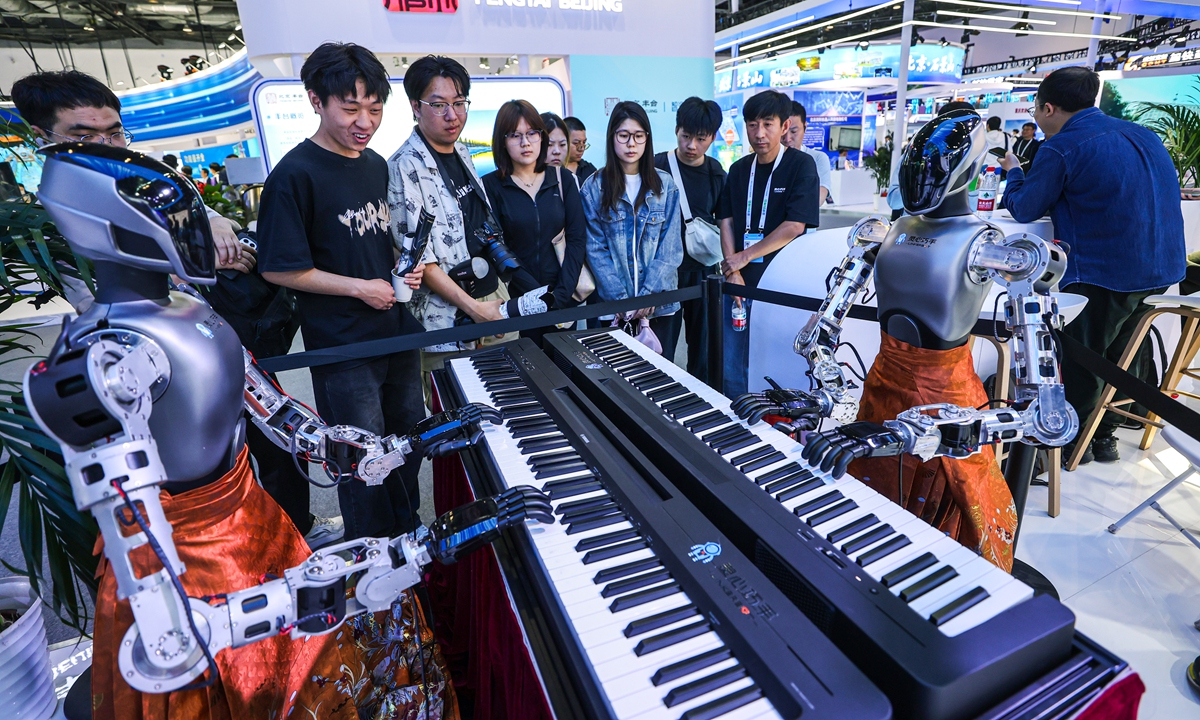
Two robots play the piano at the 28th China Beijing International High-tech Expo on May 8, 2026, drawing crowds of visitors. Photo: VCG
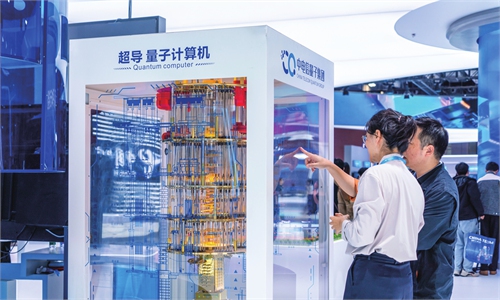
Visitors eagerly leaned forward to experience the C919 simulator cockpit, danced interactively with embodied intelligent robots, and watched rich hand gestures on brain-computer interface screens that illuminate the lives of people with disabilities. These vivid scenes capture the atmosphere of the 28th China Beijing International High-tech Expo, where people are witnessing countless visions of future life gradually turning into reality.
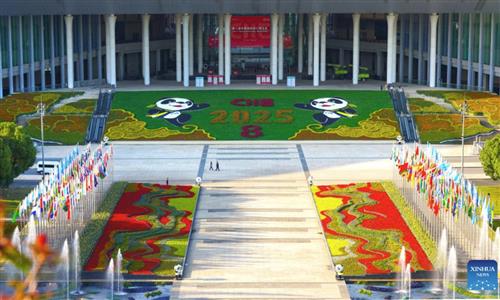
The three-day expo, which opened on Friday with the theme "Science and Technology for a Better Future", brought together more than 800 domestic and international enterprises and institutions, showcasing cutting-edge technological achievements and innovative application scenarios centered on "AI+."
As China's first large-scale international science and technology exchange and cooperation exhibition focused on science and technology, it highlighted the country's breakthroughs in hard technologies across various fields as well as its soft innovation capabilities.
Future life scenarios taking shape
A Global Times reporter personally experienced a variety of technological demonstrations on site: intelligent robots played football with the reporter; by concentrating on on-screen gestures while wearing a brain-computer interface headset and sensor gloves, various remote-control gestures could be performed in the air; relaxing with traditional Chinese-style massage delivered by robotic arms.
Through these immersive experiences, the reporter clearly felt how high-end technologies in fields such as information technology, medicine and health, green low-carbon solutions, and intelligent manufacturing are rapidly integrating into everyday life and reaching ordinary people.
Sergey, a Belarusian working in education in East China's Jiangsu Province, told the Global Times that he flew to Beijing specifically to attend the expo. "This is the first time I've seen an expo with such rich displays of AI technology. It's dazzling. What impressed me most were the AI+ intelligent education applications. I really hope these can reach Belarus and more countries."
AI and robotics featured far more prominently at this year's expo. Humanoid robots, embodied interaction control systems, bionic intelligent robots, and other cutting-edge equipment were prominently displayed.
A towering 6-meter-tall ultra-realistic humanoid robot made its debut at the expo, currently the world's tallest and largest humanoid robot. A robot that can play music performed a lively rendition of Beijing Welcomes You, becoming a popular photo spot at the exhibition.
The Global Times reporter tried on a wearable exoskeleton robot and found it remarkably lightweight. It could intelligently recognize the user's body weight, age, joint mobility, and physical condition in real time and dynamically adjust its operating mode accordingly.
"This is literally the future! China is the most technologically advanced country I've ever seen," American vlogger Christian Grossi exclaimed while trying a wearable exoskeleton robot that assists in walking and running during a visit last September to Zhangjiajie National Forest Park in Central China's Hunan Province. The video of his first-hand account has since garnered over 10 million views as of early December last year.
The exoskeleton Grossi wore precisely embodies the future China is striving to build - one in which technology empowers people's lives, bringing hope and better living experiences to more individuals.
Yang Yongtao, deputy general manager of the wearable exoskeleton device exhibitor company China Beijing Ai Robot Technology Co, Ltd, told the Global Times that the growing international attention on Chinese exoskeleton robots has brought more focus to the technology. Foreign buyers have specifically come to customize products.
In the future, they are expected to become an important direction for AI-enabled health and wellness applications — helping elderly people with daily mobility assistance while also reducing the physical burden and fatigue for hiking enthusiasts, thereby supporting the "Healthy China" initiative, Yang said.
Accessible for more people
The expo also gathered top domestic research institutes and sci-tech innovation organizations, showcasing a batch of globally pioneering, independently controllable key core technologies.
Beijing AIForce Technology Co, Ltd, established with support from the Institute of Microelectronics of the Chinese Academy of Sciences, was a standout at the event. Its display of the world's first pure-electric intelligent high-horsepower tractor attracted significant attention, with foreign visitors stopping to inquire about details.
An Zhijian, strategic director of the company, told the Global Times that core technologies for high-horsepower tractors had long been monopolized by companies in Europe and America. Over the past two years, leveraging China's strategic layout in the new energy industry and its complete industrial chain advantages, the company has not only successfully applied new energy technologies to agricultural development but also overcome multiple critical technical bottlenecks that had long been controlled by others.
The company is currently in talks with several Global South nations regarding exports. In the future, this pure-electric agricultural machinery is expected to significantly reduce production and operating costs for farmers, according to An.
In response to recent hyping of the "China Shock 2.0" narrative by some Western media outlets and think tanks, which suggest that China is achieving fast development in high-tech sectors and relies on foreign markets to absorb its overcapacity, thus sending more serious shock waves to the global economy, Chinese Foreign Ministry spokesperson Lin Jian said on Friday that from the world's factory to the world's market and innovation powerhouse, China's development is achieved through strong performance driven by innovation and brings tangible cooperation opportunities and space to the world.
China's high-tech products represented by the "new new three" of robots, AI and innovative drugs have broken high-tech barriers and monopoly and enabled people in more countries to access affordable new technologies, Lin added.
"What really creates "shocks" to the world has never been the innovation of Chinese companies and efficiency of Chinese industrial capacity, but protectionist moves of setting up barriers, decoupling and severing industrial and supply chains. China will stay committed to high-standard opening up, defend the multilateral trading system and provide more certainty and new impetus to the world economy with its own steady development," Lin said.
The active participation of foreign enterprises at this year's expo also confirms that China's open and inclusive attitude is attracting more international cooperation. Companies from countries including South Korea, Sweden, and the US are showcasing their cutting-edge exhibits at the expo.
Swedish company Envac's pneumatic waste collection system, which can reduce road collection vehicle trips by 90 percent, is planning to establish its China headquarters to actively integrate into the "Beautiful China" initiative. Multinational companies such as AstraZeneca and Sanofi displayed innovative drugs in areas including oncology, respiratory health, cardiovascular diseases, and rare diseases. The Seoul Pavilion, promoted by the Seoul municipal government, featured products in AI+ education and smart healthcare from Korean universities and enterprises.
Jaehyun Lee, the manager in charge of the Seoul Pavilion, told the Global Times that they are full of confidence and expectations for China-Korea high-tech sharing and exchanges. They also hope to use this opportunity to showcase Korea's "Smart Life" philosophy to more Chinese audiences.
Technology-themed exhibitions are regarded as important windows for observing the implementation of new quality productive forces. From the Beijing Auto Show and the Digital China Summit to the upcoming Global AI Terminal Expo 2026 & 7th Shenzhen International AI Expo, the recent cluster of tech exhibitions not only demonstrates the scale and industrialization of China's scientific and technological innovation, but also reflects China's commitment to using technology for good and its open and inclusive spirit, analysts said.
RELATED ARTICLES