Illustration: Xia Qing/GT
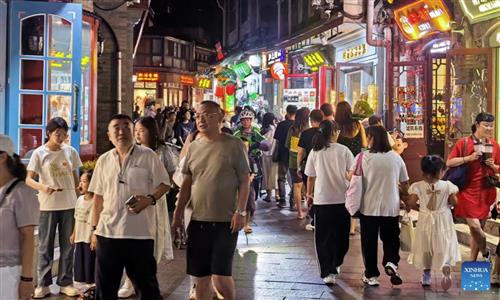
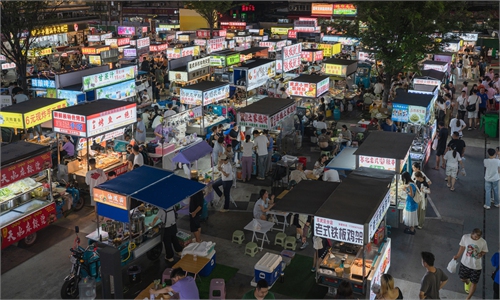
As the excitement inside stadiums hosting matches of the Jiangsu Football City League, known as Suchao, reaches fever pitch, the night markets outside are equally packed with crowds, igniting a vibrant boom in the nighttime economy across cities. In Suqian, East China's Jiangsu Province, residents gather outdoors to watch matches on large screens while enjoying local foods. Local media outlet suxinwen.cn described a bustling scene at one barbecue stall, where the cook said that he had already grilled more than 2,000 skewers over the course of the evening, with orders keeping coming.During the Suchao, multiple off-site viewing areas have been set up in Suqian, offering barbecues and other night snacks. Some sites have also offered small giveaways and other interactive activities, drawing crowds and adding to the evening's vibrancy. These arrangements are contributing tremendously to the local nighttime consumption market.
The boom in nighttime consumption is not limited to Suqian. Night markets, late-night shopping, evening tours, and diverse dining options are helping to drive the country's nighttime economy and support growth in cultural and tourism consumption. The Report on the Development of China's Nighttime Economy 2025 released by the China Tourism Academy shows that demand for nighttime tourism in China is steadily growing, with tourists' nighttime spending accounting for 32.9 percent of their total daily consumption.
The growth of the nighttime economy offers a lens through which to observe broader trends in China's consumption market. While certain foreign media reports have made various negative claims about China's consumer market, such views appear to underestimate the scale and diversity of demand. For those seeking a closer understanding of emerging consumption trends and potential opportunities, the expansion of nighttime spending provides a telling instance of how Chinese consumers are increasingly engaging with leisure, dining, and cultural experiences.
Three trends merit attention in the development of China's nighttime economy. First, demand for emotional and experiential consumption is rising. Nighttime activities are no longer limited to sightseeing; they are increasingly oriented toward experiences that provide emotional satisfaction and immersion. Through lighting installations, intangible cultural heritage performances, live-action theatrical productions, and other formats, some cities are creating nighttime environments focused on relaxation, stress relief, social interaction, and leisure gatherings.
In a town in East China's Shandong Province, actors dressed in traditional costumes are stationed throughout the streets to interact with visitors, while cultural performances and live-role experiences create an immersive historical atmosphere, according to the Xinhua News Agency. These activities have encouraged longer visitor stays and increased nighttime spending.
Second, the consumption of younger generations is increasingly influential. Young consumers are driving the development of new nighttime consumption scenarios. Their preferences extend beyond food and drink, encompassing stress-relief activities, sports and fitness, as well as other culturally and socially engaging experiences.
Activities such as studying late in 24-hour libraries, exploring museums through immersive night tours, or attending evening classes at youth-oriented night schools to learn skills such as latte art have grown in popularity. These culturally rich nighttime activities not only respond to the evolving demands of younger consumers but also support the development of new business models and consumption scenarios within the nighttime economy.
Third, demand is expanding into smaller cities and through localized nighttime leisure activities. The latest wave of nighttime consumption activities is reaching beyond first-tier cities such as Beijing and Shanghai. By drawing on a range of offerings - including locally organized sports events - nighttime consumption is extending to a broader set of markets, uncovering new potential in smaller cities and supporting local cultural and tourism spending.
These three trends are only part of a broader transformation. They are noteworthy not merely for their effect on the nighttime economy, but for the wider insights they provide into evolving patterns of China's consumption market.
China's consumer landscape is undergoing continual upgrade. Emotional and experiential consumption, the influence of younger consumers, and the growth of demand in smaller local markets are among the forces influencing spending habits. Observing these dynamics can help businesses trace the latest trends in Chinese consumption and identify where new opportunities are emerging.
Consumer activity in China remains dynamic, often defying simplified portrayals seen in some Western media. In Suqian, as in many other cities across the country, the consumption vitality is evident even late at night, highlighting the continuing evolution of China's consumption market and the opportunities it presents for those looking to engage with it.
The author is a reporter with the Global Times. bizopinion@globaltimes.com.cn
RELATED ARTICLES