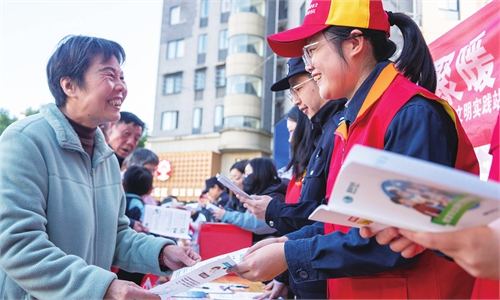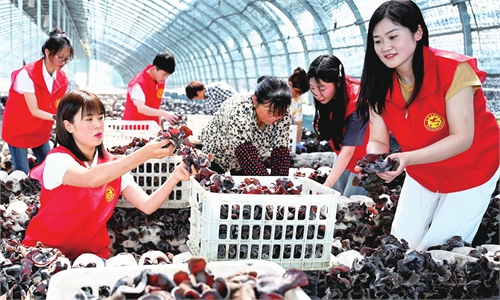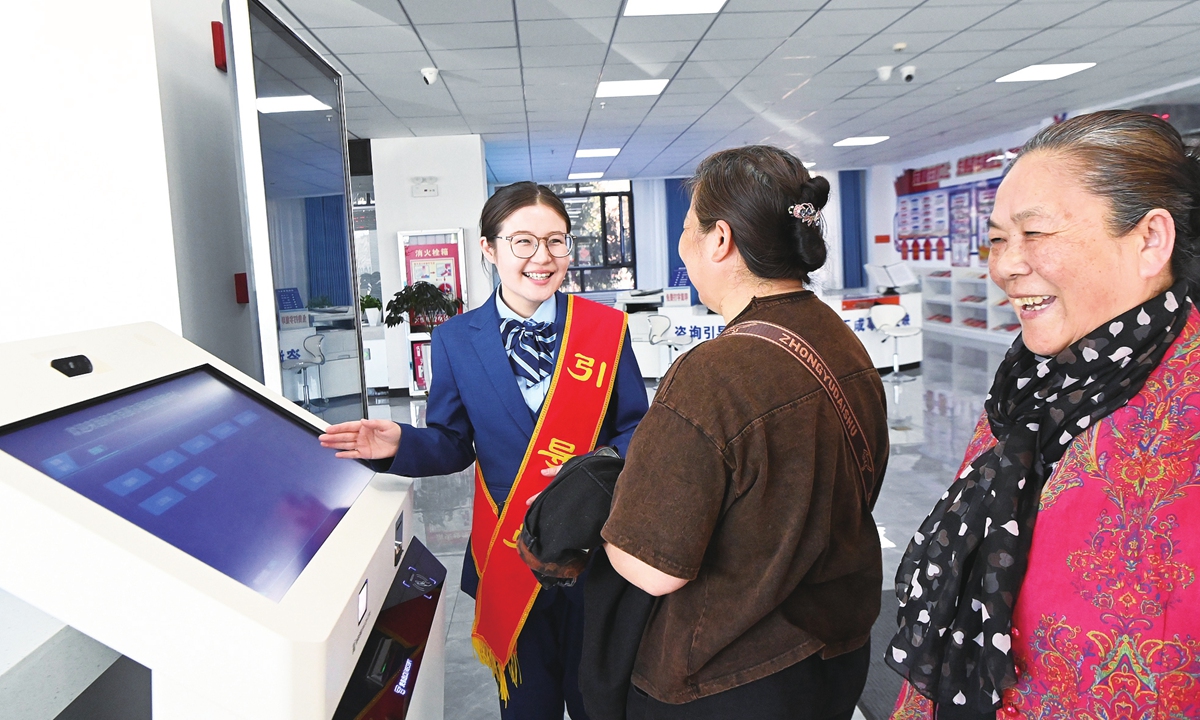
A Party member assists residents in handling procedures efficiently at the government service center in Mongolian autonomous county of Hoboksar in Northwest China's Xinjiang Uygur Autonomous Region, on April 9, 2026. Photo: VCG
Editor's Note:What does it mean to govern well and how should governance performance be gauged? The answer from the Communist Party of China (CPC) is that a correct understanding of governance performance should proceed from reality, respect objective laws, and, through sound decision-making and hard work, create achievements that withstand the test of practice and history, truly benefit the people, and earn public recognition. To examine the distinctive logic and global relevance of the CPC's correct understanding of governance performance, the Global Times (GT) launches a new series, "Understanding the correct view on governance performance," and invites leading international observers to share their thoughts on these issues.
In the fourth installment of the series, Nadia Helmy (Helmy), an Egyptian expert on Chinese politics and professor of political science of Beni Suef University, told Global Times reporter Wang Wenwen that while a correct understanding of governance performance requires proceeding from reality, China doesn't adopt a policy because it "looks good" in theory. It adopts a policy because it actually works on the ground.
GT: In your understanding, why does Chinese leadership emphasize establishing and practicing a correct understanding of governance performance?
Helmy: The reasons for this Chinese focus can be summarized as follows. First, offering an alternative for development and politics. The Chinese governance model is a highly efficient one that links economic success with political advantages, making it attractive to developing countries in the face of the absence of applicable Western models. Second, China aims to address the global governance deficit and reform the existing international system to be more equitable and just, serving the interests of developing countries and the Global South. As China attempts to address global challenges, its vision of global governance emerges as a response to escalating crises and a turbulent international system. China proposes its own model of governance based on the principles of development, security, civilization and good governance.
Domestically, it reflects a commitment to moving beyond simplistic metrics like short-term economic growth, and instead focusing on comprehensive progress, including social equity, ecological sustainability and the well-being of the people. This approach upholds the principles of socialism with Chinese characteristics and strengthens the governance capacity of the CPC.
GT: Chinese President Xi Jinping once noted, "A correct understanding of governance performance requires us to proceed from reality," and "we should focus on down-to-earth, practical work." In your observation of China's development process, what is the most impressive aspect of "proceeding from reality" and the "down-to-earth" manner? How is it embedded in the daily behavior of officials?
Helmy: What is most admirable about the "proceeding from reality" is its pragmatic flexibility; that is, the ability to deliver practical results and realistic solutions over rigid ideological frameworks. China doesn't adopt a policy because it "looks good" in theory. It adopts a policy because it actually works on the ground.
This is evident in the daily behavior of officials, through several points. First, local experimentation "modeling." Chinese officials don't immediately implement sweeping central decisions, but rather begin with "pilot zones." If the experiment succeeds in a city, it is generalized; if it fails, it is modified without political embarrassment. Second, a "problem-solving" culture. Officials focus on concrete figures and indicators, such as employment rates, infrastructure quality and poverty rates rather than rhetorical pronouncements. Third, continuous learning. There is a constant drive to gather data and adjust course based on feedback from the field - a process known as "crossing the river by feeling the stones."
In short, these approaches transform "reality" from a philosophical concept into a metric for measuring the success of policies in improving governance.
GT: How do you see the dialectical relationship between "talk" and "do," and between "know" and "act" in the CPC's working style? From an institutional point of view, how do Chinese institutions support the execution capacity where "words" will definitely be turned into "actions"?
Helmy: The CPC's philosophy of bridging the gap between "words" and "deeds" is based on the principle of "unity of knowledge and action," a concept that blends Marxism-Leninism with ancient Chinese philosophical traditions. From an institutional perspective, here's how policies are translated into concrete action and formalism is avoided. First, the Party doesn't simply issue general pronouncements; it employs a rigorous institutional system to translate grand strategic goals, such as the "great rejuvenation," into detailed Five-Year Plans. Words are broken down into quantitative performance indicators distributed across provinces and cities, making "the words" a measurable, numerical commitment. Moreover, the promotion of Chinese officials is based primarily on on-the-ground results, not lofty rhetoric.
GT: How does "a correct understanding of governance performance" foster people's trust in the Party and the government? How does the CPC's view on governance performance differ from the Western practice?Helmy: The Chinese government derives its legitimacy not from elections, but from its performance in improving living standards, providing services and achieving sustainable economic growth, which generates strong public trust. The central leadership sets the overall vision, while local officials handle direct implementation. This allows for rapid problem-solving and enhances confidence in the government's ability to govern.
In the West, governance is often subject to short electoral cycles (four to five years). This pushes politicians to focus on temporary solutions or "populist" policies to quickly improve economic indicators before the next election, potentially harming long-term strategic planning, which, in the end, jeopardizes people's interests.
GT: In your opinion, how can Global South countries learn from China's "proceeding from reality" and "down-to-earth" manner to evaluate the governance performance of their respective governments?
Helmy: Global South countries can benefit from China's pragmatic approach by adopting results-based governance, prioritizing economic development, adapting reform policies to local contexts and integrating long-term planning with technological innovation to enhance government performance, in line with the Chinese model that prioritizes development.
Regarding the detailed ways in which Global South countries can benefit from the Chinese approach, they can adopt a "trial and error" approach to economic and social policies, and evaluate government success based on tangible results, such as poverty reduction and infrastructure improvement, rather than adhering to ready-made Western models. They should focus government efforts on industrial modernization and technological innovation, thereby promoting sustainable economic growth.
Most importantly, they should learn from China's experience in rejecting the imposition of "universal values" and focus on building a unique governance model that considers their respective cultural and political circumstances.
RELATED ARTICLES