Chinese phone brand’s Mother’s Day ad sparks backlash over ‘fan-circle’ language, igniting debate on boundaries of marketing on public morality and family values
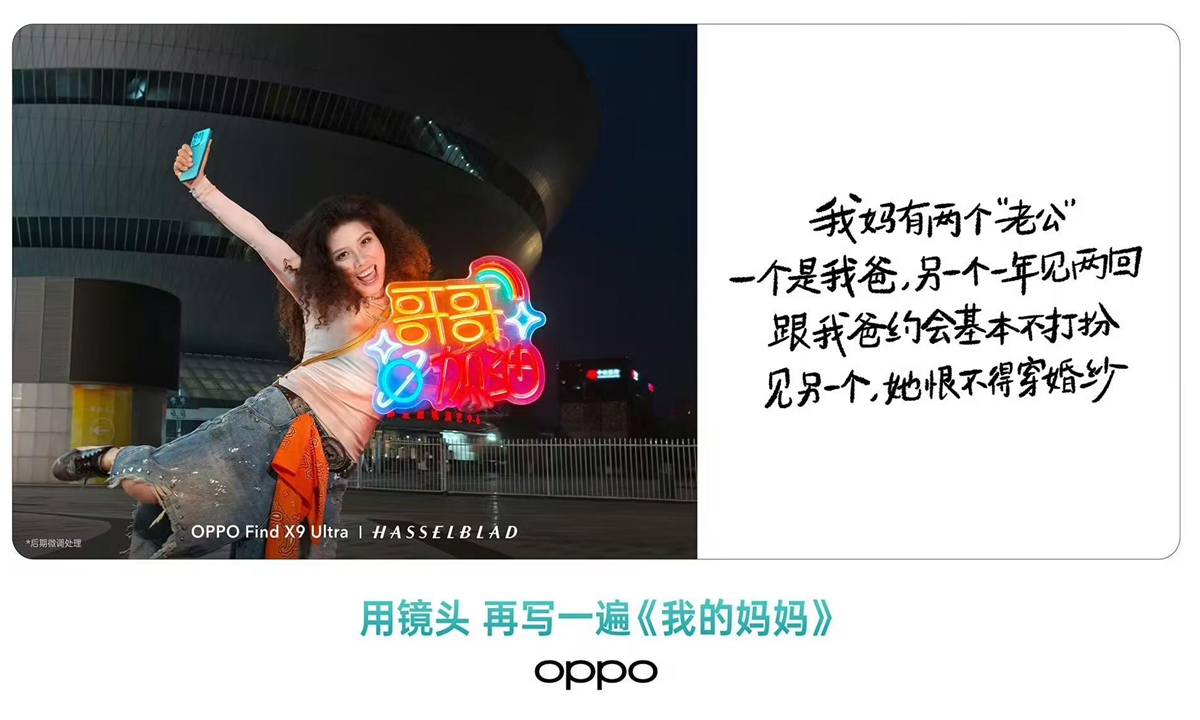
A screenshot of a controversial Mother's Day promotional image released by Chinese smartphone brand OPPO
A heated debate over the boundaries of commercial marketing on public morality and family values has gone viral online in China in recent days, triggered by a Mother's Day advertisement by Chinese smartphone brand OPPO, which issued public apologies twice as it found itself at the center of controversy due to its copywriting featuring the phrase "My mom has two 'husbands.'"
The controversy began on Friday, after OPPO launched a Mother's Day marketing campaign featuring a series of promotional images designed to showcase the camera capabilities of its upcoming Find X9 Ultra smartphone.
One of the campaign images featured the caption: "My mom has two 'husbands.' One is my dad, while the other only shows up twice a year. She barely dresses up when going on dates with my dad, but when meeting the other one, she'd wear a wedding dress if she could."
The accompanying image showed a stylishly dressed woman holding a light board reading "gege" ("elderly brother") — a term commonly used in China's fan culture to refer to male idols or celebrities — while holding up a smartphone. Another line beneath the image read: "Using the lens to write 'my mother' again."
The advertisement quickly sparked controversy among Chinese netizens, with some accusing the slogan of promoting "distorted values" or even "openly glamorizing emotional infidelity," while others argued the original intention of the company may have been to portray mothers as individuals with identities and hobbies beyond family roles.
Facing growing debate, OPPO issued an apology on its official Weibo on Friday, saying it "sincerely apologizes" for the controversy.
The company said the campaign was originally intended to "break stereotypes" and present "more diverse and multidimensional images of contemporary mothers," adding that mothers can enjoy marathons, writing or chase celebrities or idols.
"We have immediately removed all related materials. We will carefully listen to criticism from all sides and comprehensively review our content review mechanisms to ensure such problems do not happen again," the company said in the post.
Yet the initial apology failed to fully ease public anger. On Sunday, the China Advertising Association published a statement, saying advertising creation must distinguish between innovation and "bottomless hype," warning against a "traffic-at-all-costs" mentality and emphasizing that creativity "must never violate mainstream social cognition."
The association urged advertisers to respect traditional Chinese culture, family ethics and public morality, and to firmly resist sensationalist marketing that mocks family relationships or deliberately seeks public stunt.
On Monday, OPPO released a second apology statement, saying that "regarding the problems in our Mother's Day marketing materials, we extend our deepest apologies to the public. We are sorry," the company said.
"Whether it was the offensiveness of the marketing content itself or the perfunctory response afterward, both exposed serious deficiencies in our values and sense of responsibility," the company said, adding that "because of our mistaken understanding, we ignored the bottom line of mainstream social values, causing failures at every stage of the marketing process."
The company later announced punishment against senior executives responsible for the China market and other marketing management staff.
According to Chinese media outlet Jiemian News, which cited informed sources, the punishment represented "a rarely seen level of internal disciplinary action in OPPO's history."
Chinese media outlet 21st Century Business Herald published a commentary article, saying that OPPO has a consumer base that includes university students, white-collar workers and corporate executives. However, its original Mother's Day marketing copy appeared to target only the highly niche "girlfriend fan" segment within idol fandom culture — fans who habitually refer to their favorite celebrities as "husbands."
According to the article, the promotional image was released in an attempt to generate online buzz, while overlooking the fact that such expressions are rarely seen in real-life family relationships by the broader public.
The article said the brand's original intention may have been to convey that people at any age can pursue their own interests and passions. The identity within the family should not be a shackle that restrains women from pursuing their personal hobbies.
However, true understanding means respecting women, as independent individuals, in the complexity of their emotions and the diversity of their choices, rather than forcing all female behavior into the mold of so-called "fandom culture," it said.
Accompanying with the advertisement controversy, on Sunday, Wuhan University's official Weibo account reposted a statement from its School of Chinese Language and Literature, saying the university "strongly disapproves" of the content and value orientation of the Mother's Day advertisement by "a certain smartphone manufacturer."
The university said the campaign was "seriously inconsistent" with its educational philosophy of fostering virtue and moral integrity, adding that it hoped the alumnus involved would sincerely face criticism and shoulder social responsibility together with the company.
The literature school's statement said it was "astonished and shocked" by the controversy surrounding the marketing team reportedly led by a former student surnamed Yu.
It noted that Yu had been valued positively by teachers and classmates while he was studying at the school. However, the statement said the copywriting planned by Yu's team this time "seriously contradicted" the school's long-standing educational principles.
"We strongly disagree with the content, especially the sensationalist wordplay, discourse rendering and value orientation reflected in it," the statement said.
"We deeply hope alumnus Yu can face public criticism with sincerity and courage, correct mistakes without hesitation, and shoulder social responsibility together with the company," the statement said.
The university's intervention quickly triggered another round of debate on Chinese social media platforms.
Zhejiang Daily commented on Monday via its official Weibo account that Wuhan University had "overreacted to public pressure."
The outlet argued that the OPPO controversy had already begun to cool down online, but the university's statement unexpectedly pushed the issue back into the spotlight while placing the university itself "at the center of the storm."
According to the article, the response lacked the composure expected of a prestigious institution and instead gave the impression of "distancing itself from a former student at a difficult moment."
Yet, the university's response also drew some support online. The most-liked comment beneath the outlet's post read, "I think the response was quite appropriate."
"For educational institutions, value orientation is fundamental to their existence," some netizen wrote, adding that universities "must be accountable to both the country and society."
Regardless of which university the students are from, making such jokes or displaying distorted values is inappropriate. Wuhan University was simply being too straightforward in issuing a statement, a Weibo user wrote.
Meanwhile, The Beijing News commented on Monday via its official Weibo account that Wuhan University "did not need to implicate itself" in the controversy involving an alumnus.
It argued that for matters within a university's scope of responsibility — such as allegations of academic misconduct involving teachers or students — the institution should respond to public concerns and carry out investigations and disciplinary measures where necessary. For issues beyond the university's responsibilities, if others invoke the school in ways that may damage its reputation, the university may safeguard its rights in accordance with the law; if its reputation is not substantially harmed, however, the school may choose to respond with greater tolerance and composure.
Global Times
RELATED ARTICLES