Illustration:Chen Xia/GT
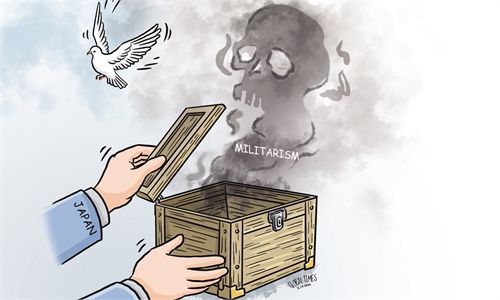
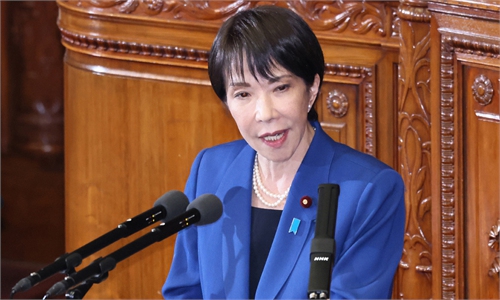
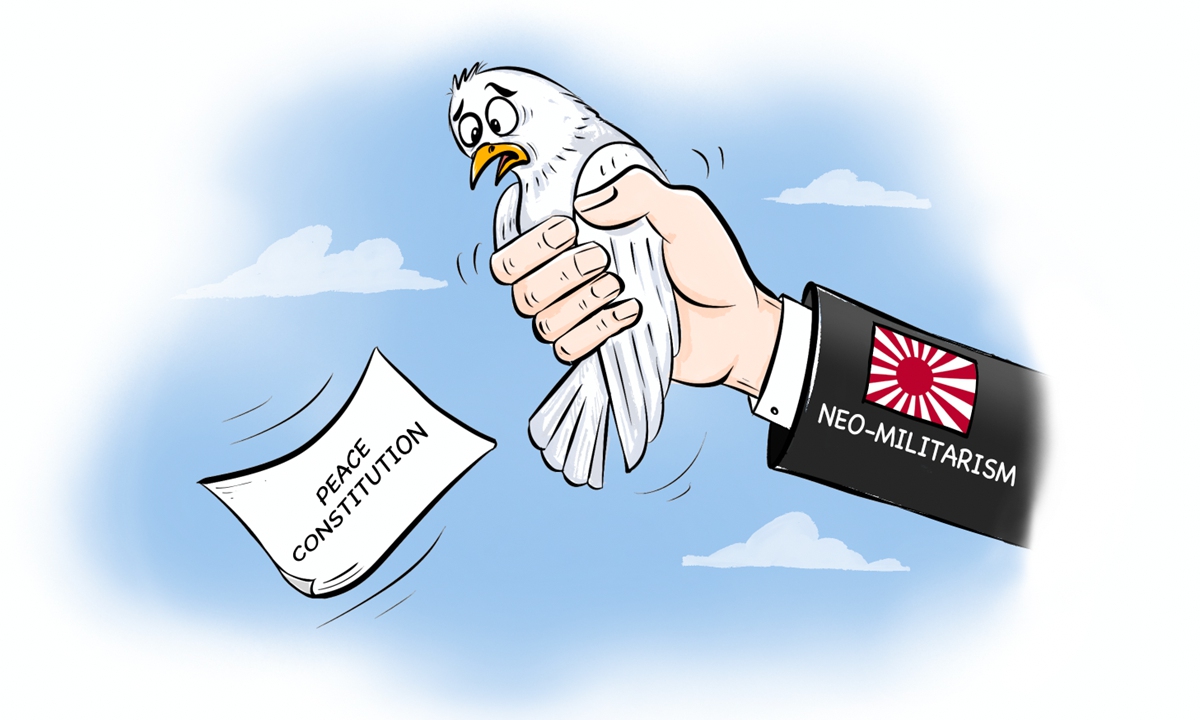
In recent years, Japan has consistently downplayed its history of aggression, accelerated its attempts to revise the "Peace Constitution," and taken frequent moves to strengthen and expand its military capabilities. It has deployed long-range missiles in multiple regions, relaxed restrictions on arms exports and even seen senior government officials openly advocating for nuclear armament. These developments suggest that Japan is trying to hollow out the post-war international peace order. This has caused serious concern in the international community, and even Western media outlets, long seen as favoring Japan, have been voicing increasing criticism.Japan is abandoning the pacifism it has adhered to since World War II and speeding up its "re-militarization." Following her victory in the House of Representatives election, Prime Minister Sanae Takaichi has pushed forward the constitutional revision agenda, relaxed arms export controls, channeled support to the military-industrial complex and blurred the "Three Non-Nuclear Principles." These actions signify that Japan has shifted away from pure defense policies and toward military expansion.
Japan's shift in defense policy has become a major factor affecting the global security landscape and regional peace and stability. As noted by media outlets, Japan is focusing on strengthening its counterattack and long-range strike capabilities beyond its existing defense system, while also stepping up overseas intelligence gathering, cyber surveillance and other related activities.
Some reports argued that Japan's defense objectives are clearly directed at the Taiwan Straits. Japan has positioned Yonaguni Island, its westernmost territory, as a forward outpost to monitor developments in the Taiwan Straits, while using Kyushu Island as a rear springboard, with its long-range strike capabilities covering the North Korea and China's coastal areas.
Publications have analyzed that although Japan claims the ultimate goal of its defense transformation is to enhance deterrence rather than launch actual offensive operations, the negative effects are becoming increasingly apparent. These effects include a spiraling arms race in the Asia-Pacific, a major shift in East Asia's security situation and a growing threat to regional peace and stability.
Behind Japan's abandonment of pacifism lies the ambition of right-wing forces to achieve "normal country" status for Japan and return to the path of militarism. Japanese militarism was not completely eradicated after WWII, and its war crimes were deliberately downplayed. As a result, right-wing forces have survived and grown stronger, laying the historical groundwork for Japan to continuously break through the "Peace Constitution" and abandon pacifism. Even Western media outlets argue that pacifism was imposed on Japan by the US after WWII, serving as an external constraint rather than an internal choice. Akira Yamada, a professor at Meiji University, pointed out that Japan has been downplaying its war responsibilities since the end of the war. In recent years, historical revisionism has spread, especially with the prevalence of erroneous views regarding the war of aggression against China. Without serious soul-searching, Japan will always face the risk of returning to the path of militarism.
Right-wing forces are steadily eroding the foundation of pacifism, bringing disaster to ordinary Japanese people. Under the pretext of national security, the Japanese government is actually expanding its military and revising the constitution, thereby gradually dissipating the peace dividend enjoyed by generations of people. Rather than providing security, these actions bring threats to the public and push Japan back toward the brink of conflict. Around military bases in Kumamoto and elsewhere, citizens have strongly protested against the Ministry of Defense's deployment of long-range missiles and demanded their immediate removal.
Massive defense expenditures are squeezing funds from people's livelihoods, with continuous cuts to investments in pensions, healthcare, and education. The Japanese government is using its people as a cash cow to support the expansion of defense spending, making them foot the bill for its military ambitions.
Today, more and more people have realized that Japan's subversion of post-war pacifism has become a major scourge for the peaceful development of the region. The international community has grown increasingly vigilant, and voices of opposition are growing. Japan once inflicted grave suffering on the Asia-Pacific region and the world at large. Embracing the path of peace was the foundation and prerequisite for Japan's reintegration into the international community after the war. If Japan now insists on breaking free from the constraints of peace and returning to the old path of militarism, which harms both others and itself, it will ultimately pay a heavy price for its misguided choices.
The author is an international affairs observer. opinion@globaltimes.com.cn
RELATED ARTICLES