Trump warning against ‘Taiwan independence’ sends shockwaves in island; remarks deal a severe blow to DPP and Lai Ching-te: KMT vice chairman
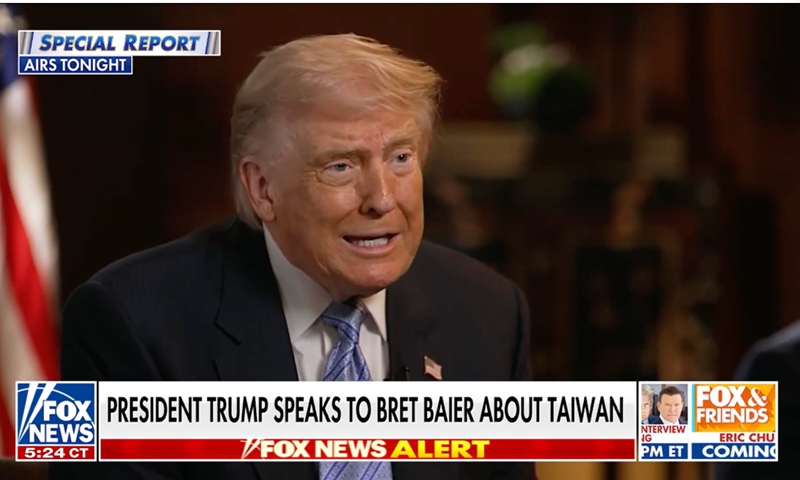
US President Donald Trump in a Fox News interview aired on May 15, 2026 US local time. Photo: Screenshot from Fox News
US President Donald Trump's warning against "Taiwan independence" has sent shockwaves through Taiwan's media and political circles. While pro-Democratic Progressive Party (DPP) outlets have largely attempted to downplay the remarks, a vice chairman of the Kuomintang (KMT) characterized the speech as a severe blow to the DPP and Lai Ching-te.For analysts, the US president's remarks underscore a highly pragmatic US approach. They note that Washington appears unwilling to allow a fringe group of separatist forces to derail vital US interests tied to the stability of China-US relations.
In an interview in Beijing with Fox News following the China-US summit, President Trump repeatedly used the phrase "not looking to have" when discussing the Taiwan question, saying, "I'm not looking to have somebody go independent ... we're not looking to have somebody say, let's go independent because the United States is backing us." He also stressed the distance involved, claiming that he was not looking for the US to travel 9,500 miles to fight a war, per the program that aired in the US on Friday local time.
Trump's remarks related to the Taiwan question have ignited strong reactions from the island, from media supporting different political factions on the island, to political figures and influencers, causing continuous ripple effects.
Chinatimes.com published on Sunday an article compiling reactions to Trump's remarks by international media including the BBC, France24 and the Japan Times, which the Taiwan outlet summarized as a warning against "Taiwan independence."
News portal udn.com mentioned the DPP authorities' Sunday claim that its stance has always been clear and consistent as "maintaining the status quo" in one article, while in another, it reported the opposition Kuomintang's (KMT) criticism of the DPP's severe misjudgment of relations between the US and Taiwan region, and the opposition party's call to abandon "Taiwan independence" and treat Trump's warning seriously.
Hsiao Hsu-tsen, vice chairman of the KMT, said Trump's remarks deal a heavy blow to the DPP and Lai Ching-te, in an interview with chinanews.com. Relevant regulations in Taiwan and the KMT's policy positions firmly oppose "Taiwan independence," and the majority of Taiwan people also reject the cross-Straits risks and troubles brought about by separatist acts, he said.
If the US government can earnestly implement its opposition to "Taiwan independence" in concrete terms, it will send a remarkably positive signal for peace and stability across the Taiwan Straits, chinanews.com quoted Hsiao as saying.
When asked by Taiwan media about Trump's remarks, Taiwan media personnel Jaw Shaw-kong said on Saturday that "Taiwan independence" will only bring disaster to the island. The DPP did not cast aside the "Taiwan independence" agenda only to provoke the mainland and consolidate its status, per reports from the island's outlets including China Times.
If the DPP is truly wise, it should abandon its "pro-independence" party platform right now, Jaw said, per China Times.
Earlier on Friday, KMT Chairwoman Cheng Li-wun remarked that "Taiwan independence" is a dead end with no viable path forward.
A poll released by a KMT-affiliated think tank on Friday suggested that 80.3 percent of the surveyed believe cross-Straits questions should be addressed through peaceful consultations. Even among DPP supporters, 60 percent preferred a peaceful approach.
News portal ltn.com, which is more aligned with the "pro-Independence" agenda, has attached great importance to the visit, publishing dozens of reports and opinion pieces on Sunday alone. Yet the Global Times noticed the media tended to highlight US statements that US policy regarding Taiwan has not changed, while downplaying Trump's interview with Fox News.
Another ltn.com report cited Shen Yu-chung, deputy minister of the island's mainland affairs council, as saying that the DPP authorities would carefully respond to Trump's remarks and maintain communication with the US.
Trend of time
Zhang Wensheng, deputy dean at the Taiwan Research Institute of Xiamen University, told the Global Times on Sunday that though Trump did not explicitly state "opposition to 'Taiwan independence,'" his new expressions of "not looking to have" such tendency has laid bare his oppositional attitude, dealing a heavy blow to separatist forces on the island.
Regarding US arms sales to Taiwan, including a package that passed Congress but has been delayed at the White House level, Trump told Fox News he is "holding that in abeyance and it depends on China" and "it's a very good negotiating chip."
Taiwan island's media outlets including udn.com took note of a New York Times report, which said the words raised new doubts about the pace and scale of US military support for the island.
Zheng Jian, a professor at the Graduate Institute for Taiwan Studies at Xiamen University, told the Global Times on Sunday that separatist forces in Taiwan are engaging in self-comfort and acting blind to real signals from the US.
Zhang noted that some "pro-Independence" forces used to hold the illusion that the US would offer unconditional backing and even take risks for them, but it has been completely shattered.
In the context of intensifying China-US strategic competition, "Taiwan independence" forces increasingly resemble a shoe that could be kicked off at any moment, remaining in a state of constant anxiety and fearing abandonment, Zheng said.
Separatist forces are rushing to seize on any signs of reassurance, treating any ambiguous signals as lifelines and staging a last-ditch struggle of a cornered beast. Meanwhile the underlying changes in the US once again demonstrate that the White House understands that the US-China relationship is so consequential that it is reluctant to have massive US interests in China ties be ruined by the Taiwan question, experts said.
According to media reports and video clips released, on his Air Force One flight back to the US, a reporter asked about so-called "assurances" to Taiwan region during former president Ronald Reagan's term, and Trump replied: Well I think the 1980s is a long way. "That's a big, far distance," the US president said.
RELATED ARTICLES