IN-DEPTH / IN-DEPTH
Beyond heartfelt film ‘Dear You,’ time-honored ‘qiaopi’ tradition keeps thriving, forging fresh connections rooted in universal cross-border emotions
By Lin Xiaoyi and Published: May 19, 2026 11:51 PM

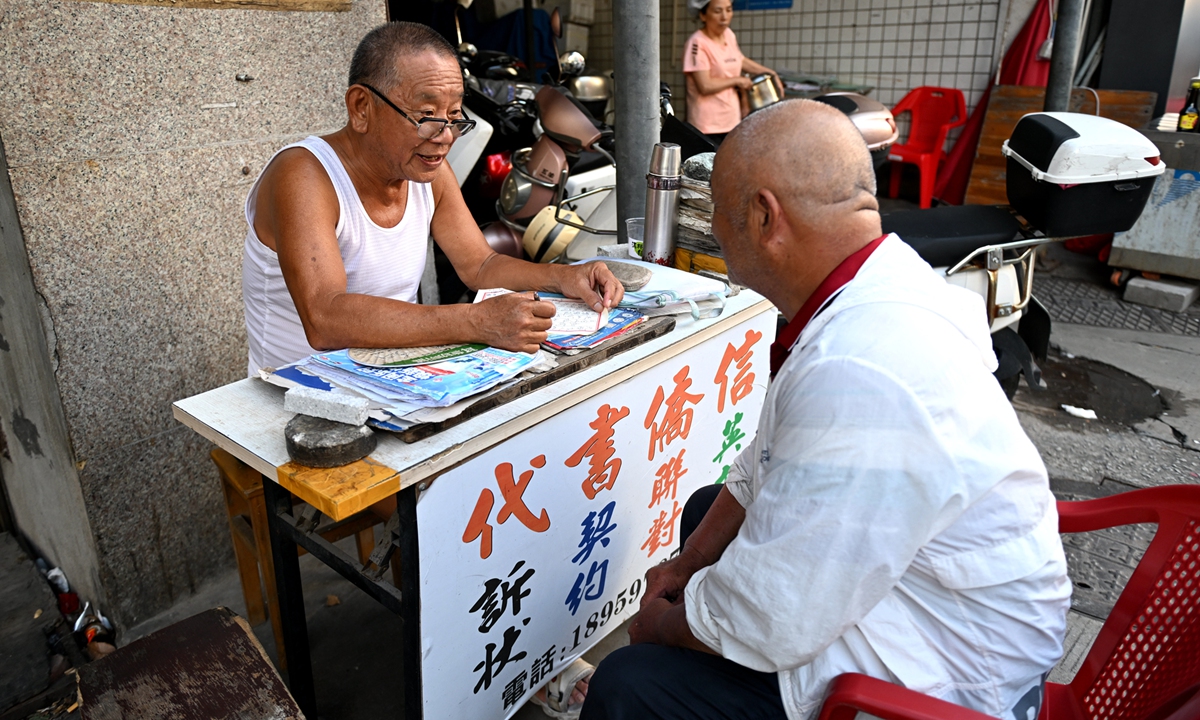
Jiang Mingdian (left) talks with a customer at his roadside stall in Quanzhou, East China's Fujian Province, on July 13, 2025. Photo: VCG
Editor's Note:"No mountain or ocean can distance people who have shared aspirations." This powerful message underscores the force of friendship and cooperation in bridging hearts across nations, cultures and civilizations.
People from diverse backgrounds and fields, united by common goals and dreams, traverse mountains and oceans to connect with each other. Through letters, face-to-face dialogues and vibrant cultural events, they are collectively weaving a magnificent tapestry of building a community with a shared future for humanity.
The Global Times presents "Intertwined Destinies, Shared Paths," a series spotlighting the touching stories written by these "friendship ambassadors." They are scholars pushing the boundaries of research, diplomats advocating for deeper cooperation on the global stage, artists igniting imaginations with their creations and ordinary people extending heartfelt love beyond national borders driven by their genuine sincerity.
Their stories illuminate the spark of cultural exchanges, the driving force of technological innovation, the bountiful harvest of economic cooperation and the enduring warmth of human connection - all contributing to a more peaceful, prosperous and open world. This is the 14th installment of the series.
For nearly six decades, 77-year-old Jiang Mingdian has written hundreds of thousands of qiaopi - a unique form of personal mail - for local men in his hometown to send to their loved ones around the world.
Despite his words having traveled far and wide, Jiang had never once left Quanzhou in East China's Fujian Province - until last Sunday, when he was invited to Beijing for a special screening of the hit film Dear You.
Jiang was invited in his capacity as a veteran qiaopi scribe. The heartwarming film Dear You explores cross-border family ties between the Chaoshan region in South China's Guangdong Province - a region where generations of people in the past often left to seek work overseas - and Thailand, using authentic qiaopi as its central narrative thread.
Made with a modest budget of merely 14 million yuan ($2 million) and mainly spoken in local Chaoshan dialect, the low-budget production has turned into a phenomenal cultural hit, grossing over 600 million yuan at the domestic box office as of press time, according to Chinese ticketing platform Maoyan. Its sweeping popularity among audiences at home and abroad has finally brought qiaopi into mainstream public view.
These unique qiaopi - which usually combine a personal letter with a remittance sent home - have emerged as invaluable historical records, embodying the profound love and longing that generations of overseas Chinese felt for their families and homeland.
For Jiang, his life has spanned the evolution of this tradition. In the past, qiaopi served as vital lifelines for survival, carrying both emotional messages and essential financial support. Today, this heritage is preserved in the qiaopi archives, which were inscribed on UNESCO's Memory of the World Register.
Boosted by the hit movie, cultural and creative products and the youth craze for ancestral root-seeking, these century-old memories have been revived, gaining new vitality through inheritance and innovation.
Letters full of devotion
The 10-hour high-speed rail trip from Fujian to Beijing was a breeze for Jiang, as his daily routine has long trained him to sit for hours on end.
During the interview with the Global Times, he talked about his work routine. He opens his street stall at 9 am and stays until dusk, always ready to help whenever clients reach out. His humble workspace features only an old yellowed wooden table on a Quanzhou street. Armed with just a fountain pen and a few tattered Chinese-English dictionaries, he has stayed devoted to this craft for decades.
Right after the film screening ended, he hurried to head back home. Eager to embark on another 10-hour high-speed rail journey, he worried his regular clients would not be able to reach him for letter-writing services.
This sense of duty took root in the mid-20th century, when nearly every household in Quanzhou had relatives that had emigrated abroad. These overseas Chinese sent home their hard-earned savings along with endless concerns via remittance letters. Since most local residents were illiterate back then, professional writers like him helped locals read incoming letters and write replies.
Among the hundreds of thousands of letters Jiang has handled, some stories haunt him. He remembers a woman from the county-level city Jinjiang surnamed Cai, whose husband had moved to the Philippines. Every month, she came to Jiang to write a letter pleading for her husband's return. Unbeknownst to her, her husband had long since died in a shipwreck. To protect her, her son began writing back in his father's name, sending small remittances to keep her hope alive.
Many such poignant stories are kept in old qiaopi archives. At the Qiaopi Museum in Shantou, Guangdong, a historic letter stands out with a huge Chinese character meaning "hardship" taking up most of the page. While it lays bare the day-to-day struggles of overseas emigrants, every line of the letters also shows their unshakable resolve to support their families through all hardships.
Wang Yujiao, a Southeast Asia-based qiaopi researcher, has found more touching facts through historical studies and field interviews. Many overseas Chinese laborers did not get paid on time, yet they still needed to support their families. Local qiaopi agencies would offer advance funds to help them send money home. Even in hardship, overseas Chinese never abandoned their families, and local agencies always lent a helping hand.
Apart from family affection, archived qiaopi records also bear witness to the profound patriotism the overseas Chinese felt for their motherland. For instance, as reported by the People's Daily Overseas Edition, in 1939 amid Chinese People's War of Resistance Against Japanese Aggression, overseas Chinese Tan Yixi in Havana, Cuba raised 165 Hong Kong dollars to support the homeland, writing that all Chinese descendants ought to fulfill their civic duties for the motherland. Another letter tells of a father sending his son to the US to study aviation, believing aircraft technology was vital to defeating foreign invaders.
Wang also shared an impressive interview experience during her research. "A descendant of a historic qiaopi agency told me that running this type of business barely brought in a profit with only slim service fees charged. Even running at a loss, his father kept the agency going and covered the deficits with income from other businesses. For them, running a qiaopi agency was more about bonding fellow townsfolk and shouldering social responsibilities," she told the Global Times.
This same sense of responsibility has kept Jiang sticking to his post all these years.
Official data shown in the film Dear You indicates that before qiaopi agencies faded away in the 1980s, more than 30 million qiaopi letters had been received nationwide. Between 1864 and 1980, overseas Chinese remittances topped over $10.8 billion.
"During the war, overseas Chinese donated money via qiaopi to buy warplanes, medicine, grain and other supplies to back the domestic resistance cause," Jiang said. "In later peaceful years, billions of annual overseas remittances were used to build local bridges, roads and schools, fueling hometown development," he added.
Heritage lives on
With the advance of communication technologies, fewer people sought Jiang's qiaopi writing services, yet he has never been idle.
"Client numbers dropped in the 1980s and 1990s, but I grew busier," he recalled. In the early days of China's reform and opening-up, many Quanzhou locals headed overseas to reunite with family members. Jiang then turned to helping them translate immigration paperwork.
Now his stall draws new groups of visitors. Some ask him to pen letters informing overseas kin of China's fast development and thriving life back home. Others, overseas Chinese returning for family visits, entrust him to organize historical records that chronicle how their forebears supported the motherland, aiming to tell more people about this period of history.
In April 2025, Jiang set up an account on social media platform Xiaohongshu (RedNote) to share his decades of experiences writing qiaopi. Thanks to online influence, he reconnected with many old acquaintances in rural Quanzhou. Though years have altered their looks, Jiang still vividly remembers their family backgrounds and former overseas addresses.
The rising public attention on qiaopi also inspires Wang. Fueled by the hit film Dear You, her book Money and Bloodlines: The Rise and Transformation of Thailand's Remittance Empire, 1850s-1990s (Chinese version) has nearly sold out in Thailand and Singapore, with reprints scheduled and a Chinese mainland release due this summer. Netizens in Malaysia and the Philippines have also left messages on her social media platforms, expecting such research works to reach their countries as well.
Her live streams also attract huge audiences, as they are more curious about specific historical details than grand historical narratives. They often ask how people sent money from Southeast Asia to China without modern banks and internet, how remittance services kept running during wars and how ordinary people built such solid cross-border trust.
"People are deeply touched not only by the homesickness and warmth in these letters, but also by how ordinary people built cross-border connections in old times," she told the Global Times.
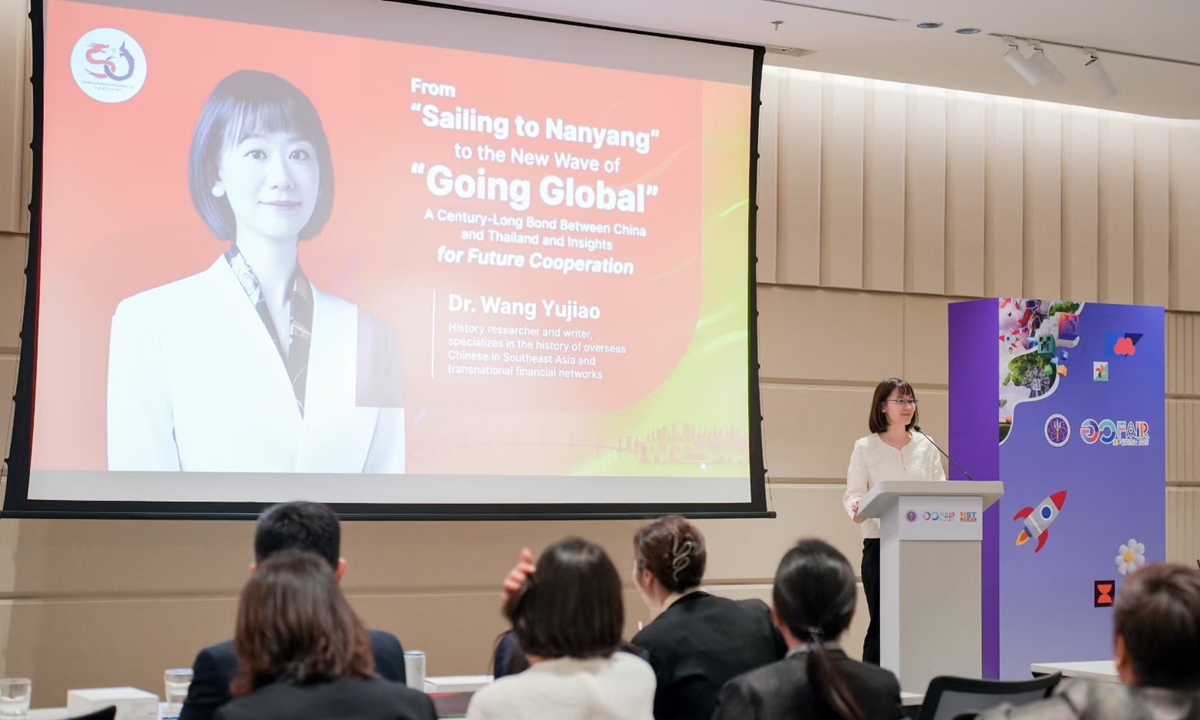
Wang Yujiao delivers a speech on qiaopi research at an event marking the 50th anniversary of China-Thailand diplomatic ties in Bangkok in August 2025. Photo: Courtesy of Wang
Having long resided in Southeast Asia, Wang views qiaopi far beyond mere historical relics. "People built connections via qiaopi, ports and trading firms over a century ago, while modern financial systems, logistics and industrial networks sustain such ties today. This historical continuity is truly touching."Listed on the UNESCO Memory of the World Register in 2013, these cross-ocean memories have become shared cultural treasures of humanity, and their touching stories are still being passed down and enriched day by day.
Preserve in innovative ways
Jiang's modest stall has evolved alongside the qiaopi tradition itself.
Today, young people travel across China to find him. They no longer come just for traditional remittance letters; they come to entrust him with their innermost thoughts. Some ask him to draft love letters or messages to their future selves; others share the pressures of modern life. For many, writing a qiaopi has become a way to process grief or celebrate heritage. Jiang's small table has become a window into history, keeping a centuries-old craft alive in the digital age.
In his spare time, Jiang volunteers as a docent at the Wulin Qiaopi Museum, where he demonstrates the art of letter writing for visitors. This spirit of revival is echoing across the country through the "Write Home Again" campaign. In nearby Fuzhou and Xiamen, local illustrator Zou Yuansheng has joined forces with Tanto, a fourth-generation Chinese Indonesian from Bandung, to launch immersive qiaopi -themed exhibitions and workshops.
Raised in an overseas Chinese household, Zou witnessed the final years of the qiaopi era. In an interview with the Global Times, he said he hoped to present these historical stories in an approachable way. He later met Tanto who has long sought his ancestral roots. qiaopi serves as his key connection to his family history, and the two eventually partnered to revive this precious cultural legacy.
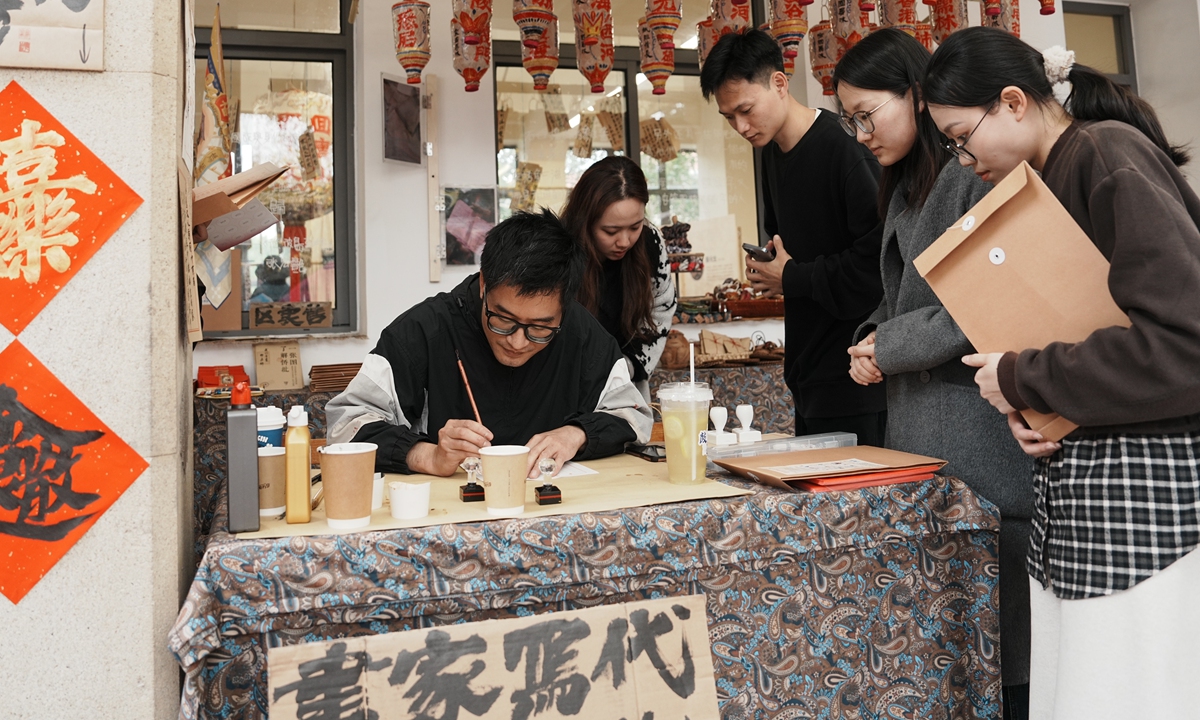
Young people join experiential qiaopi writing activities at an immersive qiaopi-themed exhibition curated by Zou Yuansheng in Xiamen, Fujian Province, in March 2026. Photo: Courtesy of Zou
Zou and his team revitalize qiaopi with comics and lanterns: Cute cat comics depict overseas Chinese migrating south, sending money home and longing for their homeland; lanterns feature clan origins, hometown sites and family messages - a vital Minnan cultural symbol, each lantern a visible letter. At events, he acts as a traditional letter writer, teaching classic formats and recreating qiaopi scenes."For young people today, writing qiaopi is a romantic ritual, a tribute to ancestors and a way to inherit Chinese culture," Zou said.
What left a deep impression on Zou was a young girl from Central China's Henan Province who came to Fujian for the event. "I guided her to write a letter to her late grandfather. I turned her words into a classical-style family letter, and when I read it to her, she burst into tears… She said she never knew writing a letter could feel so meaningful, and that longing could be expressed with such solemnity."
In March, Zou created a special lantern for Tanto, inscribing a modern qiaopi to his grandmother on it. It reads: "Your grandson has returned to our ancestral home in Fujian, started a family and built a career. I have inherited the flavors of our Indonesian-Chinese heritage and opened a restaurant in our hometown. I invite guests to enjoy the delicacies of Southeast Asia together, using food as a bridge to foster cultural exchanges between China and Indonesia."
This timeless spirit of qiaopi can also be fully seen in the letters Jiang writes for young people today. Letters now carry wishes for the future and love for the nation, not just longing for distant kin. Times change, but some things stay the same: his letters to young people always encourage self-reliance and devotion to the country, just like the hopes and love for the motherland held by the self-reliant overseas Chinese decades ago.
RELATED ARTICLES