15th Five-Year Plan expected to become an era of major breakthroughs for China: scholar
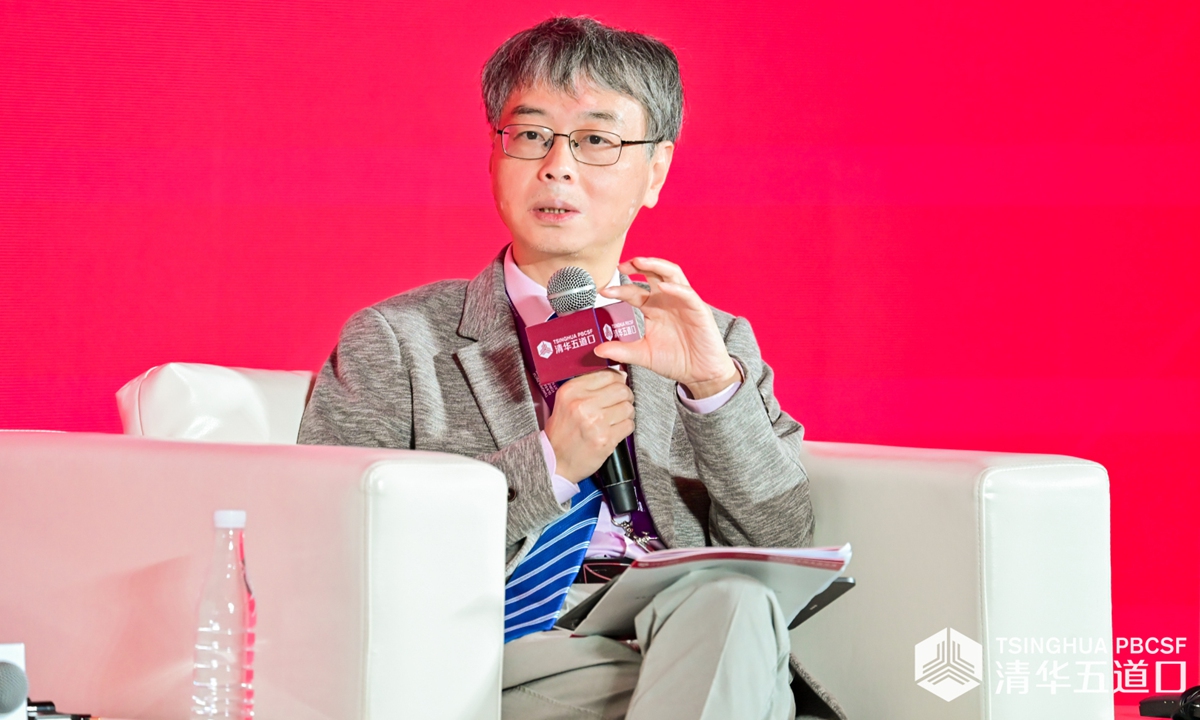
Shi Kang, chair professor at the PBC School of Finance, Tsinghua University. Photo: Courtesy of 2026 Tsinghua PBCSF Global Finance Forum
There are many positive factors driving China's economic development during the 15th Five-Year Plan period (2026-30), including technological advancement, high-quality growth of the service sector, and the "dual circulation" growth pattern. The next five years are expected to become an era of major breakthroughs for China.
In 2026, China set an economic growth target of 4.5 to 5 percent and vowed to strive for better results in practice. It reflects a more pragmatic approach - one that fully accounts for external uncertainties in the global geopolitical environment, necessitating greater caution.
However, Chinese decision-makers have demonstrated continuous confidence in the future of the economy. As China pivots toward high-quality development, the economy is prioritizing quality over sheer scale. The 4.5 to 5 percent GDP growth target leaves ample room for maneuvering.
It allows for the possibility of outpacing expectations while enabling local governments to focus on their own initiatives to seek high-quality growth. This is a positive stance, embodying the proactive spirit of "seeking progress while maintaining stability" in the Chinese economy.
As for the main driving factors driving the economy in the next five years, first and foremost is the country's internal growth strength.
Unlike many other countries, China has a clear-eyed understanding of its own capabilities. The country's advanced manufacturing now accounts for about 30 percent of the global total. Its "new trio" products, including new energy vehicles, lithium-ion batteries, and photovoltaic products, are already global leaders, while the country is still seeing the emergence of a new handful of strategic industries.
Whereas the country once relied on imported chips, it now exports mid-range semiconductors at a massive scale. In pharmaceuticals, China has moved from generic manufacturing to innovation, as the scale of drug patents out-licensing (BD) to foreign firms was substantial last year and continues to accelerate this year. These trends are encouraging, with advanced manufacturing clusters emerging faster than anticipated, reflected in the explosive growth in elecgric vehicles, batteries, and energy storage.
And, there are inspiring breakthroughs beyond high-end manufacturing. Cultural exports like Ne Zha 2 are gaining traction, reflecting growth in service exports. Moreover, the country's artificial intelligence (AI) possesses distinct advantages. The tech innovation capabilities form the bedrock of confidence for the 15th Five-Year Plan.
Second, the country's transition from an export-led model to a "dual circulation" growth pattern - balancing domestic and international demand - is beginning to bear fruit. Although consumption recovery is still a work in progress, grassroots phenomena like the "Village Super League" and various local consumption stimulus activities are proliferating nationwide, helping boost consumption.
Entering the first year of the 15th Five-Year Plan, another critical factor is policy stability. While China cannot yet claim complete stabilization, the policies have largely curbed the downward trend in real estate. As the macro policies take full effect, consumption is poised to become a new growth engine.
China's economic performance has been remarkable. The country takes great pride in its achievements and remains committed to contributing to the global community.
Regarding the global monetary system, I think China's strategy is clear: We do not seek to replace the current US dollar-centric system, nor do we intend to build a separate, parallel system. Our message is unambiguous: China aims to address the shortcomings within the existing framework.
We seek to broaden participation in the global financial system to meet the demands of global trade and foster financial stability, rather than displacing the US dollar. To advance this reform, China focuses on four key pillars.
First, the yuan's internationalization. We are promoting greater use of the yuan in cross-border trade and investment. In 2024, yuan settlement volume reached 6.4 trillion yuan, rising to 7 trillion yuan in 2025. The currency is now widely used in international trade, particularly among Belt and Road partner countries.
Second, China has also developed financial tools. Given concerns that the SWIFT system has been increasingly weaponized, China has phased in the Cross-Border Interbank Payment System (CIPS). CIPS has benefited many countries by making cross-border settlements more efficient.
Third, China has signed many bilateral currency swap agreements to inject global liquidity. By providing liquidity support to Argentina and other emerging market economies, China is increasing the supply of global liquidity and helping economies in need. Furthermore, China is increasing the use of the Special Drawing Rights (SDR) system, which benefits all nations by diversifying global reserve assets.
This article is compiled based on an interview with Shi Kang, chair professor at the PBC School of Finance, Tsinghua University. bizopinion@globaltimes.com.cn
RELATED ARTICLES