Chinese and Indonesian scientists map ancient genetic divide across Wallace Line
By Published: May 20, 2026 11:23 PM

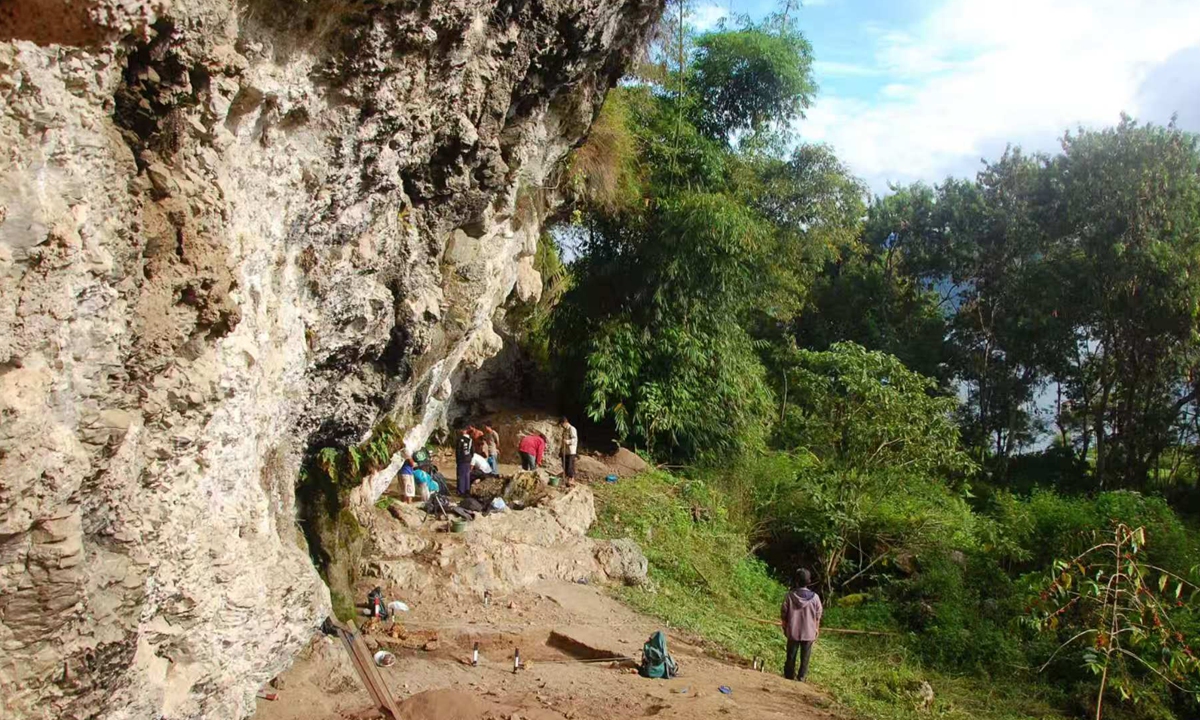
An active archaeological excavation site in Indonesia Photo: Courtesy of Kunming Institute of Zoology under the Chinese Academy of Sciences
A joint team of Chinese and Indonesian scientists has used ancient genome data to reconstruct the genetic history of populations on both sides of the Wallace Line in the Indonesian archipelago, shedding new light on how people migrated, mixed and diverged in one of the world's most geographically and genetically diverse regions, Global Times learned from the Chinese researchers on Wednesday.
The study was conducted by teams led by Zhang Xiaoming and Ji Xueping from the Kunming Institute of Zoology under the Chinese Academy of Sciences (CAS), together with a team led by Wang Chuanchao from Fudan University and a team led by Ketut Wiradnyana from Indonesia's National Research and Innovation Agency. The findings were recently published online in iScience, a multidisciplinary journal under Cell Press.
Located at a maritime crossroads between mainland Asia and Oceania, Indonesia is the world's largest archipelagic country and home to one of the most complex patterns of genetic diversity on Earth. It is also a key region for studying ancient human migration, population interaction and genetic differentiation.
"The Wallace Line was previously regarded mainly as a classic biogeographical boundary separating Asian and Australian faunal regions. Our study shows that it also played an important role in prehistoric human migration and population differentiation," Zhang, who led the research team from the Kunming Institute of Zoology, told the Global Times.
Zhang explained that by analyzing ancient genomes from the Loyang Mendale cave in northern Sumatra, dating back about 3,300 and 1,700 years, the team has obtained relatively high-quality direct ancient DNA evidence from western Indonesia for the first time.
"The findings demonstrate that the population differences between the eastern and western parts of the Indonesian archipelago did not emerge only in modern times, nor were they the result of a single migration. Instead, they were shaped by multiple waves of population movement, admixture and population continuity, built upon earlier prehistoric regional differentiation," Zhang said.
However, reconstructing this history has not been easy. Ancient DNA is extremely difficult to preserve under tropical conditions, where high temperatures and humidity accelerate the breakdown of genetic material. As a result, western Indonesia has long lacked high-quality ancient genome data, leaving a major gap in scientists' understanding of how the region's genetic structure evolved, according to the institute.
The latest study helps fill that gap, according to the study.
Researchers combined the two newly sequenced western Indonesian genomes with previously published ancient genomes from Island Southeast Asia dating from about 7,000 to 200 years ago. Through comparisons across different time periods and regions, the researchers systematically reconstructed the genetic history of populations in the eastern and western parts of the Indonesian archipelago.
The study also highlights the value of international cooperation in archaeology and human genetics. Since 2023, the Kunming Institute of Zoology and Indonesia's National Research and Innovation Agency have signed a cooperation agreement, carried out mutual visits and conducted joint archaeological surveys. The new findings are an important outcome of this growing collaboration, the CAS institute told the Global Times in a release on Wednesday.
RELATED ARTICLES