240-meter-long bamboo raft draws crowds in Beijing, offering new picture of ICH in urban life
Golden dragon lights up blessings
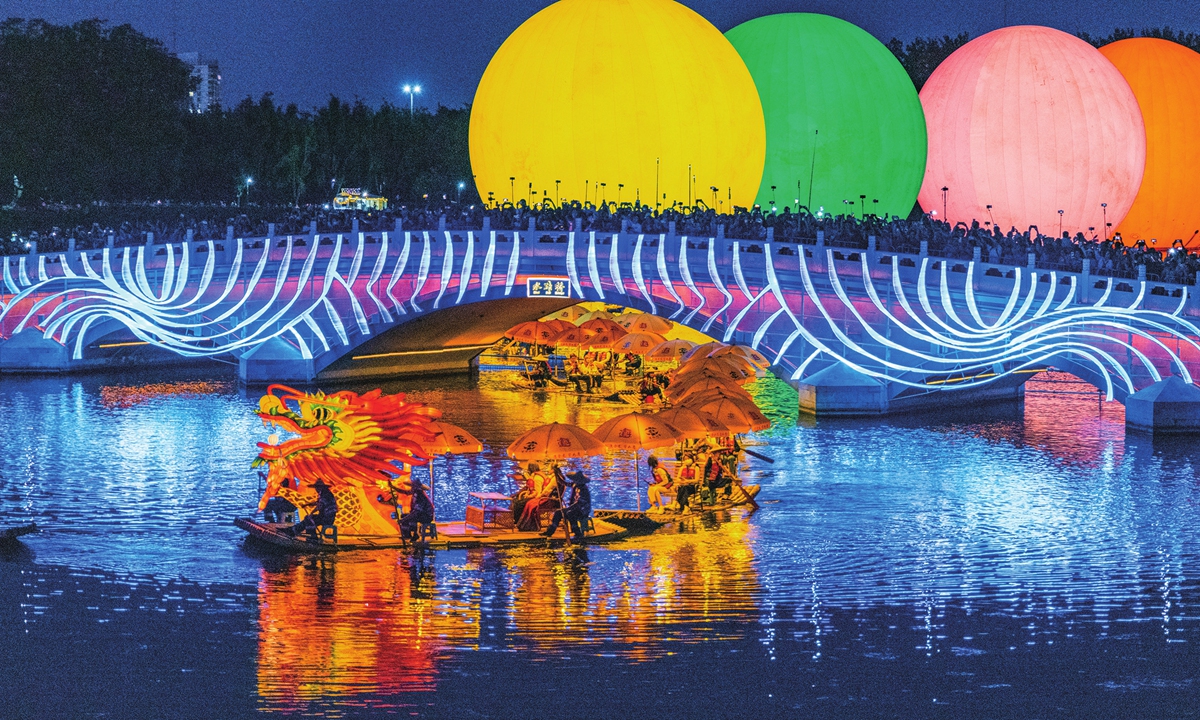
A golden dragon parade across the lake in Chaoyang Park, Beijing on May 18, 2026 Photos: VCG
At 7:30 pm, 36 bamboo rafts linked together to form a 240-meter-long golden dragon glided slowly across the water, with its illuminated body winding through the lake like a living painting. Evening winds carried shimmering reflections across the river's surface, turning every snapshot into what many visitors described as a "Chinese-style blockbuster."The scene of the golden dragon parade, a municipal intangible cultural heritage (ICH) from Yangshuo county, South China's Guangxi Zhuang Autonomous Region, did not unfold in the misty waterways of southern China, but in the heart of Beijing in mid-May.
Crowds packed the Shuidui Bridge along the Liangma River to watch the performance. Chen Pu, a photographer who came to see the parade, told the Global Times that he had once witnessed a similar golden dragon procession along the Lijiang River in Guangxi, but never imagined encountering it again in the middle of an international metropolis. "Previously, I always thought these folk customs belonged to villages and riverside towns," Chen said. "I have never expected the dragon parade could blend so naturally with an urban skyline."
While traditional folk performances are not uncommon across China, staging them within a modern urban waterway has become part of the attraction, Zhang Yiwu, a professor of Chinese language and literature at Peking University, told the Global Times.
Zhang noted that since Anhui's Zhanqi fish-shaped lantern parade gained nationwide attention in 2025, public understanding of ICH has expanded beyond static craftsmanship into immersive folk experiences capable of integrating with contemporary city spaces.
Fortune on the water
The Yangshuo "Golden Dragon Parade" was first created in 2014 during the Yulong River bamboo rafting festival in Guangxi, according to local media report. Much of the dragon's visual impact comes from the craftsmanship of its head, which incorporates the traditional Gongcheng Colored Paper Craft of Guangxi (caizha), a vibrant traditional folk art that intricately weaves bamboo framing, paper sculpting, and bright paints to create elaborate recreational and sacrificial items.
Also known as paper crafting or silk crafting, caizha is a traditional Chinese folk art dating back to the Tang Dynasty (618-907). Using bamboo strips as frameworks, artisans create lifelike figures ranging from animals and mythical creatures to historic architecture and scenes from Chinese opera, ICH inheritor Zhang Hua, also the organizer of the parade, told the Global Times.
"The greatest challenge in creating the dragon was ensuring it appeared powerful without seeming aggressive. In order to bring the spirit of Guangxi's landscapes onto this dragon head in Beijing, we repeatedly adjusted the whiskers, eyes and color palette," Zhang said. "The red, yellow and green tones were refined many times so that they would complement the city lights after illumination. We hoped audiences would feel a sense of auspiciousness, righteousness and strength."
For Zhu Jiqiang, a bamboo rafter with 26 years of experience, the success of the parade depends not only on craftsmanship but also on the water itself.
"The golden dragon is made from a very long chain of bamboo rafts. To create the effect of a coiling dragon, you have to move with the current," Zhu told the Global Times.
Zhu said the raft operators were already deeply familiar with Yangshuo's waterways, but Beijing's Liangma River differed from other venues where they had previously performed. The selected team of 36 rafters conducted multiple rehearsals to achieve the best visual effect.
Xiao Fang, head of the Department of Anthropology and Folklore Studies at Beijing Normal, told the Global Times that the dragon parade is closely tied to the natural landscape of the Yulong River and reflects local villagers' reverence for nature as well as their wishes for a better life.
Each year during the Dragon Boat Festival, the dragon's "eye-dotting" ceremony is performed by heritage inheritors before the illuminated dragon begins its journey across the river, led by bamboo rafts carrying glowing dragon pearls. Lion dances, firecrackers and festive celebrations along the shore symbolize the driving away of misfortune and the welcoming of good fortune, Xiao said.
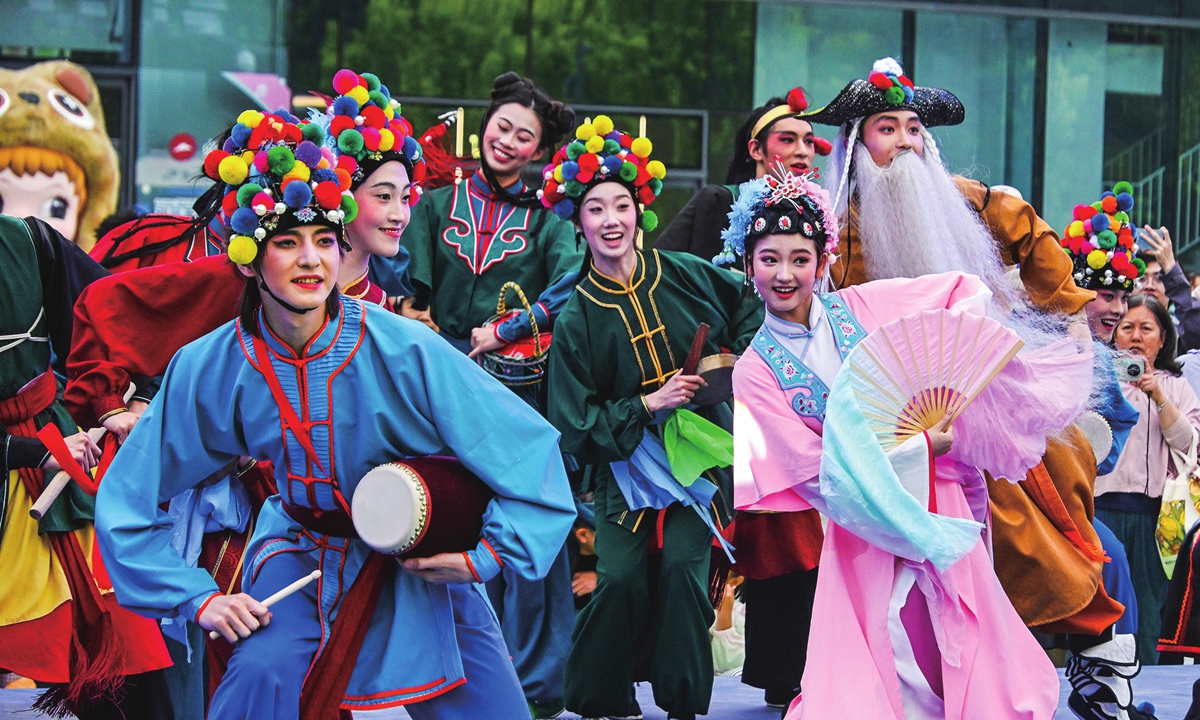
People carry out a Yangko (rural folk dance) national intangible cultural heritage project in the Xiaohongmen area of the Chaoyang district, Beijing at the 2026 China New Cultural and Creative Market and Trend Toy Carnival on May 16, 2026.
Living cultural creationThe Liangma River performance was not the dragon parade's first appearance in Beijing. It had previously been staged along sections of the Grand Canal and at Zizhuyuan Park. This year's return to the capital coincided with the inaugural China New Cultural and Creative Market and Trendy Toy Carnival.
The event was designed as China's first national-level creative cultural fair, allowing visitors to experience intangible cultural heritage at close range, according to reports by the Xinhua News Agency.
Unlike traditional markets, the event connected Chaoyang Park and the Liangma River waterfront into a combined cultural and tourism route, linking creative exhibitions, business areas and recreational spaces through both walking and water-based sightseeing paths.
Visitors could browse cultural products and experience workshops during the day before enjoying river cruises, light shows and live performances at night.
Chen said he first learned about the carnival because of the dragon parade itself.
"At the opening ceremony, entire sections were filled with intangible heritage elements, phoenix kites, lanterns, paper cutting and shadow puppetry," he said. "Visitors can even try making some of them themselves."
Zhang noted that intangible cultural heritage often feels abstract to the public, with many people simply associating it with beautiful handicrafts while knowing little about the techniques or cultural traditions behind them.
At the event, 43 booths showcased heritage projects from across China, including jade carving, incense-making and dough sculpture. Visitors were encouraged not only to watch but also to participate under artisans' guidance, according to China National Arts and Crafts Museum.
Among the displays, Chen said the most memorable item for him was a bright red lacquerware jar.
"I had previously watched influencer Li Ziqi restore lacquerware online, but I still did not fully understand why such a time-consuming craft - one that can even cause allergic reactions - continues to be preserved," Chen said. "Then I saw this lacquer jar in person."
Though covered entirely in shades of red, the jar revealed intricate layered patterns under the light, its glossy surface reflecting the craftsmanship behind the centuries-old technique.
Today, the hashtag for intangible cultural heritage on the Chinese lifestyle platform RedNote has accumulated more than 6 billion views and over 16 million posts.
"For many people, cultural creation no longer just means blind boxes or fridge magnets," Zhang said. "The display and making of intangible cultural heritage can itself become a form of dynamic cultural creation. People want to experience these traditions firsthand, while online creators are also helping revive traditional crafts through videos that reveal the cultural stories behind them. That, too, is part of China's new cultural trend."
RELATED ARTICLES