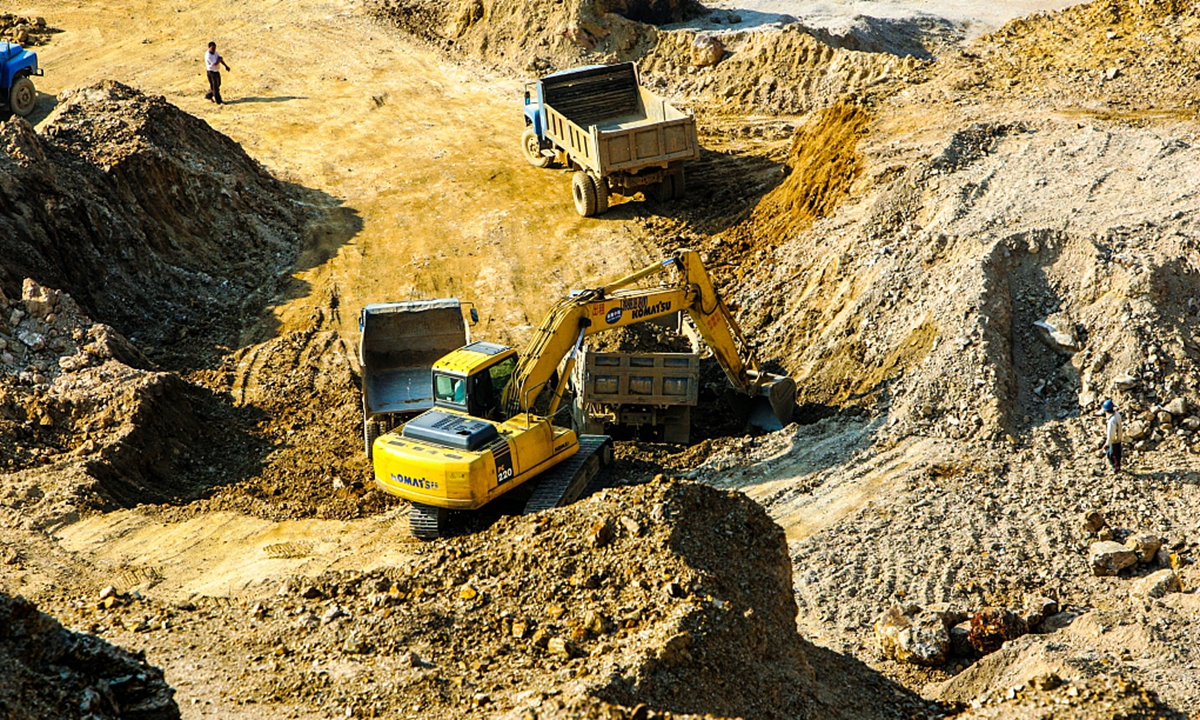
Rare earth Photo:VCG
Some in the West appear to believe that a breakthrough on pricing could facilitate investment in critical minerals supply chains. But the real problem with Western rare earths is not a lack of pricing rules; it is the lack of a commercially viable industrial foundation for critical minerals.Europe must build its own pricing system for specialty metals and rare earths to reduce reliance on China and unlock investment in mining and processing, industry expert Bernd Schaefer of the EIT Raw Materials, an agency partly funded by the EU, told Reuters on Wednesday.
EIT Raw Materials is collaborating with digital platform Metalshub to create a European index to foster innovation in new minerals mining, refining and recycling projects in the bloc, Reuters reported.
This approach is simply the latest in a long series of Western efforts to boost rare-earth production through pricing mechanisms. A Reuters report in September 2025 said that G7 members and the EU were considering price floors to promote production. In January this year, finance ministers from the G7 and other major economies met in Washington and discussed setting a price floor and new partnerships to build up alternative rare-earth supplies, according to Reuters.
All these efforts aim to boost rare-earth production, yet the root difficulty facing Western projects is not a lack of financial support, but rather the weak economic viability of the projects themselves.
A price index can only function properly if it is supported by sufficient spot market liquidity and an active community of buyers and sellers whose transactions facilitate real price discovery. China's market prices naturally serve as a reference for participants across the global industrial chain.
The Western eagerness to create a pricing system or a price floor lays bare the very financing dilemma that afflicts rare‑earth projects. Rare-earth development is a capital-intensive, high-risk and long-cycle industry. The entire industrial chain, from resource exploration and mining to smelting and separation, demands sustained long-term capital investment and entails high operational risks.
Yet, market capital inherently pursues profits and avoids uncertainties. While rare earths are strategically indispensable for advanced manufacturing and the new-energy and defense industries, the raw-material market itself is not big. Meanwhile, China is the world's major source for many rare earths, its rare-earth exports in 2025 totaled $511 million, up 4.6 percent year-on-year, according to Chinese customs. In this context, for Western investors, the rare-earth market scale and profit margins are insufficient to generate sustainable returns on their own.
While some Western governments have rolled out support policies and subsidies, these can only cover part of the cost in the short run. They cannot change the underlying reality that, under today's conditions, building an independent Western critical minerals supply chain is highly likely to be unprofitable. Private capital will not invest in a supply chain that lacks commercial competitiveness purely for geopolitical reasons. If an industry cannot stand on its own feet in an open market, counting on prolonged fiscal support is obviously risky in today's volatile world.
A price floor could in theory guarantee a minimum return for producers, but the side effects would be significant. It would mean that prices would be inflated, and artificially raising raw material prices would directly increase costs for downstream manufacturers, hurting their competitiveness in global markets.
Ultimately, the Western rare-earth sector's fundamental problem is not a lack of pricing rules, but a comprehensive deficiency in industrial capacity. China's unique position in the rare-earth supply chain is built on a complete industrial ecosystem, mature processing technologies and long-term cost advantages forged through decades of industrial accumulation. Such solid industrial competitiveness cannot be offset or overturned by a few financial tweaks and pricing adjustments.
RELATED ARTICLES