Brazilian president calls China-developed surgical robot ‘incredible’; device set world record for longest-distance remote surgery in March, company rep tells GT
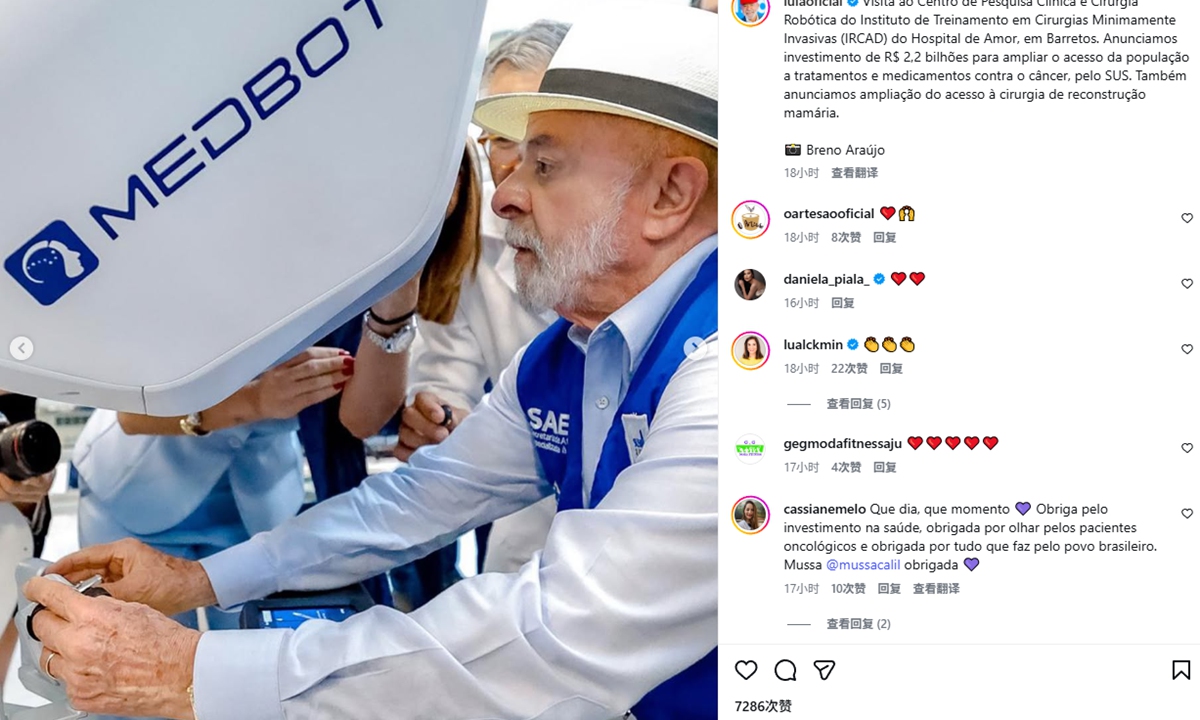
Photo: Screenshot from MedBot's website
"It is incredible to see up close how innovation can expand access, save lives, and further strengthen Brazil's Unified Health System," Brazilian President Luiz Inacio Lula da Silva said on social media after conducting a simulated remote surgery using a China-developed Toumai MT-1000 surgical robot from 1,400 kilometers away.The device praised by Lula was developed by Shanghai MicroPort MedBot. A company representative confirmed to the Global Times that the China-developed multi-port laparoscopic surgical robot supports complex procedures in urology, general surgery, thoracic surgery and gynecology, and is capable of remote operation via 5G and fiber-optic networks.
The system is equipped with an advanced imaging platform capable of delivering a high-definition surgical view with 10x optical magnification and naked-eye 3D imaging, the representative said.
Its robotic arm system features seven degrees of freedom and can effectively filter out surgeons' physiological hand tremors during operations. The robot's wristed surgical instruments provide flexibility, precision and stability beyond that of the human hand, enabling doctors to perform a wide range of highly complex procedures within narrow body cavities.
The representative said the Toumai robot is currently the world's only commercial remote robotic surgery system capable of supporting all major departments and surgical procedures. Before being incorporated into Brazil's Unified Health System, the company worked closely with Brazilian medical institutions on a series of remote surgery trials and technical verification programs that have achieved the expected results.
According to the official website of Shanghai MicroPort MedBot, citing Brazil's Health Ministry, Hospital de Amor — the hospital visited by Lula — has become one of the country's leading benchmark institutions in robotic surgery. Since introducing its first robotic surgical system in 2014, the hospital has carried out nearly 4,000 procedures across specialties. With the introduction of the Toumai surgical robot, the number of patients treated each year has risen from around 400 to 680.
Clinical applications of the remote surgery system have already expanded to urology, general surgery, thoracic surgery, gynecology, pediatric surgery and cardiac surgery, supporting procedures ranging from routine operations to highly complex Class IV surgeries, the representative noted.
"The system has secured regulatory approval in 13 countries, including China, Brazil, India and Thailand. It has also obtained a US FDA Investigational Device Exemption (FDA-IDE), making it the only system in the world currently authorized to conduct human clinical surgical research in the US, and has entered the stage of real-world commercial clinical application."
Among the representative high-difficulty procedures enabled by the system are ultra-long-distance pancreaticoduodenectomy surgeries — regarded as among the most challenging abdominal operations — radical prostatectomy procedures widely considered the "gold standard" in robotic surgery, and remote atrial septal defect repair combined with tricuspid valvuloplasty, a highly sophisticated cardiac procedure requiring extreme precision, he said.
To meet the demands of remote robotic surgery, Shanghai MicroPort MedBot has developed a comprehensive technological framework that includes ultra-low-latency image compression, multidimensional data encryption, dynamic communication network optimization strategies and surgical safety assurance mechanisms for complex network environments, the representative said.
The company has also pioneered integrated multi-network communication technology, enabling compatibility with 5G, broadband, dedicated lines and satellite communications while supporting hybrid communication across different carriers and transmission media. The technologies provide strong technical support for the transition of remote surgery from exploratory applications to large-scale and sustainable clinical practice, the representative added.
President Lula has repeatedly praised China in recent months and highlighted the strength of bilateral ties. Speaking at the industrial park of Brazil's CAOA automotive conglomerate in March, he expressed confidence that Brazil's partnership with China will "go from strength to strength," describing China as Brazil's "best partner."
Chinese official data shows that two-way trade between Brazil and China reached roughly $188 billion in 2024, reaffirming China as Brazil's largest trading partner.
RELATED ARTICLES