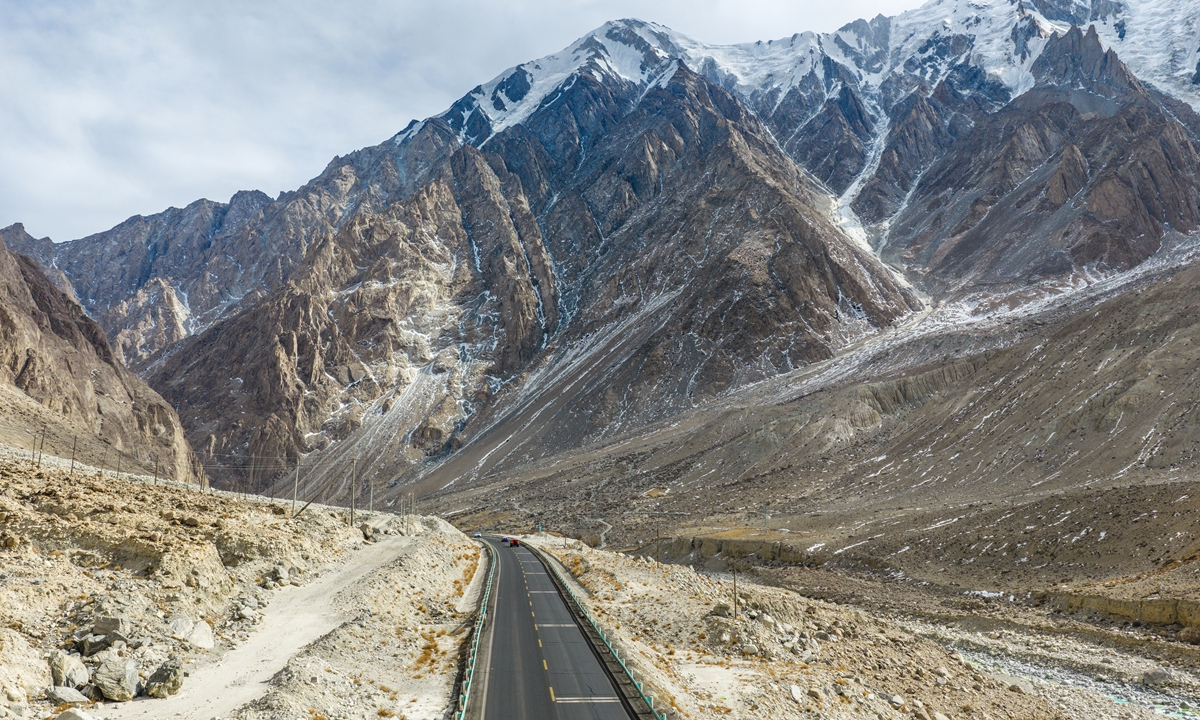
An aerial photo taken on February 17, 2026 shows the Karakoram Highway across the Pamir Plateau in Kashi, Northwest China's Xinjiang Uygur Autonomous Region. The Karakoram Highway, also known as the China-Pakistan Friendship Highway, is a key overland route under the framework of the China-Pakistan Economic Corridor, linking Kashi in China with Thakot in Pakistan. Photo: VCG
Seventy-five years of Pakistan-China relations reveal a truth that to understand a nation as vast and dynamic as China, one must not mistake a single paragraph for the whole. Our partnership has often been viewed through individual milestones: the Karakoram Highway, the restoration of the People's Republic of China's lawful seat at the United Nations, diplomatic ice-breaking between China and the United States, or the construction of China-Pakistan Economic Corridor (CPEC) in recent years. Yet none of these moments alone fully explains the endurance of this relationship. The deeper story lies in something less visible but ultimately more consequential: the gradual construction of strategic trust across generations, different institutions, and changing international orders.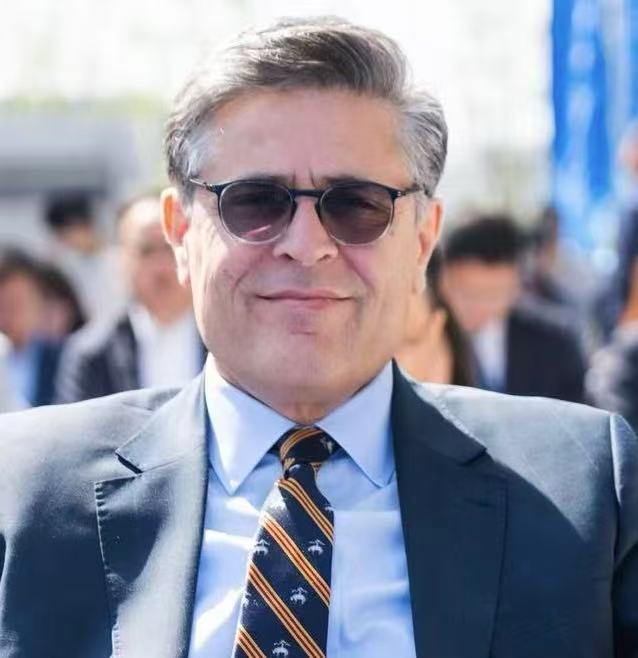
Khalil Hashmi, Ambassador of Pakistan to China Photo: Courtesy of Pakistani Embassy in China
When Pakistan and China established diplomatic relations in 1951, neither country occupied the position in international affairs that it does today. Both were navigating a rapidly changing post-war world and defining their respective paths in an emerging international order. Yet even at that early stage, our leaders recognized that relationships built on mutual respect, sovereign equality, and long-term trust often outlast shifting geopolitical circumstances. Over time, the Pakistan-China relations matured into one of the most resilient and adaptable partnerships in contemporary international relations.That foundational trust was tested and strengthened in the years ahead. In the early 1970s, Pakistan played a principled role in supporting the restoration of the People's Republic of China's lawful seat at the United Nations, reflecting our shared commitment to sovereign equality and the rightful participation of developing nations in global governance. Around the same time, Pakistan facilitated the diplomatic opening between China and the United States. These moments were historically significant not simply because they altered diplomatic trajectories, but because they revealed the political confidence underpinning Pakistan-China relations.
Soon afterward, engineers and workers from both countries began constructing the Karakoram Highway across some of the world's most unforgiving terrain. What emerged was more than a road connecting two neighbouring countries. The highway became a geopolitical and civilizational statement: that geography needs not to impose isolation, and that connectivity can transform mountains from barriers into bridges.
Over time, this trust expanded into broader economic, political, and institutional cooperation. Whether through close coordination at multilateral forums or the later emergence of construction of the China-Pakistan Economic Corridor, the relationship continued to evolve with changing times while preserving the same principles that shaped it from the outset.
What distinguishes Pakistan-China relations today is not simply their longevity, but their increasing multidimensionality. Today, Pakistan-China cooperation extends across multiple layers: connectivity that creates opportunity, innovation that drives transformation, and institutions that sustain long-term partnership. The CPEC should therefore be understood not merely as a collection of infrastructure projects or energy investments, but as one phase within a longer continuum of strategic cooperation. As the construction of CPEC enters a new stage, the emphasis is increasingly shifting toward industrial modernization, digital connectivity, green development, agricultural innovation, and climate-resilient growth.
During my diplomatic engagements across China, I have witnessed firsthand how deeply this partnership now extends beyond official corridors. Whether visiting renewable energy projects in western China, meeting joint research teams in central laboratories, or speaking with Pakistani alumni leading startups in southern technology hubs, I witness the same pattern repeatedly: the Pakistan-China relationship is becoming progressively more human-centered, innovation-driven, and future-oriented.
Educational cooperation has long occupied a special place in Pakistan-China relations. The Pakistan Embassy College Beijing, established in the 1960s, became China's first international school and remains a quiet but enduring symbol of the trust that has long defined our partnership. Today, that educational connectivity continues through expanding university collaboration in science, engineering, medicine, digital learning, and innovation.
Indeed, the most consequential transformation in Pakistan-China relations may now be taking place not at the level of grand strategy alone, but within societies themselves. Joint research initiatives are adapting agricultural technologies to local developmental conditions, while universities deepen collaboration in engineering, medicine, biotechnology, artificial intelligence, and advanced scientific research. A growing generation of Pakistani researchers, engineers, doctors, and entrepreneurs that received training and exchanged cooperation in China increasingly serves as a living bridge between our societies. Increasingly, the relationship is measured not only in roads, ports, or powers generated, but also in human capital, institutional knowledge, technological capability, and shared problem-solving capacity.
This multidimensional cooperation reflects a shared conviction that developing nations must participate more actively in shaping the rules governing trade, technology, finance, and climate cooperation rather than merely adapting to frameworks designed elsewhere. Through coordination within the Shanghai Cooperation Organization, support for fairer digital governance, and advocacy for reform of international financial institutions, Pakistan and China continue to demonstrate that South-South cooperation need not operate through hierarchical models. Instead, its strength lies in reciprocal modernization, institutionalized dialogue, and long-term strategic thinking.
As Pakistan aligns its development priorities with China's emphasis on high-quality Belt and Road cooperation and new productive forces, the partnership is increasingly entering a knowledge-driven phase centered on technological transfer, industrial upgrading, green transition, scientific collaboration, and sustainable capacity building. In many respects, the future of Pakistan-China relations may be defined as much by research ecosystems, digital networks, and human capital as by physical infrastructure alone.
In an era often defined by fragmentation and short-term competition, Pakistan and China have instead chosen strategic continuity and patient cooperation. Against a global backdrop increasingly characterized by volatility, economic insecurity, and declining institutional trust, the enduring strength of Pakistan-China relations lies not merely in their longevity, but in their ability to evolve without losing strategic trust at their core. As Chinese philosophy reminds us through the concept of 和而不同, harmony without uniformity, that enduring partnerships do not depend on sameness, but on mutual respect and shared purpose. Pakistan and China do not mirror each other; we complement each other. The strength of this relationship lies precisely in its ability to connect distinct historical trajectories through shared developmental purpose.
As we mark the 75th anniversary of diplomatic relations, the next chapter of Pakistan-China relations will increasingly be shaped by students, researchers, entrepreneurs, and institutions working together to address shared challenges and build shared prosperity. From the Karakoram Highway to cooperation in outer space, every era of Pakistan-China relations has expanded the horizon of what the partnership could become. Its enduring significance lies not merely in its history, but in its continuing ability to go beyond itself amid changing times. In an age searching for stable foundations, perhaps the greatest lesson of 75 years of Pakistan-China relations is that strategic trust, patiently built and consistently sustained, remains one of the most valuable assets in state-to-state relationships.
RELATED ARTICLES