China reports breakthrough in spinal cord injury treatment with brain-spine joint interface system
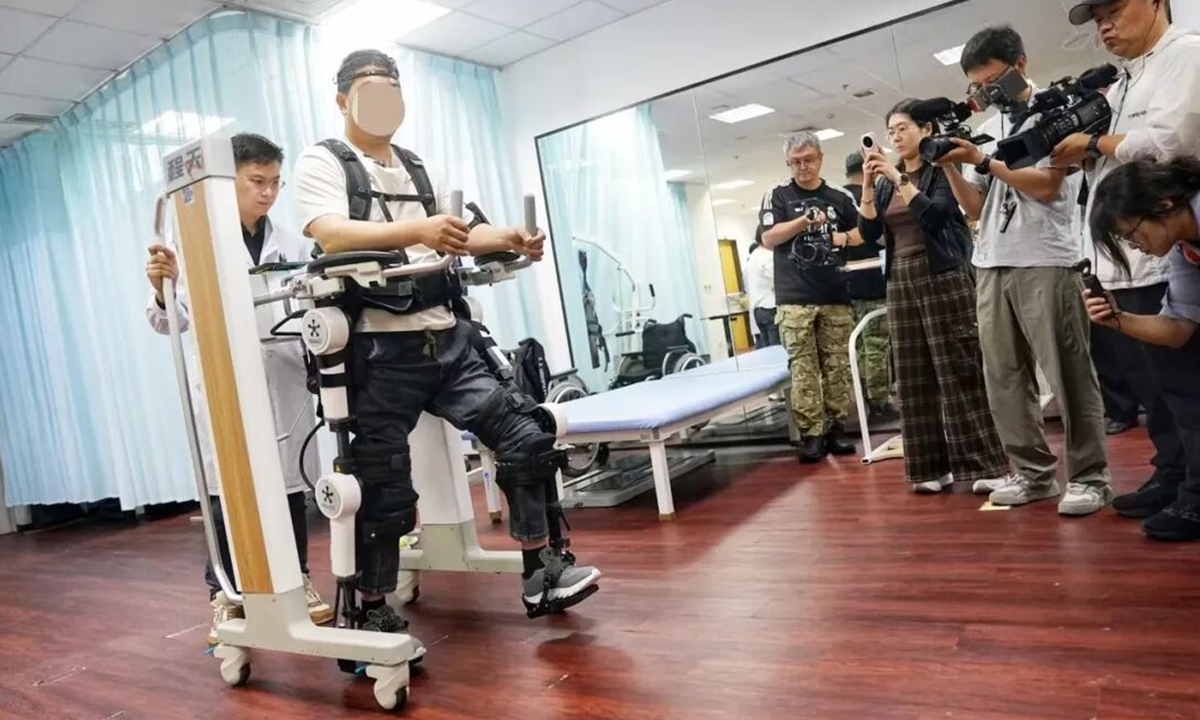
A patient who received China's "Beinao No.1" brain computer interface undergoes rehabilitation training using an exoskeleton device and assistive braces at Xuanwu Hospital of Capital Medical University in Beijing. Photo: official WeChat account of Beijing Daily
A late-stage paraplegic patient who became the world's first to simultaneously receive the invasive "Beinao No.1" brain-computer interface (BCI) and a temporally programmed spinal cord stimulation system has shown significant neurological recovery after one year of surgery and staged rehabilitation, marking a major breakthrough in China's clinical application of brain-inspired intelligent technology and spinal cord injury repair, China Central Television (CCTV) reported on Tuesday.The joint treatment research program, carried out by a team from Xuanwu Hospital Capital Medical University in collaboration with leading domestic brain science research institutions, led to the patient's neurological function improving from complete spinal cord injury (ASIA Grade A) before surgery to incomplete spinal cord injury (ASIA Grade C).
The patient had suffered a severe T12-L1 spinal cord injury in an accident five years ago, resulting in the loss of sensation and motor function in both lower limbs. Traditional rehabilitation treatments failed to produce notable improvement, per reports.
On May 16, 2025, the medical team performed a multi-target combined surgery on the patient. The procedure enabled the "Beinao No.1" system to accurately decode the patient's motor intentions from brain signals and, within seconds, trigger temporally programmed spinal cord stimulation to activate the damaged lower spinal cord. The system was further integrated with an exoskeleton device to reconstruct gait through closed-loop control.
The breakthrough challenges the long-held medical belief that complete spinal cord injuries lead to irreversible loss of motor and autonomic nervous system functions. It has also verified the safety and neurorestorative effectiveness of the "brain-spinal cord-exoskeleton" multimodal integrated regulation system in clinical applications.
Global Times
RELATED ARTICLES