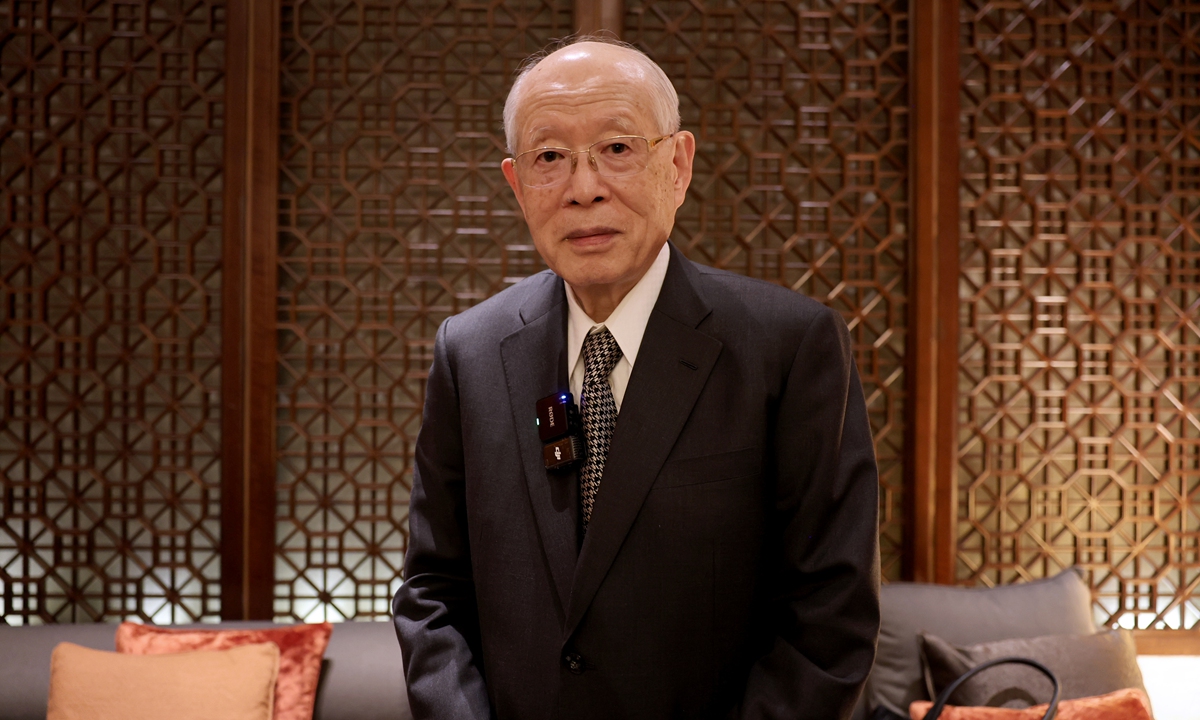
Photo: Chen Xia/GT
Editor's Note:Ryoji Noyori (Noyori), Nagoya University Distinguished Professor, was awarded the Nobel Prize in Chemistry in 2001 for his work on chirally catalyzed hydrogenation reactions. He was elected as Foreign Member of the Chinese Academy of Sciences in 2011, thus forging deep ties with China's scientific community.
China's 26th National Science and Technology Week runs from May 24 to 31. In the era of artificial intelligence (AI), how should we reflect on China's path of scientific and technological development and envision its future landscape? In a recent exclusive interview with Global Times (GT) reporters Liu Xuandi and Xing Xiaojing, Noyori shared his views, offering insights on topics including how humanity can safeguard its ability to think in the AI era and how the scientific spirit can transcend confrontation in pursuit of consensus.
GT: China's 15th Five-Year Plan (2026-30) proposes to markedly boost the overall performance of China's innovation system and project an annual average increase of at least 7 percent in nationwide R&D spending. As China embarks on the inaugural year of its 15th Five-Year Plan period, how do you view China's consistent emphasis on scientific and technological innovation as a core national strategy?
Noyori: In my view, the Chinese government's continuous and well-planned investment over several decades is a key reason why China has been able to achieve ongoing success in scientific and technological development and innovation. The research paradigm of science and technology has constantly evolved with the times. In our era, the linear model - from basic research to applied research and then to social implementation - was the global mainstream.
In recent years, however, "creating social value" has become a major global innovation agenda. The time span from research to application has been dramatically shortened, and the leading force of innovation is no longer universities or research institutions, but society itself.
Enterprises of all kinds are playing an increasingly important role in improving the efficiency of technological transformation. Demis Hassabis and John Jumper of Google DeepMind were co-awarded the 2024 Nobel Prize in Chemistry for using AI to advance scientific development, which is highly symbolic.
We must always value basic science or "pure" science in the pursuit of truth, while also continuing to innovate in order to create economic and social value. For beautiful flowers to keep blooming and sweet fruits to be borne, we must cultivate strong trees and nurture the soil that sustains them.
If top-tier young research talents are seen as the seeds with high potential, then what nurtures them into towering Nobel Prize-level trees is the strength of the social system. The development of science and technology requires a long-term vision and should not be rushed. China has consistently advanced in this direction in a steady manner, and I believe it will continue to do so in the future.
GT: We are moving toward an era of deep integration between AI and industry. At the same time, some worry that the development of AI may cause humanity to lose the ability to think. How do you view this concern? What role can China play to address this?
Noyori: What worries me most is that humans may become too lazy to think as a result of AI. This is, in essence, humanity's "self-domestication," and I believe this must be avoided at all costs.
As a tool, AI is indeed excellent, but human beings may stop thinking because of it. French philosopher and mathematician Blaise Pascal once wrote: "Man is but a reed, the most feeble thing in nature; but he is a thinking reed... All our dignity consists, then, in thought."
I am deeply afraid that when we lose this ability to think, humans will no longer be human. China is now already a country leading the world, with great influence. I hope that China can help steer global public opinion in the right direction in the AI era, particularly on issues such as ensuring that humanity does not lose its ability to think.
GT: You have repeatedly emphasized the idea that science has no borders. In recent years, China has actively promoted open innovation and introduced a series of supporting policies. From your perspective, in this uncertain era, how can the scientific spirit help us transcend confrontation and seek consensus?
Noyori: I have always believed that science and technology are closely connected, yet distinct from each other. Science is a vast and boundless realm filled with endless possibilities. Technology seeks to accomplish what humanity cannot yet do and create what does not yet exist. In today's era, the true source of value creation lies in the continuous accumulation of diverse forms of wisdom.
Today, rather than how intelligent a single individual may be, what matters more is whether one can communicate and connect with many others. Technology alone is far from enough; human diversity and mobility are the keys to bringing together knowledge and wisdom. It is necessary to build platforms that gather people of different backgrounds and talents together.
In terms of scientific and technological progress, excessive "country-first" thinking is by no means a good thing. Only by overcoming conflicts and differences among nations and working together can human civilization continue to endure. Problems such as global warming pose severe threats to humanity's survival, and no country can solve these challenges alone. If the 20th century was an era of competition, then in the 21st century we must embrace one another and cooperate in order to coexist and thrive together.
GT: You had a close relationship with Nobel laureate Tsung-Dao Lee. Which of his spiritual qualities left a deep impression on you?
Noyori: Lee gave me invaluable guidance in many aspects of my life, and I have many cherished personal memories with him.
I remember our first meeting in the autumn of 2003. At the time, I had just become president of RIKEN [a highly renowned conglomeration of advanced research institutes in Japan]and was unfamiliar with many things.
In September 2005, I traveled to Columbia University to visit Lee. He took out many photographs and recounted to me numerous stories from the history of physics. During that meeting, Lee gave me a small handkerchief, an ordinary towel once used by Hideki Yukawa, Japan's first Nobel laureate in physics. He had carefully kept it for more than half a century before passing it on to me. At that moment, I felt as though an invisible red thread of fate had connected everything together.
Lee once told me that a truly outstanding scientist is someone who connects history and culture. From him, I came to understand what it truly means to be a scientist, as well as the profound relationship among science, civilization and culture.
I still carry his teachings with me to this day. That seemingly ordinary handkerchief is, in fact, one of the best examples of the idea that science has no borders.
GT: In your observation, what is the most important quality of a scientist? What message would you like to share with young researchers?
Noyori: The truly original scientists do not necessarily rely on having a "brilliant mind," but rather on exceptional intuition and the ability to think deeply. In science, the most important thing is not solving questions posed by others, but actively discovering genuinely valuable questions on one's own.
It is necessary to constantly step outside, encounter different things, and spark inspiration through exchanges and collisions.
Groundbreaking achievements are rarely recognized by the world immediately, which means learning to endure loneliness is also an essential lesson. Scientists must possess not only sharp insight and strong curiosity, but also tremendous inner strength, along with deep passion and unwavering dedication to their research.
The world of science is boundless and open to everyone. I hope young people will not simply crowd into "popular" fields, but instead have the courage to choose their own paths and pursue unique value. Only in this way can science truly move forward.
RELATED ARTICLES