Shanghai launches first human-robot collaborative urban management enforcement pilot program
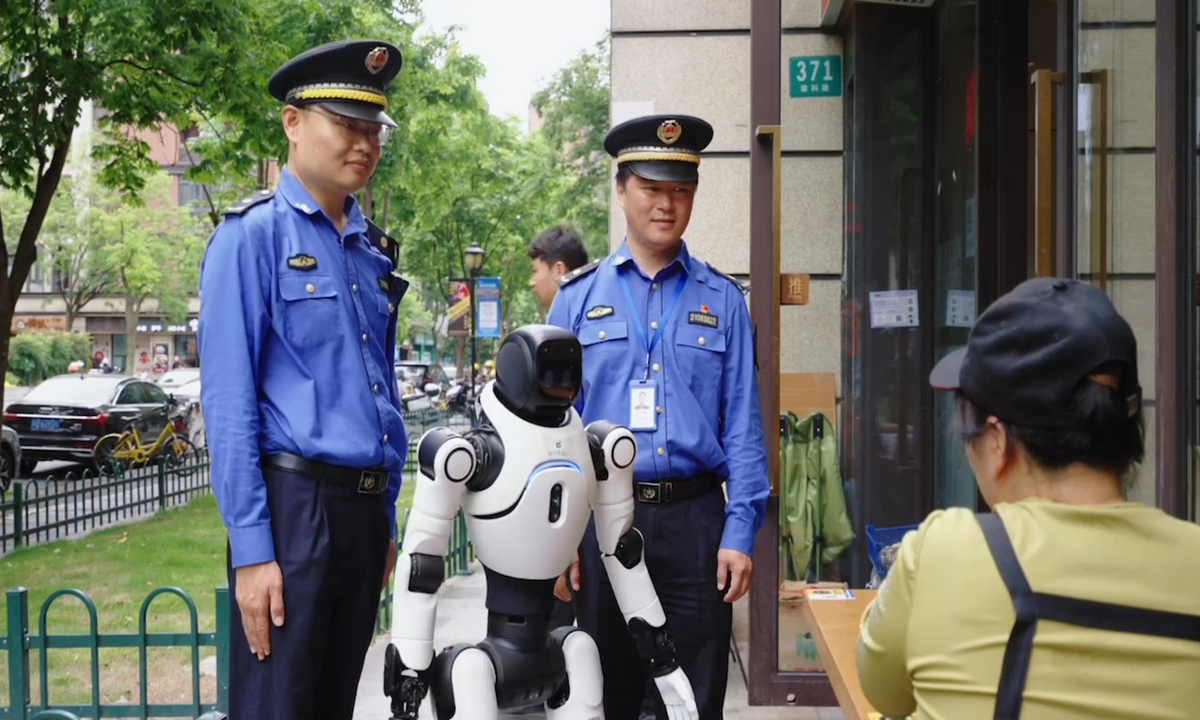
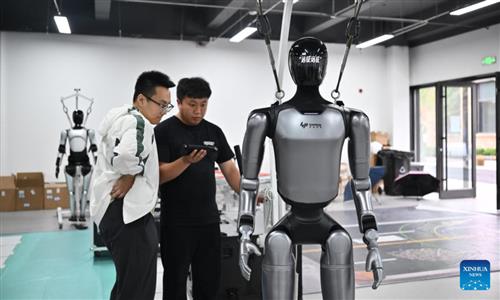
Two officers work together with a humanoid robot Lingxi X2, developed by Shanghai-based robotics firm AgiBot in Shanghai, on May 20, 2026. Photo: Courtesy of AgiBot
China has launched its first urban management enforcement pilot program featuring collaboration between human officers and a humanoid robot. The robot is capable of handling support tasks such as legal education and promotion, policy explanation, and intelligent question and answer service, the company behind the robot told the Global Times on Sunday.
The pilot program was rolled out recently at the Zhangjiang AI Innovation Town in Shanghai's Pudong District. During the operation, an intelligent drone monitoring system first detected a violation by a street-side merchant and relayed the information in real time to on-site patrol officers and to a humanoid robot, Lingxi X2, developed by Shanghai-based robotics firm AgiBot, according to the compay.
AgiBot told the Global Times that the Lingxi X2 robot can clearly articulate relevant management requirements and legal provisions while responding swiftly to merchants' inquiries.
"For frontline enforcement officers, this represents an effective enhancement of our capabilities," Pan Weijia, a Pudong official noted. Asked whether robot-assisted urban management enforcement could become routine, Pan said that the bureau would focus more on practical performance evaluation rather than simply expanding deployment numbers.
AgiBot said that the pilot demonstrated that humanoid robots are not replacing frontline officers but rather serving as new "intelligent assistants" in urban management.
In on-site handling, drones are responsible for front-end detection and real-time transmission, officers handle situation assessment and legal enforcement, while the robot undertakes auxiliary tasks such as law promotion and policy interpretation.
AgiBot stressed that the robot's strengths lie in its broad knowledge base and objective expression, as this model enables more timely problem detection and more multifaceted communication approaches that are more readily accepted by merchants.
"Robot participation allows repetitive and procedural tasks to be performed more thoroughly and completely — such as clearly explaining street-front business regulations, storefront responsibility requirements, and relevant legal provisions, while providing immediate responses to merchant questions," the company said.
This human-robot collaborative enforcement practice in Shanghai demonstrates China's active push to transition humanoid robots from merely being able to "move" toward being able to "work effectively" — driving the large-scale application of embodied intelligence robots to create tangible productivity value, said Pan Helin, a member of the Expert Committee for the Ministry of Industry and Information Technology.
Pan Helintold the Global Times on Sunday that the pilot program is expected to lay a solid foundation for expanding such applications to additional scenarios, underscoring China's rapid advancement in AI-driven public safety and smart city technology.
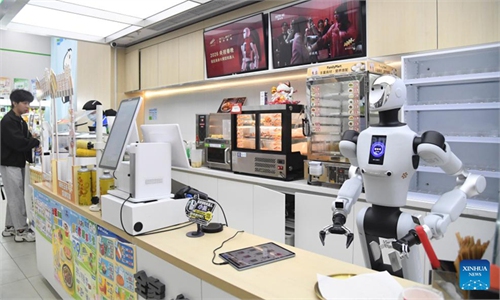
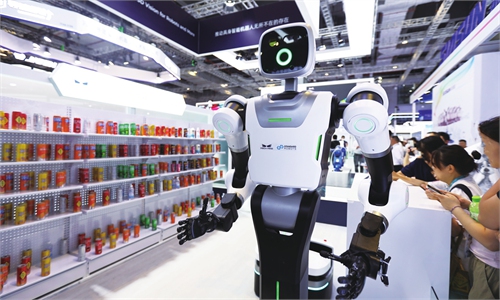
In a broader move to push humanoid robots into daily life, China is deploying AI-powered robots to manage traffic and pedestrian flows in cities.
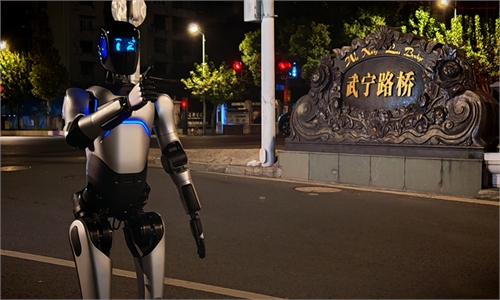
A humanoid robot dressed like a police officer was stationed at a busy intersection in Shanghai's bustling Huangpu district in July 2025. The appearance of the robot, nicknamed Xiao Hu, signaled a trial phase in public traffic management. In addition to directing traffic, Xiao Hu can offer directional assistance to pedestrians and answer basic questions related to traffic laws, local media outlet the Shanghai Observer reported.
RELATED ARTICLES