Photo: Screenshot from the website of Science and Technology Daily
Chinese scientists have made new progress in the field of robotic “spatial intelligence,” developing a new “bio-inspired cognitive navigation” framework that could allow robots to understand space, use past experience, and make flexible decisions in unfamiliar environments, the Science and Technology Daily reported on Sunday.
Scientists describe the innate ability of humans and animals to navigate unfamiliar environments using internal spatial awareness as “spatial intelligence,” a capability that remains a major challenge for embodied robotics, according to the Science and Technology Daily.
The research team of Human-Machine-Object Integrated Intelligent Computing at Northwestern Polytechnical University said they made new progress in this field on Friday with their review paper being accepted by Nature Reviews Electrical Engineering, a journal under Nature.
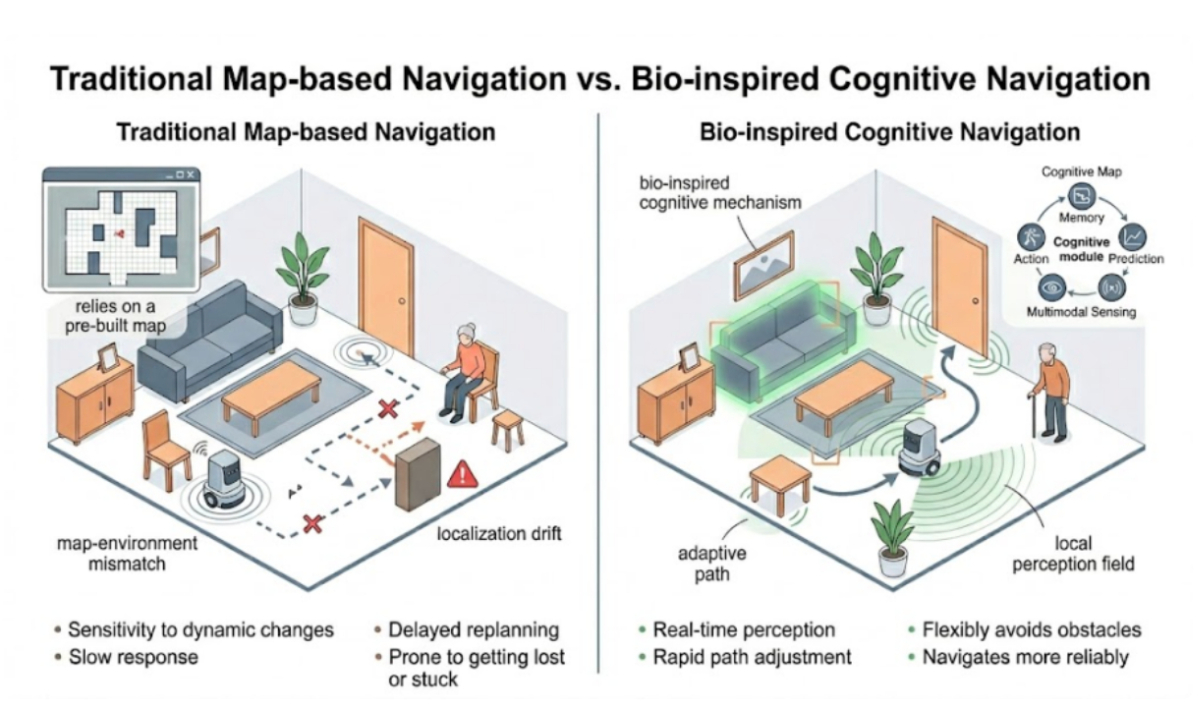
According to Guo Bin, professor from the School of Computer Science, Northwestern Polytechnical University, traditional robot navigation follows a fixed process of “mapping-localization-planning-control,” much like a person walking with a paper map who cannot proceed along routes that are not marked. This approach works in structured environments such as warehouses and factories through large-scale data training, but once the environment or scenario changes, the robot can instantly become “disoriented” and unable to navigate.
The research team was inspired by how mice navigate mazes using key landmarks and forming memories and abstract knowledge in the brain to build a “cognitive map.” When encountering similar environments later, the mice can reuse previous experience and memory.
Guo explained that animals do not navigate well simply because they have good memories, but because they can summarize, associate, and flexibly apply knowledge. Based on this, the research team broke down animals’ navigation abilities – including landmark recognition, experiential memory, and flexible decision-making – and transformed them into a low-cost, highly generalizable humanoid robot navigation framework.
The new framework enables robots to accurately determine their position and state in space, anticipate surroundings, apply past experience to unfamiliar environments, and plan routes more flexibly, “enabling robots to walk with thought,” shifting from passive execution toward active decision-making.
The research team is currently collaborating with multiple organizations on technology transfer and practical applications.
According to Guo, scenarios such as elderly care companionship, operations in complex environments, and disaster emergency rescue share the common characteristics of being dynamic, unpredictable, and full of uncertainties. These have long been the “last mile” challenge for the real-world deployment of robotic technology.
The framework enables robots to autonomously perceive, decide, and act in unknown and dynamic environments. “Drawing more wisdom from humans and animals will enable robots to truly have the potential to enter and operate in the complex real world,” Guo said.
Global Times
RELATED ARTICLES