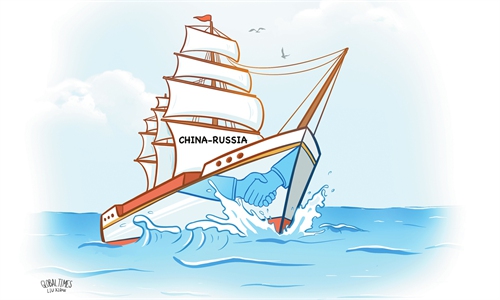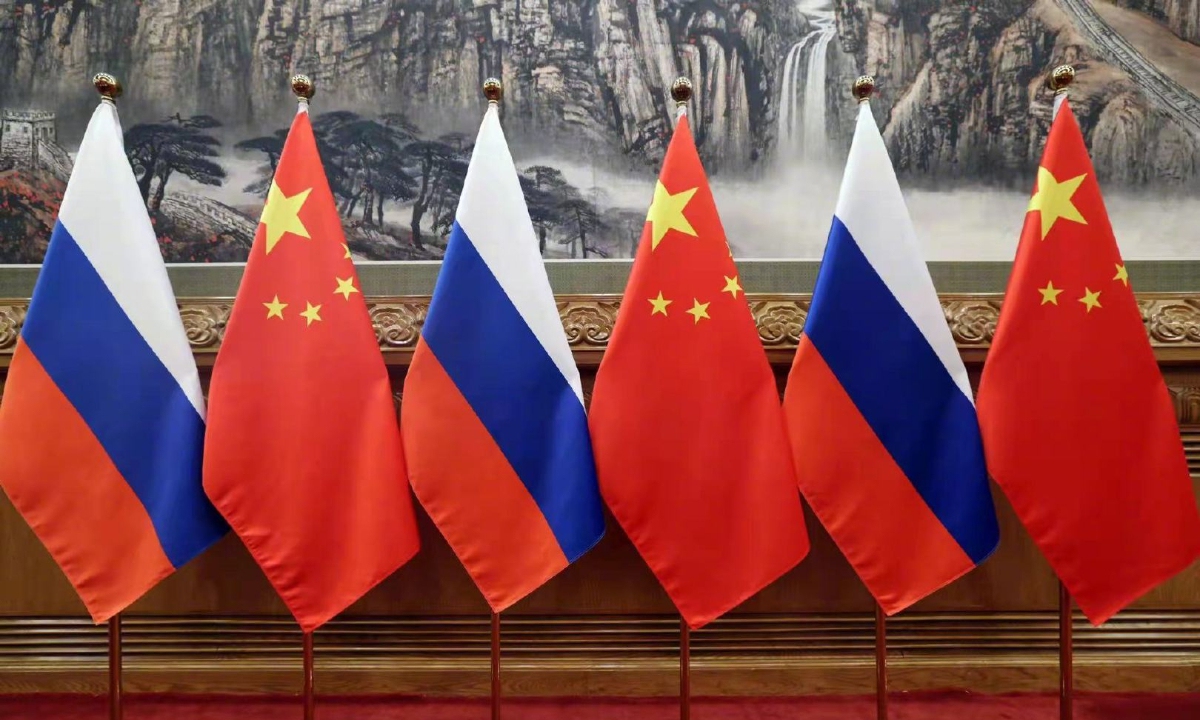
China Russia Photo: Xinhua
Editor's Note:Russian President Vladimir Putin's recent state visit to China saw the signing of a slew of cooperation documents with upgraded cooperation in the fields including economy and trade, investment, energy and resources, transportation, and scientific and technological innovation. The high-profile meeting between the two presidents has set the course for the next stage of bilateral relations and underscored the two major countries' commitment to advancing global governance reform in the right direction. Against this backdrop, in what ways do China-Russia relations act as a stabilizing anchor in a multipolar world, and how will practical cooperation drive their bilateral ties forward? The Global Times invites two experts to share their views.
Andrew Korybko, a Moscow-based American political analyst
This was Putin's 25th visit to China. He arrived with a delegation of 39 people, which included many high-level officials and senior business leaders, and signed about 40 documents. One of the most significant achievements was a joint statement on advocating a multipolar world and new type of international relations. They also extended the Treaty of Good-Neighborliness and Friendly Cooperation.
The strengthening of China-Russia relations is taking place in a historic context. The world is undergoing changes unseen in a century. The global systemic transition to multipolarity has unprecedentedly accelerated since its start in the late 1990s when China and Russia adopted a joint declaration announcing their shared vision of this new order.
Since then, China and Russia have served as the engines of multipolar processes, with China's record economic growth shattering the West's monopoly on global trade and Russia's geopolitical challenge to NATO undermining its monopoly on global security. To avoid any misunderstanding, China and Russia aren't partnered against any third parties; they are jointly building the multipolar future with their growing range of Global South partners.
The strategic resolve of China and Russia, which was on display during the latest meeting between the two presidents, is the logical culmination of their countries' decades-long partnership. As responsible stewards of the global systemic transition, China and Russia will continue to jointly and comprehensively accelerate multipolar processes through closer trade, investment, technological, security and other ties.
No other country can divide these two or decelerate these processes. A multipolar future is inevitable.
Yang Jin, an associate research fellow with the Institute of Russian, Eastern European and Central Asian Studies at the Chinese Academy of Social Sciences
Pragmatic cooperation was key to the success of President Putin's visit this time. In recent years, bilateral trade between China and Russia has exceeded $200 billion for three consecutive years, and grew by 20 percent in the first four months of this year, demonstrating the strong economic complementarity and resilience of the two countries' cooperation. Energy cooperation remains a cornerstone. Oil and gas, nuclear energy, and green energy are not only related to the development of both countries but also to the stability of regional industrial and supply chains.
The two heads of state witnessed the signing of 20 cooperation documents in the fields including trade, education, science and technology, as well as the announcement of 20 other cooperation documents in other areas, covering infrastructure construction, key industrial products, customs and quarantine, market supervision, intellectual property, nuclear energy technology, media, and university cooperation. These documents are transforming "high-level political mutual trust" into actionable projects, connecting trade and energy cooperation with technological innovation, transportation and logistics, and cultural and educational cooperation to form a more complete cooperation chain.
The current international environment is complex and volatile, with unilateralism and protectionism being on the rise, posing uncertainties to the global energy market and industrial chain. China and Russia adhere to equality, mutual benefit, open trade and multilateralism, which not only benefits their respective development and revitalization but also adds certainty to the world economy.
The outcomes of President Putin's visit to China demonstrate that practical cooperation between China and Russia has moved from a phase of quantitative growth to one of qualitative consolidation. As long as both sides implement the consensus reached by the heads of state into projects, mechanisms and standards, economic and trade cooperation will have a more solid foundation, energy cooperation will have broader scope, and the comprehensive strategic partnership of coordination for a new era between China and Russia will gain stronger endogenous momentum.
RELATED ARTICLES