Heightened tensions continue to weigh on fragile US-Iran talks
China urges peaceful settlement of disputes as negotiations show mixed signals
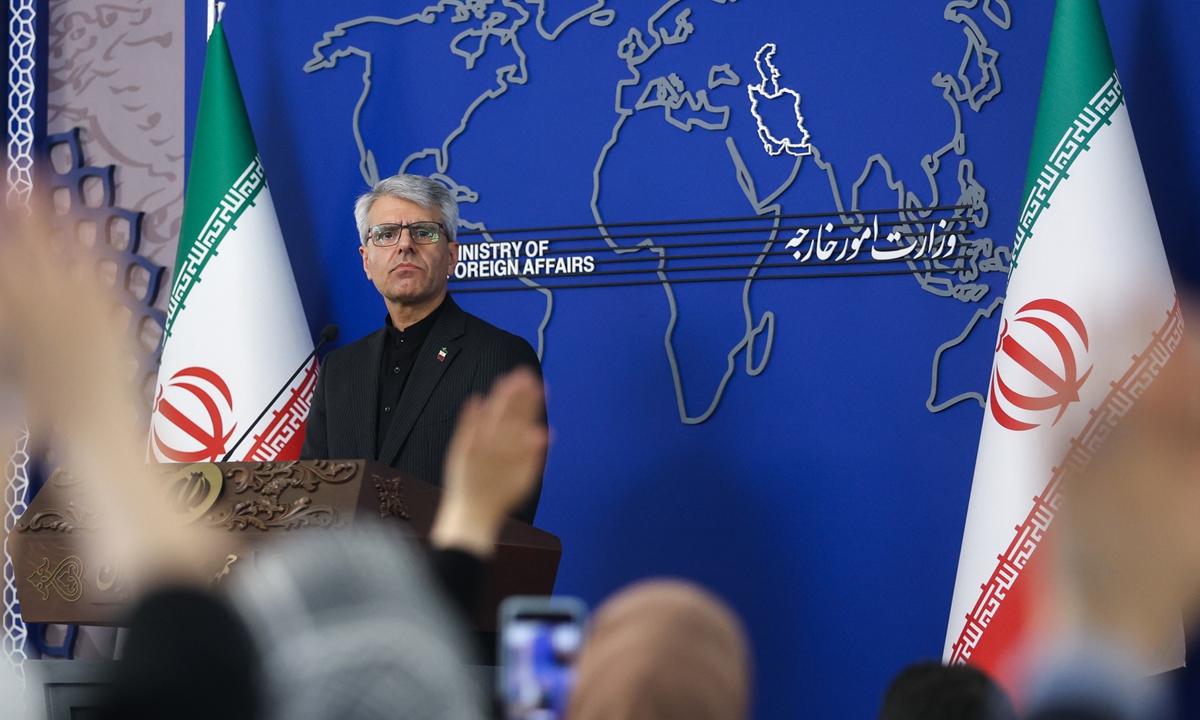
Iranian Foreign Ministry spokesperson Esmaeil Baghaei hosts his weekly press conference on May 25, 2026. Photo: VCG
Heightened tensions between Iran and the US on Tuesday continued to weigh on the fragile diplomatic efforts as US launched a series of strikes near the Strait of Hormuz, prompting warnings of retaliation from Iranian officials.
The United States Central Command (CENTCOM) claimed it carried out the "self-defence strikes" to protect US troops from threats posed by Iranian forces. Iranian media reported explosions in Bandar Abbas, some 70km (42 miles) from the Strait of Hormuz, in southern Iran.
Following the strikes, Iran's Foreign Ministry on Tuesday released a statement accusing the US of breaching the ceasefire agreement with "aggressive acts" in Iran's Hormozgan region, where Bandar Abbas is located.
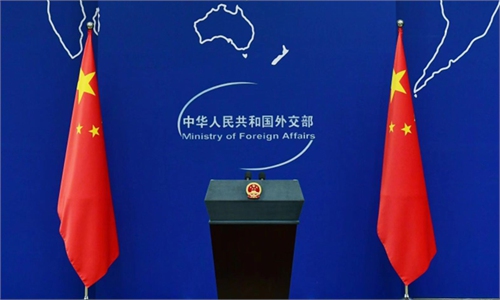
Chinese Foreign Ministry spokesperson Mao Ning said on Tuesday that China urges relevant parties to honor the commitments to ceasefire, solve disputes in peaceful ways, and continue to work for solutions that accommodate the legitimate concerns of all parties through dialogue and negotiation so as to enable peace to return to the Middle East and Gulf region at an early date.
Delicate phase
Reports said senior Iranian officials — including Foreign Minister Abbas Araghchi, Parliament Speaker Mohammad Bagher Ghalibaf, and Central Bank Governor Abdolnaser Hemmati — were in Doha on Monday evening for talks on unresolved issues tied to a potential deal to end the nearly three-month US-Israel war involving Iran.
According to Al Jazeera, an "informed" source cited by Iran's Tasnim news agency described the discussions by Iranian negotiators in Qatar as "good overall," saying the talks "led to progress in the overall negotiations."
But prospects for a quick agreement appear slim. According to Reuters, US Secretary of State Marco Rubio said negotiations could still "take a few days," tempering expectations for an imminent breakthrough after US forces conducted what they described as defensive strikes in southern Iran.
According to Al Jazeera, the US military launched a series of strikes near the Strait of Hormuz on Monday, as an Iranian delegation led by top officials travelled to Qatar to hold negotiations to end the US-Israel war on Iran.
Iran's Islamic Revolutionary Guard Corps (IRGC) claimed in a statement that its forces downed an MQ-9 Reaper drone and opened fire on an F-35 fighter jet and another drone that that had entered Iranian airspace, per CNN.
"The Islamic Revolutionary Guard Corps warns against any violation of the ceasefire by the aggressive US military, and considers its right to reciprocal response to be legitimate and certain," a statement by the group said, CNN reported, citing Iranian state-affiliated media.
Against this backdrop, Chinese experts said reconciliation remains extremely difficult due to entrenched mistrust and sharply divergent strategic goals.
"At present, both the US and Iran still harbor high levels of distrust toward each other, and the signals they release are often contradictory. The US is attempting to exert maximum pressure on Iran, while Iran is unwilling to yield, making prospects for peace talks still appear dim," Sun Degang, director of the Center for Middle Eastern Studies at Fudan University, told the Global Times on Tuesday.
Li Haidong, a professor at the China Foreign Affairs University, said the long-term absence of direct communication channels between Washington and Tehran has significantly complicated efforts toward reconciliation, forcing both sides to rely heavily on third-party mediation.
"There remains a large gap between the core demands of both sides," Li said. "Whether it is Iran's desire for the US to reduce or even withdraw military bases from the Middle East and unfreeze overseas assets, or Washington's desire to ensure the complete opening of the Strait of Hormuz and demonstrate domestically that the US has prevailed, these are all extremely difficult goals to reconcile."
Reuters reported that despite a ceasefire reached in early April, the two sides have remained at odds on difficult issues including Iran's nuclear issues, Israel's war in Lebanon with the Iranian-backed Hezbollah militia and Tehran's demands for the lifting of sanctions and the release of frozen assets.
After weeks of mainly indirect talks, both sides say they have made progress on a memorandum of understanding that would halt the war and give negotiators 60 days to reach a final deal, according to Reuters.
Still, Iranian Foreign Ministry spokesman Esmaeil Baghaei cautioned that major disagreements remain unresolved. Iran and the US "have reached a conclusion on a large portion of the discussion topics," he said, while warning that "this does not mean that the signing of an agreement is imminent," Al Jazeera reported.
Differences have also extended to regional mediation efforts. On Monday, US President Donald Trump posted on social media that "it should be mandatory" for Saudi Arabia, the United Arab Emirates, Qatar, Pakistan, Egypt, Jordan and Bahrain to sign the Abraham Accords as part of an agreement ending the war with Iran.
According to France 24, the Abraham Accords refer to US-brokered agreements initiated during Trump's first term aimed at normalizing relations with Israel.
Pakistan swiftly voiced opposition to the proposal. The country's defense minister, Khawaja Asif, rejected the possibility of Islamabad joining the Abraham Accords, saying Pakistan could not become part of any arrangement that conflicted with its "fundamental ideologies," Arab News reported on Tuesday.
Meanwhile, disputes surrounding the Iranian nuclear issue remain among the most sensitive obstacles in the negotiations. Addressing a news conference in Tehran, Iranian Foreign Ministry spokesperson Baghaei also emphasized that at this stage, Iran and the US have not been "talking about the nuclear issue" and their focus is "on ending the war," according to Al Jazeera.
Trump, however, signaled a much tougher approach. In a social media post on Tuesday, he wrote that "The Enriched Uranium (Nuclear Dust!) will either be immediately turned over to the US to be brought home and destroyed or, preferably, in conjunction and coordination with the Islamic Republic of Iran, destroyed in place or, at another acceptable location, with the Atomic Energy Commission, or its equivalent, being witness to this process and event."
Sun said the two sides fundamentally disagree over sequencing. "Iran hopes to first discuss issues related to the blockade and reopening of the Strait of Hormuz, as well as US sanctions and restrictions against Iran, before moving on to the nuclear issue. The US position is exactly the opposite — Washington insists Iran must first abandon its nuclear program and hand over nuclear materials," he said.
On Tuesday, a Bloomberg reporter asked Chinese Foreign Ministry spokesperson Mao Ning to confirm whether Iran had asked China for help in transferring the highly enriched uranium to China, and whether China would be willing to accept it.
Mao emphasized that China hopes relevant parties will resolve differences through negotiation, adding that Beijing will continue to play a constructive role in supporting a political and diplomatic solution to the Iranian nuclear issue, while safeguarding global non-proliferation efforts.
China's constructive role highlighted
Since the outbreak of the US-Israeli war with Iran, China has maintained close communication with all relevant parties, including Iran, and has been making active efforts to promote ceasefire and peace, Mao said during the Tuesday press briefing.
"China has long served as a key and constructive force in the US-Iran reconciliation process, helping both sides build channels of communication, break deadlocks on the nuclear issue, safeguard the security of navigation through the Strait of Hormuz, and promote peace talks," Li said.
Li noted that the lack of direct communication channels between Washington and Tehran has made third-party mediation indispensable. "China has made tremendous efforts to promote ceasefires and ease tensions between the two sides, playing an irreplaceable role in resolving key differences," he said.
China's role has also been acknowledged by Iranian officials. According to Xinhua News Agency, Iranian Foreign Ministry spokesman Baghaei said at a press conference in Tehran on Monday that China had played a "constructive and positive role" in promoting regional ceasefire efforts and negotiations.
Baghaei also said China and Russia had adopted positive positions during relevant UN Security Council meetings and that Iran had recently held consultations with Chinese and Russian diplomats regarding the evolving regional situation, according to Xinhua.
"From the very beginning of the conflict, China has played an important mediating role," Sun said. "Whether through dispatching special envoys to the Middle East or carrying out high-level diplomacy with regional leaders, China's efforts have consistently focused on promoting peace and dialogue. China does not take sides, nor does it want to see the conflict escalate further. Instead, it hopes the issue can be resolved fundamentally through political principles and negotiations."
RELATED ARTICLES