Understanding China needs to learn how to read the blank spaces
By Published: May 27, 2026 07:52 PM
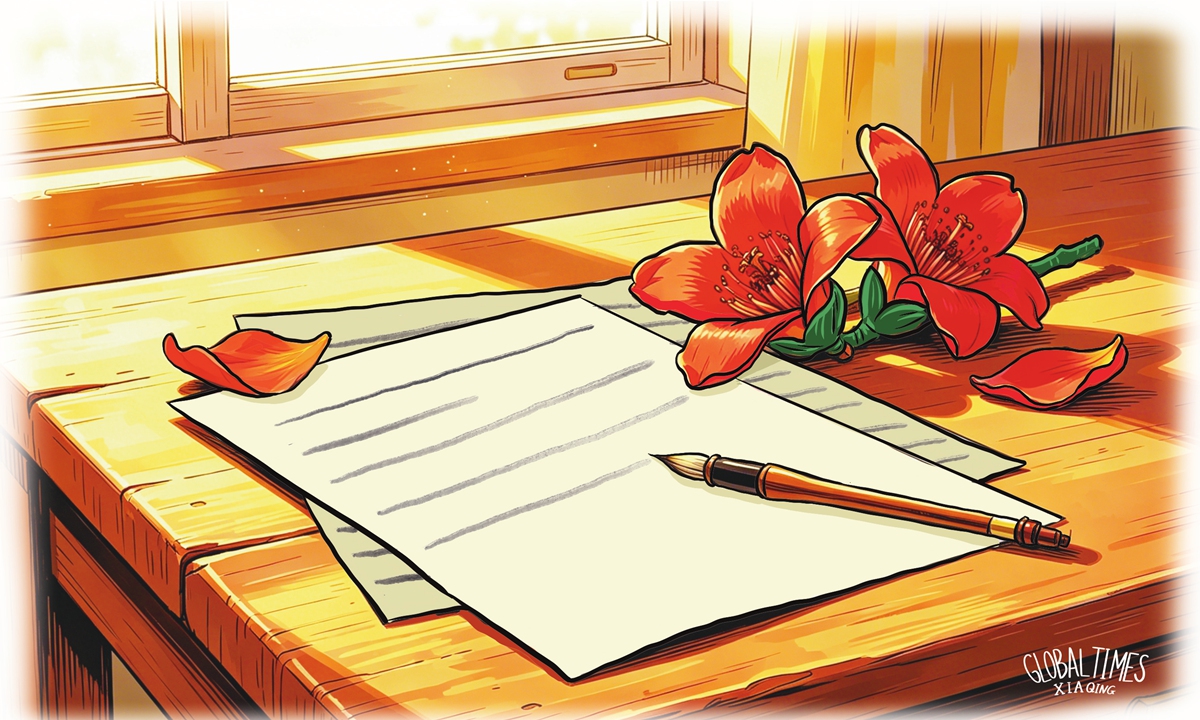
Illustration: Xia Qing/GT
To understand a nation, one usually begins by listening to what its people have to say. For decades, as China has steadily assumed its position as one of the most consequential powers of the 21st century, the international community has been listening intently.Analysts parse diplomatic speeches, economists dissect official data and linguists translate policy documents with meticulous care. Yet, despite this unprecedented scrutiny, a profound sense of bewilderment often remains. The world looks at China and often feels it is reading a text in which the most crucial paragraphs are missing.
Perhaps the difficulty of understanding China does not stem from a lack of information, but from a fundamental mismatch in how meaning is constructed. To grasp this divide, we might look away from modern geopolitics and turn instead to a seemingly unrelated piece of history: the letters written by 19th-century emigrants.
In 2015, British scholar Emma Louise Moreton conducted a fascinating study of correspondence written by the Lough sisters, Irish emigrants who settled in the US. Utilizing corpus linguistics, Moreton analyzed how these women communicated with their families back home.
The Irish letters are characteristically uninhibited. Emotions spill across the pages, often unconstrained by punctuation. When a sister dreamed of her mother's death, she wrote of waking up crying, pouring her heartbreak directly onto the paper.
Compare this with the contemporaneous Chinese qiaopi - a unique system of letters attached to remittances sent by Chinese emigrants from Southeast Asia back to their ancestral villages. If an Irish letter is a sweeping, emotional confession, a qiaopi is an exercise in extreme, almost stoic brevity. They are typically short, highly formulaic and remarkably devoid of direct emotional outpourings.
Recently, a Chinese film, Dear You, has become a hit in China, with box office revenue exceeding 1.1 billion yuan ($162 million). It tells the story of qiaopi.
But what is on that sheet of paper is a kind of feeling that only those who understand Chinese characters can truly grasp. This understanding is not just about reading or hearing the words, but about comprehending the deeper meanings within them - something that comes from growing up reciting Tang poetry and Song lyrics.
A Chinese laborer, enduring unimaginable hardship in a foreign country, would rarely write about his suffering, loneliness or tears. Instead, he would brush a few customary characters: "Seeing these words is like seeing my face. May peace be with you."
More often, he would use an ancient Chinese poem to express his longing for his family. To an uninitiated Western reader, these letters might seem emotionally barren, mere administrative notes accompanying money.
But this is precisely where the surface betrays the truth. The Chinese language and the culture it carries operate on an aesthetic and philosophical principle known as liubai - the intentional leaving of blank space. In traditional Chinese ink painting, the unpainted silk is not empty; it is the mist, the river or the infinite sky. It gives the painted mountains their weight.
Similarly, in a qiaopi, the omission of hardship is not an absence, but a profound expression of filial piety and protective love. The writer hides the pain to spare the reader. The immense emotional gravity - the distance, the longing and the unspoken sacrifices - is folded entirely into those few, restrained syllables.
Cultural differences in expressing deep connections reveal a crucial truth for engaging with China. The West values explicit communication - clear intentions, verbalized emotions and transparent policies - interpreting silence as absence or concealment.
Chinese culture, however, has spent millennia perfecting the art of the unsaid. Meaning in Chinese discourse is highly contextual; it relies on shared history, subtle references and the delicate balance of what is articulated and what is deliberately left unspoken.
Comprehending this is not merely a linguistic challenge; it is a profound cognitive shift. When one encounters a Chinese narrative - whether in a piece of classical literature, a business negotiation or international diplomacy - reading only the literal words is akin to looking only at the black ink on a painting, entirely missing the mist and the mountains.
As China's footprint on the global stage expands, the question of whether the world can truly understand it becomes an era-defining challenge. It requires a willingness to look beyond the surface phenomena and to abandon the assumption that everything of value must be spoken aloud. To understand China is to learn how to read the spaces between the characters, to recognize the profound weight of restraint, and to realize that sometimes, the most powerful messages are the ones that are never written down.
The author is a senior editor with the People's Daily and currently a senior fellow with the Chongyang Institute for Financial Studies at the Renmin University of China. dinggang@globaltimes.com.cn. Follow him on X @dinggangchina
RELATED ARTICLES