GT Voice: Protectionism won’t address anxiety of Europe’s lagging green transition
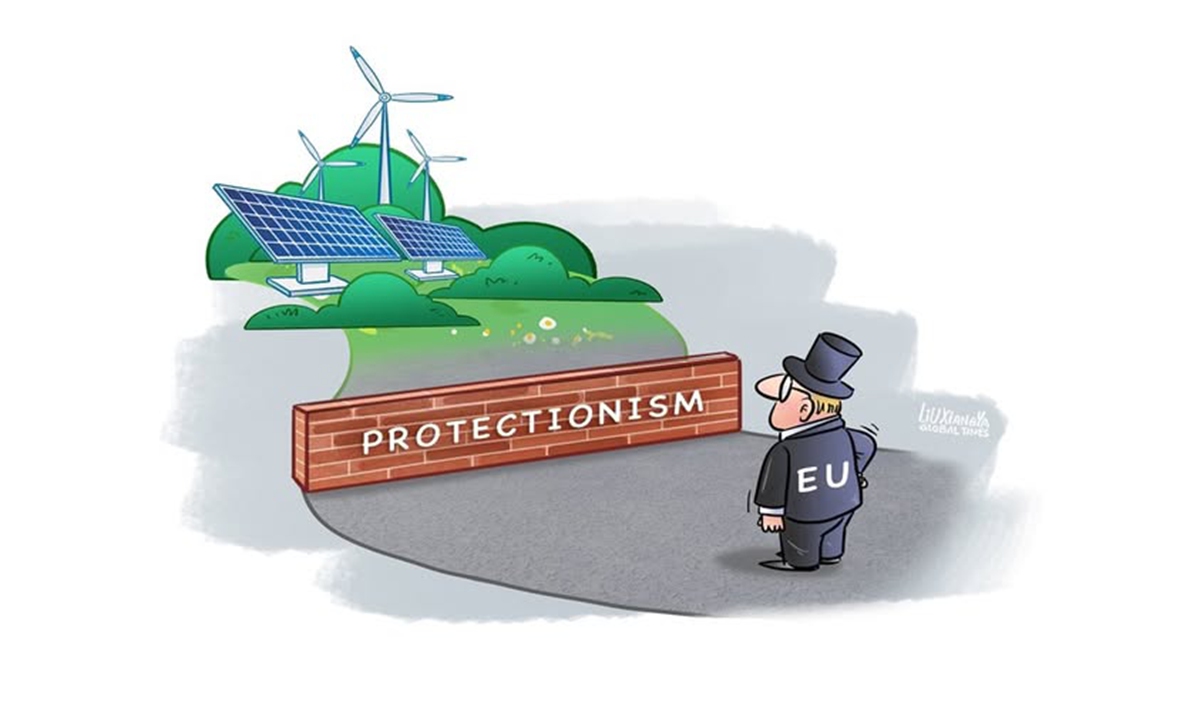
Illustration: Liu Xiangya/GT
The CEO of Nordex, one of Europe's biggest wind turbine makers, claimed that "non-western" rivals should be blocked from selling in the EU in a warning about the perceived "threat" posed by Chinese technology to the bloc's security and industrial future, the Financial Times reported on Tuesday."Non-western" turbine makers should be designated as high risk under the EU cybersecurity rules, he told the Financial Times.
Though his remarks appear to be concerned with supply chain security, they are actually a display of trade protectionism, exposing the double standards and anxiety of Europe's wind power industry.
Chinese companies are the only large turbine makers outside the US and Europe. At the same time, China also supplies hardware to European wind turbine manufacturers including Nordex.
Last year, Nordex signed a deal with China's Jingye Yingkou Medium Plate for the supply of steel plates to produce wind turbine towers, according to the Chinese company's website. This kind of global industrial collaboration is normal in a globalized economy and has been conducive to the profitability of Europe's wind power industry.
Aren't European wind players trying to have it both ways? They want to enjoy the cost advantages brought by mature Chinese industrial chains to sustain their profitability and market edge, while fearing the rising competitiveness of Chinese companies and trying to use administrative measures to keep Chinese turbines out. Such double standards fully expose the hypocrisy behind Europe's so-called "security concerns."
What lies behind Europe's protectionist rhetoric is not a genuine risk to supply chain safety, but a fear of fair market competition and a desire to preserve long-held dominant interests through non-market means.
What makes this anxiety even harder to justify is that European wind companies still dominate the regional wind power market, while Chinese turbine makers hold only a marginal market share in Europe. If European wind turbine makers feel pressure, it stems not from external competition, but from internal bottlenecks that have stalled the industry's growth.
In recent years, sharply rising interest rates in Europe sent financing costs skyward, which greatly increased the costs for wind power projects. According to a separate report from Danish energy company Ørsted entitled "Offshore wind at a crossroads: Reviving the industry to secure Europe's energy future," surging input costs and rising interest rates are responsible for reversing years of declining offshore wind costs.
Also, industrial permitting process in the EU is complex and lengthy. A staggering 81 percent of European renewable wind capacity is stuck in various permitting stages, according to a BusinessEurope survey. It is not uncommon for obtaining approvals to take seven to nine years and there are examples of the process exceeding 10 years. These lengthy timelines come at a cost for renewable projects' developers, reaching 10 to 35 percent of the total project value, according to Accenture's analysis.
In the context of an accelerating global green transition, this lag in efficiency is far more dangerous than any external competitor. It is precisely these internal bottlenecks that explain why the EU's target of 425 gigawatts of installed wind capacity by 2030 is likely to fall short, with only about 344 gigawatts achievable at the current pace.
So instead of lobbying for erecting higher trade barriers in Brussels, European wind turbine makers need to focus on pushing for internal EU industrial policy reforms: simplifying approval procedures, lowering financing hurdles, and unblocking grid connection bottlenecks.
China's wind power supply chain should be an opportunity for European countries to lower their production costs, while not a threat to be guarded against. The EU is trapped in a dual bind of high energy costs and sluggish economic recovery.
The green transition is the key for breaking through development bottlenecks and rebuilding industrial advantages. To achieve an efficient green transition, the most practical approach is to embrace the world's best supply chains and pursue targets with the most cost-effective solutions. Defining partners as security "threats" will ultimately harm Europe's own transition rhythm and industrial competitiveness.
RELATED ARTICLES