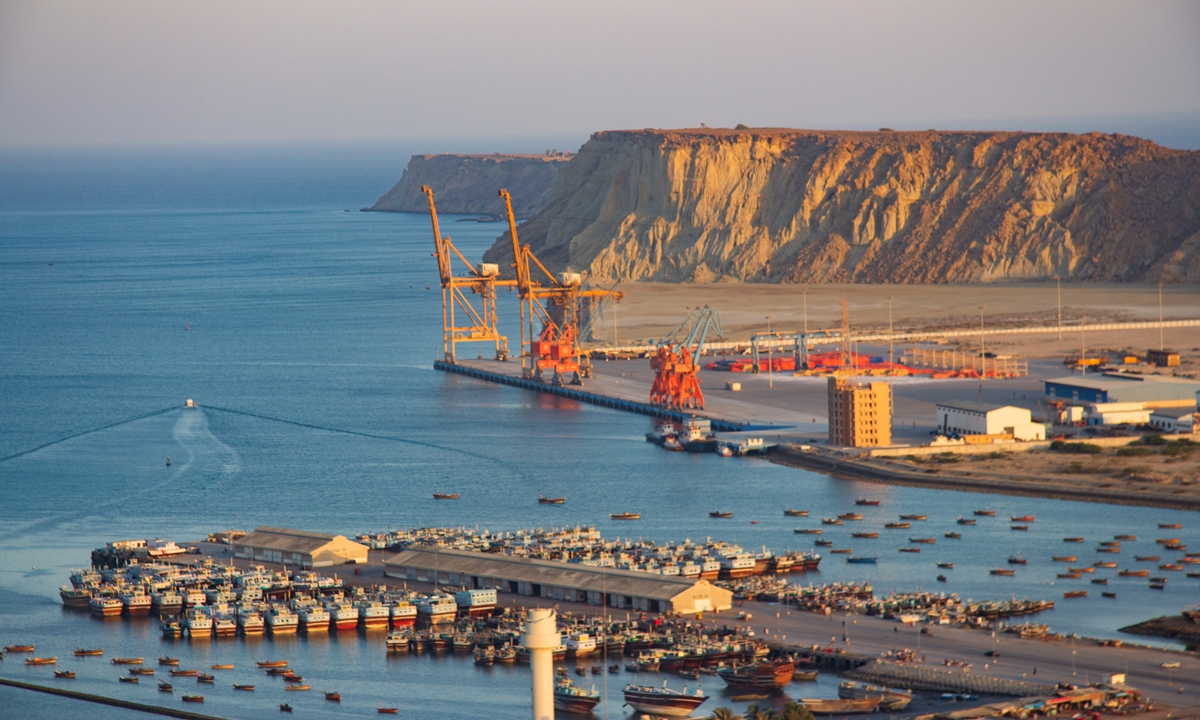
A view of Gwadar Port in Pakistan Photo: VCG
Pakistani Prime Minister Shehbaz Sharif's recent visit to China has underscored the importance of the China-Pakistan relationship, while also reinforcing the all-weather strategic cooperative partnership and ironclad brotherhood. The visit coincided with the 75th anniversary of the establishment of diplomatic relations between China and Pakistan, one that has been marked by unwavering commitment and sincerity, one that has withstood various tests, remained rock-solid, and set a shining example for state-to-state relations.
During the visit, the leaders of China and Pakistan agreed to steadily advance the Action Plan to Foster an Even Closer China-Pakistan Community with a Shared Future in the New Era and accelerate the development of the upgraded version 2.0 of the China-Pakistan Economic Corridor (CPEC).
Under this vision, bilateral pragmatic cooperation in agriculture, technology (artificial intelligence, information and communication technology, and big data), and green development could be a game-changer for Pakistan. To achieve high-quality development, cooperation in these three areas will be crucial.
Agriculture remains a major contributor to Pakistan's GDP and employs a significant portion of the labor force. However, the sector faces multiple serious challenges, including low productivity, the adverse impacts of climate change, an outdated supply chain, and weak governance. Cooperation under the upgraded version of CPEC and the Action Plan could play a vital role in overcoming these challenges by providing high-quality inputs, providing modern technologies, and building strong climate resilience.
From a long-term perspective, technological cooperation will be another focal point under the BRI framework. We live not merely in the age of technology, but in an era defined by cutting-edge innovation. Artificial Intelligence (AI) has fundamentally transformed the relationship between humans and technology. Today, technology has become a critical driver of economic growth, national development, security, and people's welfare. Consequently, a country's technological edge will largely determine its standing in the global economy.
Unfortunately, Pakistan has lagged significantly behind in the technology sector and remains in the early stages of technological development. In this context, China, as a global technology leader, could play a pivotal role in helping Pakistan fast-track its technological advancement.
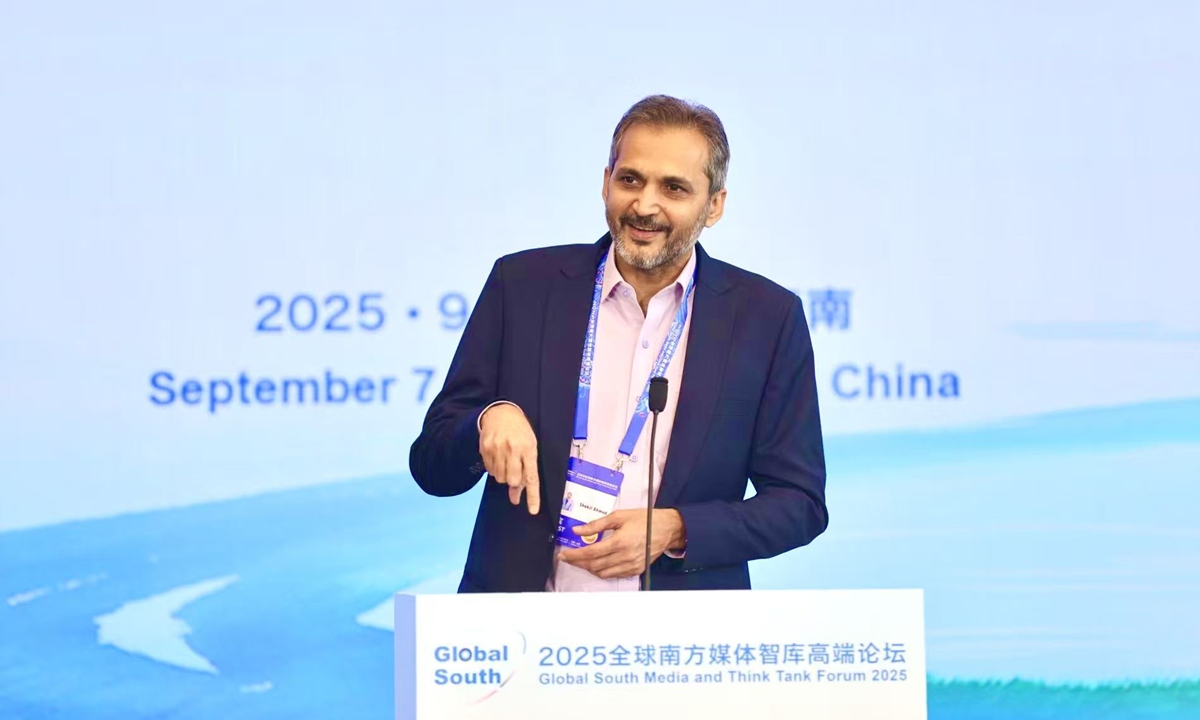
Shakeel Ahmad Ramay Photo: Courtesy of Shakeel Ahmad Ramay
China has implemented the Belt and Road Science, Technology and Innovation Cooperation Action Plan. China also vowed in 2023 to increase the number of joint laboratories established with partner countries to 100 in the next five years. China has also put forward the Global Initiative for Artificial Intelligence (AI) Governance. We believe those concrete efforts in forging cooperation in science, technology, and innovation will help BRI partner countries embark on the Fourth Industrial Revolution.
Cooperation in green development is another key area that will generate substantial economic opportunities, helping Pakistan address its dual crises of economic instability and climate change and supporting sustainable growth. Pakistan lacks the resources and institutional capacity to overcome these challenges on its own.
In this context, green development presents Pakistan with a significant and timely opportunity. China, with its advanced technology and proven expertise, is well positioned to assist Pakistan in pursuing green development.
At the same time, China has introduced numerous initiatives to promote and implement green cooperation under BRI, such as establishing the BRI International Green Development Coalition to continuously promote international consensus and joint actions on green development through dialogue and exchange, joint research, capacity building, and industrial cooperation.
It is anticipated that, in addition to green development and technology, common prosperity will emerge as a major objective of BRI cooperation between China and Pakistan over the next decade.
Common prosperity is presented as a defining feature that sets Chinese modernization apart from Western development models. According to Chinese philosophy, without people's welfare and prosperity, nothing is truly sustainable, including peace, security, development, national sovereignty, and dignity. Common prosperity is a shared goal of the people and leadership of both countries, and this goal can also be effectively pursued and realized by Pakistan. Therefore, in the coming decade, bilateral cooperation under the BRI will prioritize advancing common prosperity by creating broad economic and livelihood opportunities.
As the host of the CPEC corridor, Pakistan is uniquely positioned to seize this strategic opportunity to fast-track its green development, strengthen its technological capabilities, and advance the common prosperity agenda. China and Pakistan can jointly transform the upgraded version of CPEC - a flagship BRI project - into a pioneering model of green development, technological cooperation, and shared prosperity.
Shakeel Ahmad Ramay is the CEO of the Asian Institute of Eco-civilization Research and Development in Pakistan.
RELATED ARTICLES